I’m Kim Tae-hyung, CEO and head dentist at Gangnam Blanche Dental Clinic.
When parents bring their child into the clinic, the question they ask most often is about permanent teeth.
“Can a wobbly tooth just be pulled out?”
“The child next to mine already has a permanent molar—why doesn’t mine?”
“Are the number of baby teeth and permanent teeth different?”
These are the kinds of questions we hear a lot.
When you actually look into it, the information is scattered, so many parents say they don’t know where to start.
Since permanent teeth are the teeth we use for life once they come in, parents need to keep an eye on when they appear and what condition they are in to some extent.
Ages 5 to 12 are the most important period, when baby teeth fall out and permanent teeth settle into place.
If signs such as how they wobble, how many there are, where they appear, and what color they are are missed at this stage, it can later lead to orthodontic treatment or even extraction.
In this post, I’ll summarize the 5 permanent tooth signs parents should definitely check.
- The normal number of permanent teeth is 28 to 32

Children have 20 baby teeth in total in the upper and lower jaws combined, while permanent teeth number 28 to 32, including wisdom teeth.
To be exact, if you exclude the 4 wisdom teeth, there are 28 permanent teeth; if all wisdom teeth erupt, 32 permanent teeth is normal.
Usually around age 6, the first permanent molars start coming in behind the baby molars.
By around age 12, when the second molars have also erupted, the 28 permanent teeth excluding wisdom teeth are complete.
It is also surprisingly common to have missing permanent teeth, meaning fewer than the normal number.
Statistically, about 5 to 10% of Korean children are found to be missing one or two teeth.
In many cases, parents don’t know this themselves and it is only confirmed on a screening X-ray.
This is an important point that should not be overlooked, so I’ll explain it in more detail in the next section.
- Missing permanent teeth can be identified with a single X-ray

Missing permanent teeth means there is no permanent tooth germ in the child’s mouth.
In other words, the baby teeth erupted normally, but the permanent tooth germ beneath them did not form.
Genetic factors are the most common cause, and if one of the parents has missing teeth, the child may also have them.
If teeth are missing, baby teeth may not fall out for a long time, or even after they do, a permanent tooth may never erupt in that space.
If left unnoticed, neighboring teeth may tip into the empty space, making orthodontic treatment more complicated later or even leading to consideration of implants.
The important thing is that missing permanent teeth can be checked in advance with just one X-ray at age 6 or 7.
Whether the permanent tooth germ is present in the jawbone or not is visible on the image, and the earlier you know, the more treatment options you have.
If it seems like your child’s permanent teeth are coming in later than their peers, it’s worth getting a screening X-ray.
- Permanent tooth wobbling: when to remove it and when to wait
The time when people search most intensely about permanent teeth is when baby teeth are about to fall out.
Usually around age 6, the lower front teeth start to wobble first, and at this time parents are most confused about whether the wobbly tooth is a baby tooth or a permanent tooth, and whether it should be pulled or left alone.
First, to tell them apart: if a baby tooth is even slightly wobbly, you can hold it with your finger and wiggle it, and it will come out without much difficulty. Permanent teeth are normally either barely wobbly or not wobbly at all. If a permanent tooth is noticeably loose, other causes such as trauma, gum problems, or root resorption should be suspected.
For a wobbly baby tooth, it’s best to let it fall out naturally. However, if it has been loose for more than a month and still hasn’t come out, if a permanent tooth is pushing through behind the baby tooth, or if the gums around the wobbly area are swollen or painful, please get it checked.
In particular, if a permanent tooth is erupting behind a baby tooth, leaving it alone can cause the permanent tooth to settle in a crooked position, which may require orthodontic treatment later.
In the clinic, when we find a double row of teeth and remove only the baby tooth, in most cases the permanent tooth settles into the normal position.
- If a permanent tooth is fractured or knocked out, 30 minutes is the golden time

This is an emergency guide, but it’s something parents should know in advance, so I’ll mention it here.
If a child falls or gets hit and a permanent tooth breaks or is completely knocked out,
whether the tooth can be saved depends on how quickly it is treated.
If a knocked-out permanent tooth is reinserted at a dental clinic within 30 minutes, the chance of survival is very high.
Do not scrub it under running water or wrap it in tissue paper. The living cells on the root surface will die, and even if it is reinserted, it may not reattach.
The correct approach is to hold the tooth by the crown (the visible part), rinse off only any dirt lightly, then place it in milk or saline and go immediately to the nearest dental clinic. Milk is best; if there is no milk, you can have the child hold it in their mouth with saliva. If the tooth is fractured, bringing the broken piece in the same way may allow it to be bonded back together in some cases.
Surprisingly, many parents are not familiar with this emergency procedure, so by the time they arrive, 30 minutes have already passed.
- Check the color and shape of permanent teeth during dental exams

When permanent teeth first erupt, it is normal for them to look slightly more yellow than baby teeth.
Permanent teeth have thicker enamel than baby teeth, and the dentin shows through more, so they naturally appear a bit darker.
Many parents worry when their child’s teeth look yellow, but in most cases this is normal.
However, it is different if only one permanent tooth is especially darker or has a grayish tint compared with the others.
This may be due to nerve damage from trauma or a problem during tooth formation.
Do not delay—please get it checked.
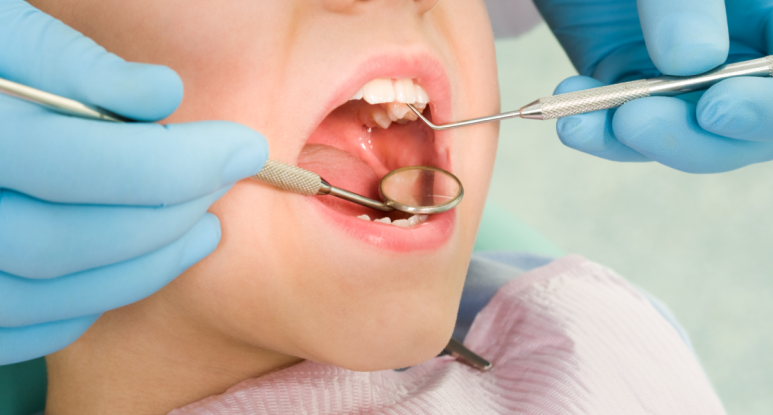
The same applies to shape. A deep groove on the surface, an abnormally small tooth (microdontia), or a tooth with a sharply split tip (conical tooth) may be a form of developmental abnormality. These are signs that the child may not be able to explain themselves and parents may easily miss, so it is safest to check them during regular dental visits.
The standard for pediatric dental checkups is once every 6 months,
and during the 5 to 7 age range, when permanent teeth start coming in, once every 3 to 4 months is safer.
There are parts parents may find hard to see directly
I’ve summarized the five signs up to this point,
but in fact, in cases such as missing permanent teeth or developmental abnormalities, there is a limit to what parents can confirm just by looking in the mouth.
That is why it is better to check the state of the permanent tooth germs in the jawbone, the degree of root formation, and the position of impacted permanent teeth with an X-ray.
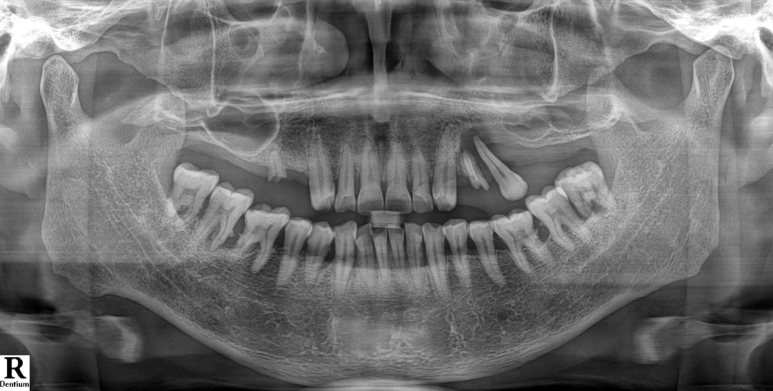
The most unfortunate cases in the clinic are when missing or impacted permanent teeth are discovered too late, making orthodontic treatment complicated or even leading to implants.
These are things that could have been caught early with just one checkup at age 6 or 7, so please don’t miss that window.
For children, an X-ray about once a year is usually enough, and the radiation dose is adjusted to be much lower than for adults, so it is safe.
Permanent teeth are teeth you use for life once they come in.
If parents keep an eye on these five things—number, missing teeth, wobbling, trauma, and color and shape—most major problems can be caught early.
Of course, the most reliable answer is to have a dentist examine your child directly and determine whether their permanent teeth are developing normally, so I hope you won’t hesitate to visit the dentist.
If you have any more questions, please feel free to leave a comment.
This has been Gangnam Blanche Dental Clinic. Thank you.