"Doctor, my upper teeth hurt so much that I went to two local dentists, but both of them said there was nothing wrong.
But it really hurts. Every time I wash my face, it feels like an electric shock is running through it."
Among patients who visit us with pain in the jaw or cheek, it is not uncommon to find no cavities or gum problems even after taking X-rays.
When these patients say they are still in pain despite having already undergone root canal treatment at another dental clinic, I first suspect one possibility: the pain may be a signal sent by the trigeminal nerve rather than by the tooth itself.
To be honest, as a dentist, trigeminal neuralgia is not a condition treated by dentists. However, the first place patients usually visit is the dentist’s office. That is why I believe accurately distinguishing this condition is an important role of a dentist. Today, I would like to explain the criteria I use in the clinic to distinguish tooth pain from trigeminal neuralgia.

Why Is Trigeminal Neuralgia Often Confused with Tooth Pain?

The trigeminal nerve is the largest nerve responsible for sensation in the face. As its name suggests, it divides into three branches.
The second branch, the maxillary nerve, and the third branch, the mandibular nerve, pass around the upper and lower teeth.
Simply put, the wiring that transmits sensation to the teeth itself is malfunctioning.
The wiring is the problem, but because the light bulb connected to the end—the tooth—is flickering, it is like replacing the light bulb under the assumption that it is broken.
This is why some people undergo root canal treatment on healthy teeth or, in severe cases, even have teeth extracted, yet the pain does not go away.
In fact, overseas studies have reported that a considerable number of patients with trigeminal neuralgia had undergone unnecessary dental treatment before receiving a diagnosis. This is a type of pain that is not easy to distinguish.
When Does a Dentist Suspect Trigeminal Neuralgia?
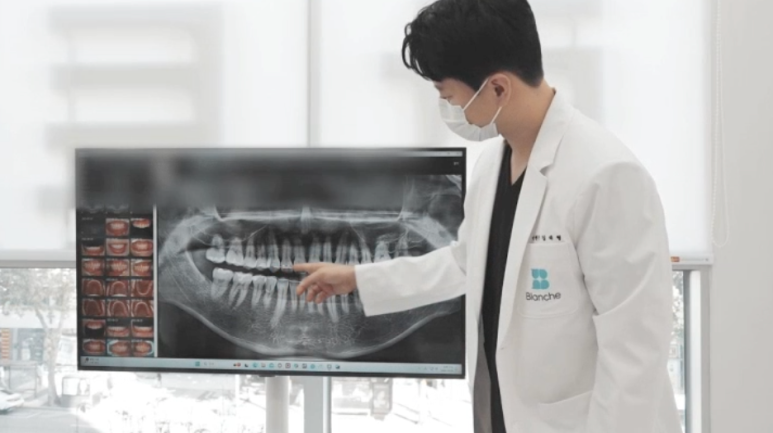
There are moments in the clinic when I think, “This may not be a tooth problem.”
First, when the pain is severe despite the examination findings being normal.
Even after taking X-rays and performing cold-and-hot sensitivity tests and percussion tests, there may be no abnormality in the teeth. There are no cavities, the gums are healthy, and there are no signs of cracks. Yet the patient says, “It really hurts here so much that I feel like I could die.” The greater this discrepancy, the more strongly I suspect trigeminal neuralgia.
Second, when the pattern of pain differs from typical tooth pain.
Ordinary tooth pain may throb continuously, feel sensitive to cold, or hurt when chewing. Trigeminal neuralgia, on the other hand, has a different pattern altogether. It causes pain like an electric shock or lightning strike that lasts from a few seconds to, at most, about two minutes, then stops abruptly and suddenly returns. It follows this kind of episodic pattern.
Third, when the pain is triggered by specific movements.
Pain may occur when water touches the face while washing, when a cold breeze brushes against it, when shaving, or even when talking or laughing. Tooth pain would not normally be expected to respond to these kinds of stimuli. When I ask in the clinic, “When does it hurt?” many patients initially do not know, but then remember and say, “Oh… now that I think about it, it suddenly hurts when my toothbrush touches the inside of my cheek.”
Key Points for Distinguishing Tooth Pain from Trigeminal Neuralgia

To summarize:
With tooth pain, the cause can be seen. There may be a cavity on the X-ray, swollen gums, or a crack in the tooth. There is usually some visible finding. The pain is also continuous, responds to cold or hot stimuli, and hurts when the affected tooth is tapped.
With trigeminal neuralgia, the cause cannot be seen. No matter how many tests are performed, there may be no problem with the teeth themselves. The pain comes and goes like a short, intense electric shock and may be triggered by lightly touching the face or even by exposure to wind. It is also characteristic that it occurs on only one side of the face.
The history I consider most important is, “The treatment did not make it better.” If the pain persists after root canal treatment, or if a neighboring tooth starts hurting after an extraction, and this pattern repeats, there is a high likelihood that the problem lies not with the tooth but with the nerve itself. At this point, what matters is not treating another tooth, but accurately tracing the cause.
So, What Is the Role of a Dentist?

The treatment of trigeminal neuralgia itself falls within the fields of neurology and neurosurgery. Medication is usually the first approach, and surgical treatment may be considered if necessary. Trigeminal neuralgia is not directly treated at a dental clinic.
However, the biggest problem with this condition is that it often takes too long to receive a diagnosis. Because they are in pain, patients visit a dentist. If the dentist cannot find the cause, they visit another dentist. There, they may undergo root canal treatment because the dentist wonders, “Could it be this tooth?” When the pain still does not improve, they visit yet another dentist. In the process, healthy teeth may be sacrificed.
I believe dentists have an important role to play in this situation. When a patient reports extreme pain despite there being no findings on the X-ray, we should honestly say, “There is no problem with your teeth. We need to consider other causes.” If necessary, we should also refer the patient to a neurologist. Avoiding unnecessary treatment is also part of a dentist’s role.
If you would like to learn more about cases in which the pain feels like tooth pain but the teeth are not the cause, please refer to this article as well.
When you feel pain even though your teeth are not the cause, this is something that can only be determined through examination. In practice, it is difficult to distinguish the cause on your own based solely on information from the internet. Especially if you have visited two or three dental clinics and the cause is still unknown, it may be worth considering other possibilities and having them evaluated.
Please feel free to contact us with any questions.
This was Gangnam Blanche Dental Clinic. Thank you.