"Doctor, for the past few days, I’ve felt a sudden twinge whenever I chew something on the right side.
I think I may have developed a cavity. Could you take a look?"
Hello. I’m Kim Tae-hyung, the director of Banpo Blanche Dental Clinic.
When you treat several patients for cavities every day, you often encounter people who come in thinking they have a cavity, only to find that there is no cavity at all.
The patient is clearly in pain, but there is no visible cavity,
so I can imagine how frustrating that must be, while the patient becomes even more anxious, wondering, “Then why does it hurt?”
There is another cause of this type of pain that is just as common as cavities. It is a cracked tooth—a tiny fracture in the tooth.
However, these cracks have symptoms that are similar to, yet different from, those of cavities, so many people worry unnecessarily because they assume they have a cavity.
Today, I’ll explain how this sudden pain that occurs only when chewing differs from cavity pain and why it often does not show up clearly on images.

This kind of pain may not be caused by a cavity

The pain caused by a cracked tooth has some fairly distinct characteristics. The tooth feels fine when you are still, but a sudden twinge occurs only at the moment you chew something. It does not happen randomly, either—it can come as a sharp pain when you bite down in a particular direction or chew something hard. In many cases, the tooth is more sensitive when you release your bite after chewing.
This happens because of the way a cracked tooth behaves. The crack remains closed under normal circumstances, but when chewing pressure is applied, it opens slightly and irritates the nerve inside. It is similar to a hairline crack in a glass cup that looks fine normally but opens when pressure is applied.
Sudden pain that occurs only when chewing, and only at a particular moment, is actually a typical sign of a cracked tooth rather than a cavity.
It is different in character from the persistent sensitivity or throbbing pain that cavity pain often causes.
Cavities, tooth sensitivity, and cracked teeth cause different types of pain
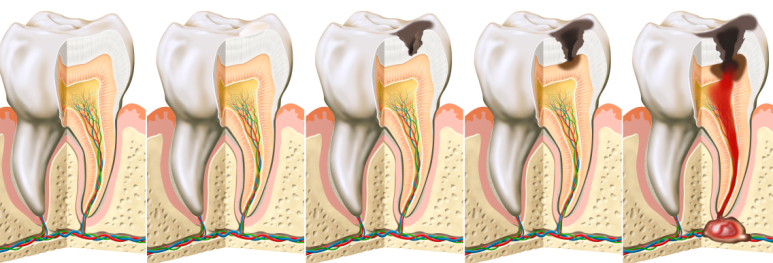
Let me distinguish the three conditions that patients most commonly confuse based on their pain patterns.
Even when someone simply says, “My tooth hurts,” the likely cause can differ considerably depending on when and how it hurts.
| Condition | When does it hurt? | Character of the pain | When at rest |
|---|
| Cavity | When exposed to sweet or cold foods and drinks; as it progresses, it may hurt at various times | Sensitivity or throbbing that persists | It may hurt to some degree |
| Tooth sensitivity | When cold water or cold air touches the tooth | A brief sharp sensitivity that soon subsides | Usually fine |
| Cracked tooth | Only when chewing or biting down in a particular direction | A sudden, sharp twinge | Feels normal |
Of course, these are only clues for making a rough assessment yourself, and in reality, more than one of these conditions may occur at the same time.
Therefore, rather than making a definite judgment based solely on the pain pattern, knowing which condition your symptoms resemble most can make the diagnosis easier when you visit a dentist.
Why doesn’t a crack show up in images?
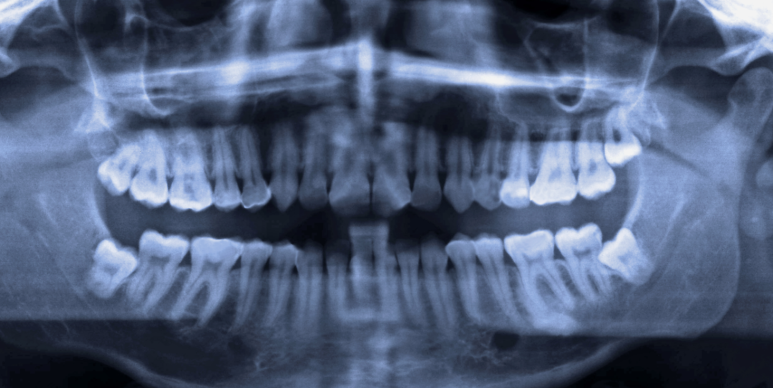
This is the most frustrating aspect of a cracked tooth: “It definitely hurts when I chew, but the X-ray looks normal.”
This does not mean that the examination was performed incorrectly; it is a characteristic of cracked teeth themselves.
X-rays show the hard tissues of the tooth, while a crack is merely a very thin gap, so it is often barely visible on images in the early stages.
Because cracks are difficult to see on standard X-rays at first, they are often assessed together with the pain pattern experienced while chewing and the results of additional examinations.
In the dental office, the dentist may have you bite down on selected areas to reproduce the pain or perform tests that make the crack more apparent in order to trace it. Therefore, being told that “nothing abnormal is visible on the image” does not necessarily mean that “there is no crack.”
If left untreated, a crack will not heal on its own
People sometimes ask, “Won’t it come back together if I just leave it alone?”
It may be hard to believe, but surprisingly, quite a few people think this way.
Unfortunately, as you might expect, once a crack forms, it does not heal on its own.
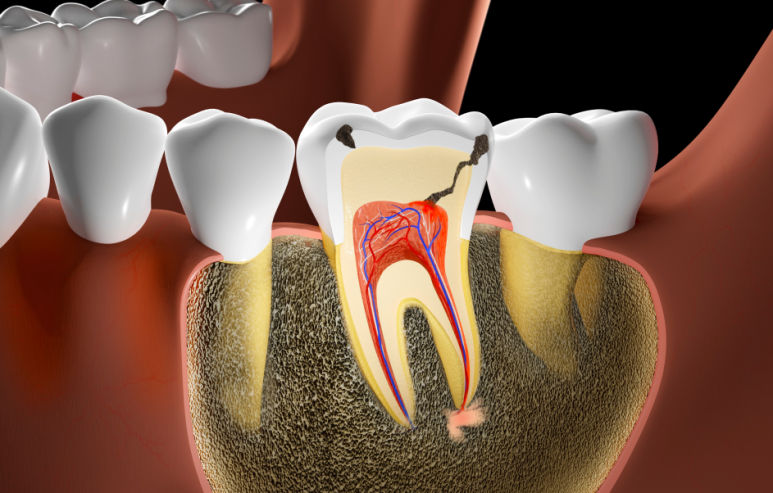
Instead, every time you chew, pressure is applied to the gap, causing the crack to gradually spread deeper and wider.
It is similar to a small crack in a car windshield gradually extending over time.
When the crack is shallow, it may be possible to monitor it while providing protection during biting, but if it reaches the nerve, root canal treatment followed by covering the tooth with a crown may be necessary. If the tooth splits all the way to the root, it may ultimately lead to extraction.
Even with the same type of crack, the range of possibilities for saving the tooth can change completely depending on the stage at which it is detected.
That is why I tell people who may have a cracked tooth to have it examined as soon as possible.
For more details on how cracked teeth are treated at each stage once a crack has been confirmed,
please see the article
「Could Leaving a Broken Tooth Untreated Lead to Extraction? Cracked Tooth Treatment and First Aid」.
If you dismiss sudden pain that occurs only when chewing as a cavity, the crack may quietly continue to spread in the meantime.
Whether the pain is caused by a cavity or a crack, and how far the crack has progressed, are questions that can only be distinguished by examining the tooth and having you bite down directly.
Even when the sensation is the same sudden twinge, the sooner it is checked, the greater the possibility of resolving it without progressing to root canal treatment.
If the same pain has been recurring for several days, please do not put off having it checked.
This has been Banpo Blanche Dental Clinic. Thank you.