When you are told that a tooth must be extracted because the cavity is deep, your thoughts become complicated.
You wonder whether extraction is really the only option and how much an implant might cost.
After all, you may feel reluctant to have a tooth that appears perfectly fine removed.
Hello. I am Kim Tae-hyung, the lead dentist at Banpo Blanche Dental Clinic.
I often meet patients in the treatment room who come in for one more opinion before an extraction,
and I actually welcome that cautious attitude.
Once a tooth is extracted, it cannot be brought back, so the first step is to determine whether there is still a way to save it before removing it.
Not every deeply decayed tooth needs to be extracted.
There is an intermediate step—the final stage for saving a natural tooth—which is root canal treatment.

Root Canal Treatment Does Not “Kill” the Tooth

Let me first clear up a common misconception.
Many people misunderstand root canal treatment as a procedure that kills the tooth, but in fact, the opposite is true.
It is a treatment that saves a tooth at risk of extraction.
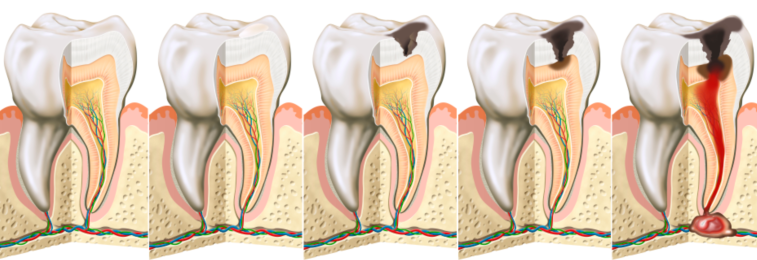
When decay passes through the outer enamel and reaches the inner nerve, simply filling the tooth will not solve the problem.
At this point, root canal treatment involves removing the inflamed nerve tissue, disinfecting and filling the empty space, and then reinforcing the tooth.
Like a wooden post, it is similar to removing only the decayed interior and filling it with a strong material so the post can continue to be used, rather than pulling out the entire post because its inside has rotted.
Root canal treatment does not create a dead tooth. It leaves the root in place so you can continue using your own tooth.
When the root remains, the jawbone is maintained, and the sensation when chewing is more natural than with an artificial tooth.
So when a tooth can be saved, preserving the natural tooth through root canal treatment is generally a better option than an implant.
Many people ask, “Doesn’t root canal treatment hurt?” In fact, the procedure itself is performed under anesthesia, so many patients find it more comfortable than they expected.
The throbbing pain caused by inflammation in the nerve often subsides once treatment begins.
If the inflammation was severe, the tooth may feel sore for a few days after treatment, but this can be understood as part of the healing process.
Cases That Can Be Saved and Cases That Truly Require Extraction
Of course, not every tooth can be saved with root canal treatment.
This is where the distinction becomes clear.
Even if decay has reached the nerve, the tooth can often be saved sufficiently with root canal treatment followed by a crown if the root and jawbone remain strong.
On the other hand, saving the tooth is difficult if inflammation has spread to the tip of the root, if the root itself has split vertically, or if almost none of the remaining tooth structure is left.
A vertically split root is particularly unfortunate.
Even if a crown covers and surrounds the outside, there is no way to seal the crack inside the root, so bacteria continue to enter through the gap.
That is why this is one of the situations in which there is no way to save the tooth, no matter how much you may want to.
If you try to hold on to such a tooth at all costs, the neighboring teeth and jawbone may also become damaged. In that case, extracting it cleanly and considering an implant becomes the better choice.
Cases That Can Be Saved with Root Canal Treatment vs. Cases Better Treated with Extraction
| Category | Cases that can be saved with root canal treatment | Cases better treated with extraction |
|---|
| Extent of decay | Reached the nerve, but the root remains healthy | Inflammation has spread to the tip of the root |
| Condition of the root | Intact, without cracks | Split vertically |
| Remaining tooth structure | Enough wall remains to support a crown | Almost no structure remains |
| Effect on surrounding tissues | Saving it will not place excessive strain on neighboring teeth | Holding on to it may damage neighboring teeth and the jawbone |
| Treatment direction | Preserve it with root canal treatment followed by a crown | Extract it cleanly and consider an implant |
The important thing is to accurately distinguish between these situations, and this can only be determined by examining the condition of the root and jawbone on an X-ray.
This is why, even when the diagnosis is the same—“the tooth needs to be extracted”—some teeth may still have a chance to be saved.
What Happens After Saving the Tooth Is Even More Important
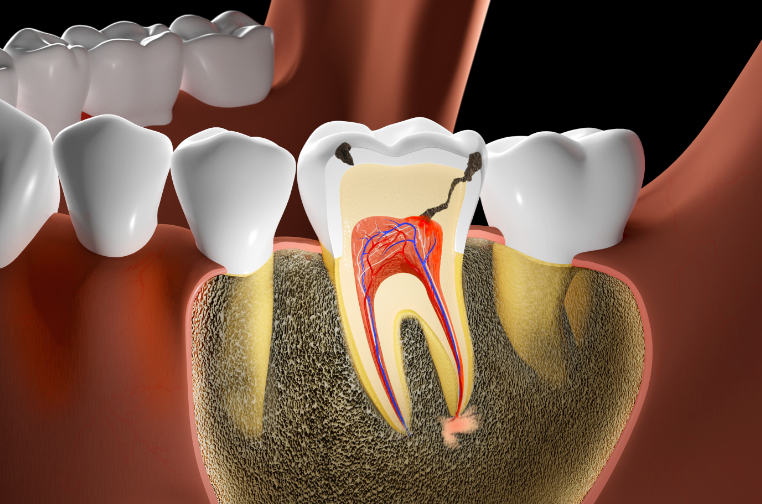
Saving a tooth with root canal treatment is not the end of the process.
A tooth from which the nerve has been removed receives less nourishment and may gradually become weaker and more prone to breaking over time.
For this reason, most teeth are covered with a crown after root canal treatment to protect and surround them.
If this step is skipped, the tooth that was painstakingly saved may split under chewing forces, eventually resulting in a situation where extraction is necessary.
Root canal treatment is usually performed over several appointments depending on the number of roots and the extent of inflammation. Including the crown, the entire process takes several weeks.
A tooth that has been properly treated and protected with a crown can be used for a long time with proper care.
However, a tooth without its nerve is naturally somewhat more brittle than before, so it is best to be a little careful about biting down forcefully on very hard foods with that tooth.
During regular checkups, having the area examined for new decay beneath or around the crown can also help the tooth last longer.
Many people ask, “What is better—just extracting it and getting an implant?”
To be honest, even when the cost of root canal treatment and a crown is combined, it is generally less burdensome than getting a single implant.
Of course, the exact cost can vary depending on the condition of the tooth and the materials used, so an examination is needed to know for sure.
Above all, because this approach preserves your own root, taking the time and going through the process to save a tooth that can be preserved is a way to keep your natural tooth for longer than extracting it and proceeding with an implant.
The decision to extract or save a single tooth is connected not only to immediate discomfort but also to your ability to chew for decades to come.
That is why, before bringing up extraction, I first examine whether there is truly no way to save the tooth.
If there is a clear reason it must be removed, I will tell you honestly. If it can be saved, I first look for that option.
That is the only way Blanche Dental Clinic approaches tooth decay.
If you are worried because your tooth hurts, your desire to have it checked one more time before extraction is already pointing you in the right direction.
This has been Banpo Blanche Dental Clinic. Thank you.
✅ Recommended Reading