At-Home Teeth Whitening vs. Professional Dental Whitening
Which Should You Choose?
"Doctor, do the teeth-whitening products sold online actually work?
How are they different from the whitening treatment provided at a dental clinic?"
Hello.
I’m Kim Tae-hyung, the director of Blanche Dental Clinic.
When I provide consultations about teeth whitening,
I meet many people who have already tried at-home whitening at least once.
However, because they used the products themselves at home,
many tell me that the results were not as good as expected, their teeth became sensitive,
or the color became uneven. ^^
When people begin saying things like this,
many probably expect me to say,
“At-home teeth whitening is bad!”
But I am not trying to say that at-home whitening is always bad. Haha.
There are teeth that can be whitened at home
and teeth that should not be treated at home.
So in this post, I would like to explain in detail
how to make the right choice.
- At-Home Teeth Whitening and Professional Dental Whitening:
Why Don’t At-Home Treatments Produce Good Results?
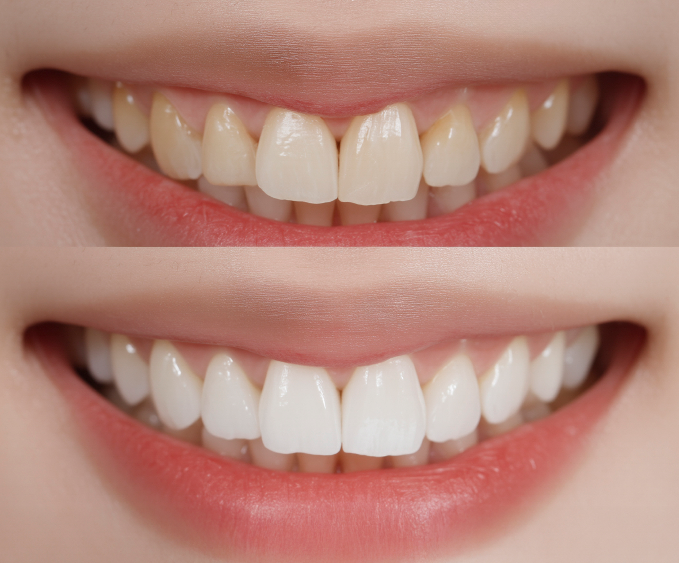
The basic principle behind both methods is the same.
Hydrogen peroxide-based ingredients break down the staining molecules
that have accumulated inside the teeth.
That is how whitening works.
However, there are two differences.
The first is concentration.
At-home whitening products are classified as quasi-drugs,
so they cannot be sold if the hydrogen peroxide concentration exceeds 3%.
Whitening agents used at dental clinics
can have a concentration of up to 15%.
Therefore, at-home whitening must be repeated for at least 2 hours a day
for 14 days to gradually brighten the teeth,
while professional whitening is often performed as a one-day treatment,
with three 15–20-minute sessions.
The second is the preparation process.
Before applying the whitening agent, dental clinics first remove tartar and surface stains
through scaling and tooth polishing.
A protective material is then applied over the gums
to prevent direct contact with the agent.
At-home products do not include these two steps.
That is why, even at a low concentration,
using them for a long time and frequently can cause the gums to react first.
- Actual Side Effects of At-Home Teeth Whitening
Seen in the Dental Office
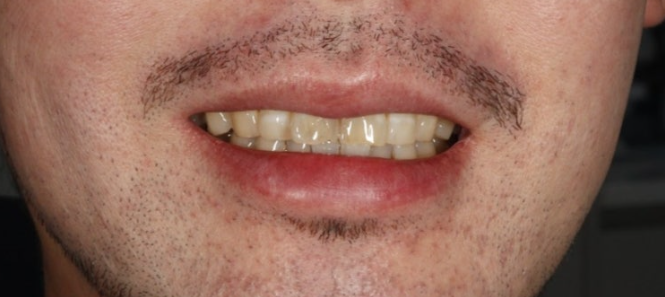
The side effects of at-home whitening that I see most often
during consultations are threefold.
The first is sensitivity.
As the whitening agent passes through microscopic channels in the enamel
and reaches the area around the nerve,
the teeth become temporarily sensitive.
In most cases, this subsides over time.
However, the situation is different if the tooth already has decay
or a microscopic crack.
The second is gum irritation.
The area touched by the agent may turn white
or remain sore.
The third is uneven color.
If the surface tartar and stains are not removed before applying the agent,
the amount absorbed can vary,
causing different areas to become different shades of brightness.
This is what surprises people the most.
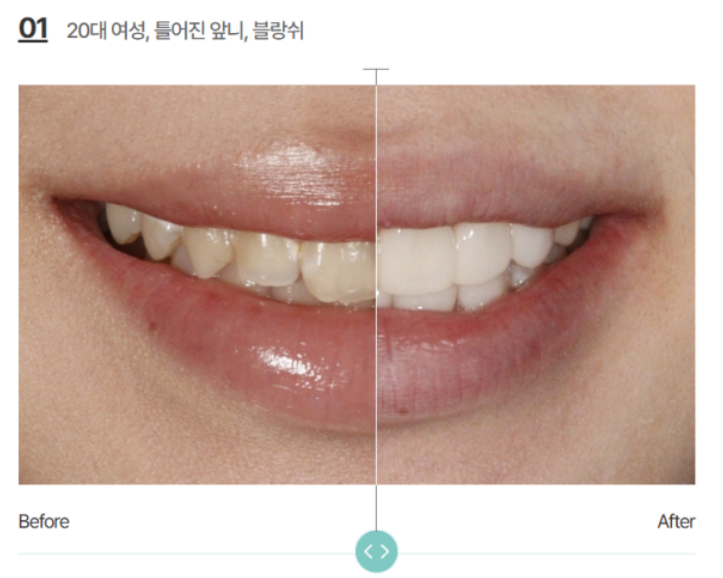
Resin, crowns, and laminates do not become whiter with whitening.
If you have dental work on your front teeth,
only the natural teeth may become brighter as you continue whitening,
which can unfortunately make the color difference more noticeable.
- How to Choose Between At-Home and Professional Whitening
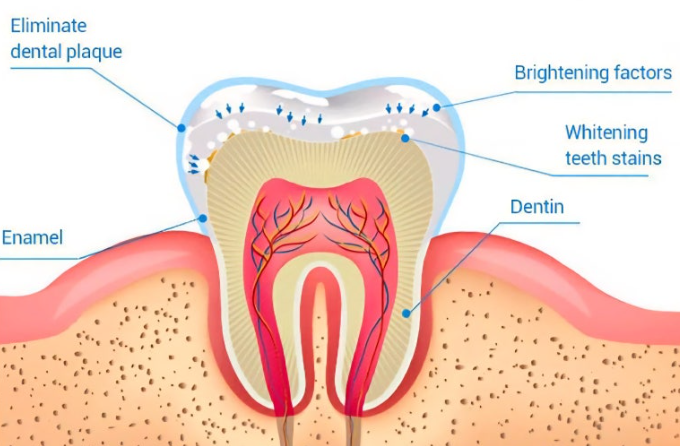
When you are considering whitening,
if I had to suggest just one criterion,
I would choose the type of staining.
Staining is divided into extrinsic discoloration,
in which pigments accumulate on the surface from coffee, wine, or smoking,
and intrinsic discoloration,
in which the color changes within the tooth due to genetics, antibiotics, or root canal treatment.
At-home treatment can address extrinsic discoloration to some extent.
Simply put,
At-home whitening may be considered when:
There are no resin restorations or prosthetic materials on the front teeth,
the staining is on the surface and caused by food,
and the gums are healthy without sensitivity.
Professional dental whitening is recommended when:
There are resin restorations or crowns on the front teeth,
only one tooth has become darker after root canal treatment,
the teeth were stained by medication during childhood,
or the teeth are already sensitive.
Even with intrinsic discoloration, treatment at a dental clinic using a higher concentration
may have the potential to improve the appearance.
However, if the dentin itself has a yellowish color,
it may be difficult to see a major change through whitening that only brightens the surface.
- Why an Examination Comes Before Whitening
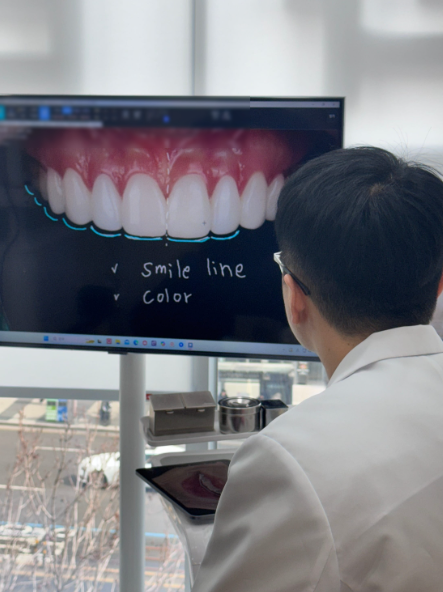
When I see people who come in because their at-home whitening did not work,
in many cases the problem was not the whitening agent
but the condition of their teeth.
They may have tooth decay or gum inflammation,
or what they thought was staining may actually have been
discoloration of an old resin restoration.
It was not that whitening was ineffective;
it was a condition in which whitening should not have been performed.
To determine which type of staining you have,
it is necessary to examine the teeth directly and take X-rays.
For 24–48 hours immediately after whitening,
the teeth are in a condition where they absorb pigments most easily.
If you eat strongly colored foods such as coffee, wine, or curry during this time,
the color may return quickly.
Rather than choosing a product first,
I recommend checking whether your teeth are currently in a condition
that can safely undergo whitening.
Closing Remarks
To be honest, whitening also has clear limitations.
In other words, it is not a cure-all. Haha.
Within the concentration standards used domestically,
teeth usually become about one to two shades brighter.
Although this varies depending on lifestyle habits,
in many cases the color gradually returns after around six months.
Therefore, it is more important to first understand
which method is suitable for your teeth
than to focus on how white they can become. ^^
If you are wondering whether your staining can be addressed at home
or whether professional dental whitening is needed,
please feel free to contact us through the comments or by phone.
I will check your teeth personally
and give you an honest answer.
This has been Blanche Dental Clinic in Gangnam.
Thank you.
| Comparison of At-Home Teeth Whitening vs. Professional Dental Whitening |
|---|
| Blanche Dental Clinic · The whitening method varies depending on the condition of the teeth, and results vary from person to person. |
| Category |
| Whitening agent concentration |
| Preparation |
| Type of discoloration |
| Treatment period |
| Degree of brightening |
| When resin or crowns are present |
| Root canal-treated teeth |
| Suitable when |