When I talk with many people who come in for consultations carrying various concerns from the front lines,
I find myself asking, “Is there really a fixed answer that everyone can agree on when it comes to cosmetic surgery that changes one’s appearance?”
Based on my clinical experience so far,
in cosmetic surgery, there is no single correct answer, and I believe that as the surgeon in charge, the right attitude is to align as closely as possible with the perspective of the person who has the concern.
But,
when you repeatedly perform the same surgeries in everyday practice, and repeatedly hear the same questions about postoperative progress at each stage,
without realizing it, you can become accustomed to it,
and your own standards can become too rigid, creating the risk that flexibility in thought may be lost.
I had a recent experience like that as well.
Toward the end of winter,
a person who had undergone facial contouring surgery at another medical institution (square jaw surgery and cheekbone surgery)
came to see me for a consultation because they were deeply depressed due to the awkward contour of the front cheekbone area and the step-like contour connecting to the side cheekbone area.
After taking a 3D CT scan to analyze the condition of the facial bones, we had a consultation in the examination room, and
in my opinion, rather than the contour of the protruding front cheekbone and the 45-degree cheekbone, the face had a shape in which the second angle of the lower jaw and the chin, as well as the area around the chin, looked too heavy,
so I told them rather strongly that if only one area were to be operated on to address the awkward facial contour, it would be better to properly refine the lower jaw area rather than the cheekbone area.
After three months of worry, summer came and the person decided on surgery and returned for another consultation,
so I told them once again that, rather than the cheekbone area, the priority was to lighten the heavy impression of the lower jaw,
but since they said their biggest complex was the cheekbone area,
I performed the surgery according to the area they were concerned about. Even while performing the operation, though, I worried a lot about whether, even if the prominent front cheekbone became softer, the relatively heavy lower jaw contour might stand out even more.
The surgery consisted only of shaving the body area of both cheekbones, so it was a simple procedure that took about 20 minutes in total, and the patient was discharged that afternoon with almost no swelling.
Two weeks after the surgery, seeing that person enter the examination room holding a lovely, cute child and looking brighter than I had ever seen before, I felt deeply moved,
and it became another opportunity for me to reflect on my own rigid thinking, which had become fixed in prejudice about the surgical approach.
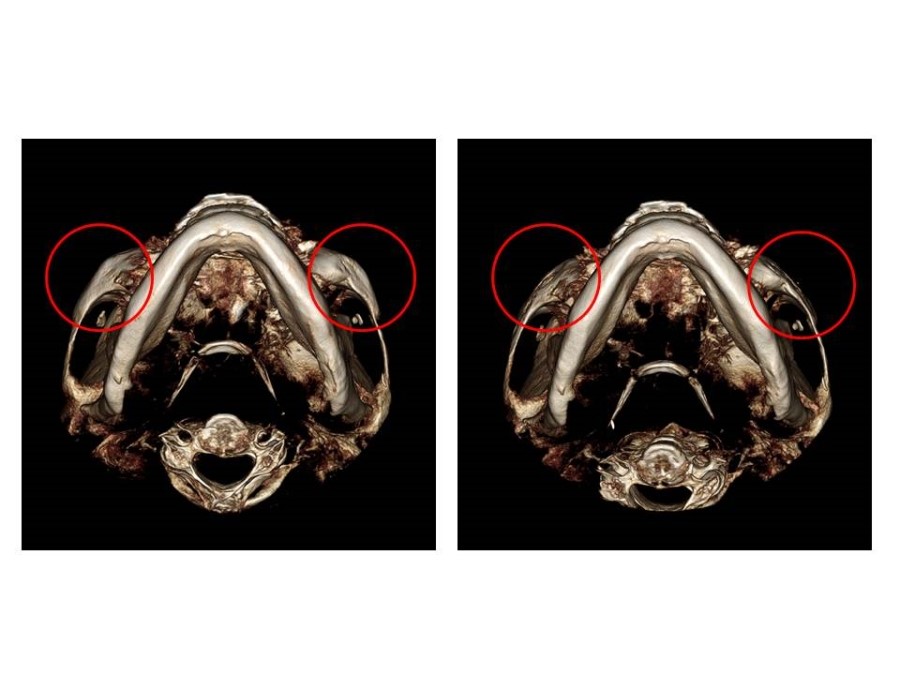
This is a change in the contour of the cheekbone body area, viewed from the base of the 3D CT, taken before surgery and at two weeks after surgery.
Measurement on the 3D CT showed that the volume of the cheekbone body area that had protruded forward on one side (the front cheekbone and 45-degree cheekbone area) was reduced by 6 mm on each side.
The patient was in their mid-30s, and even after shaving the cheekbone body area, there was no sagging of the cheeks at all, and the level of satisfaction with the surgical result was much higher than I had expected.
- In the past, a woman in her early 20s who had come for a consultation with her mother once argued with me, asking how I could say that the thickness of the cheekbone body area was only a few millimeters and that it could be reduced by 4 to 5 mm with shaving alone,
and many plastic surgery specialists still say that cheek sagging after cheekbone surgery is caused by excessive dissection and shaving of the cheekbone area, but
in reality, the overly developed cheekbone body area can be reduced by at least 5 mm through shaving,
and from my experience, the cheek sagging after cheekbone surgery is attributable to complete osteotomy of the front cheekbone area.^^