Recently, I briefly answered a few questions in response to an inquiry that came to me,
but I thought a more practical understanding would be needed,
so I am sharing an actual surgery case as well.
The inquiry was
"In zygoma reduction surgery, I heard that some hospitals deliberately do not fix the posterior part of the zygomatic arch because posterior osteotomy and fixation may affect the temporomandibular joint.
Is that true?"
In my view, that seems like a very flimsy and embarrassing excuse for not being able to fix the posterior osteotomy site of the zygomatic arch as the most posterior point.
Accurately determining the posterior osteotomy position of the zygoma and deciding the fixation position are very important parts of zygoma reduction surgery,
and they have a major impact on the surgical result, but they also require a great deal of actual experience.
Speaking of actual cases, I have performed revision surgery about four times for the following reason.
The patient had undergone zygoma reduction surgery at another plastic surgery clinic or dental clinic, but because the posterior osteotomy site of the zygomatic arch had not been fixed,
the zygomatic arch had dropped downward, interfering with the movement of the temporomandibular joint.
Because of that functional problem, after lifting the zygomatic arch upward, bringing it inward, and fixing it in the proper position,
the problem that had been interfering with temporomandibular joint movement was resolved.
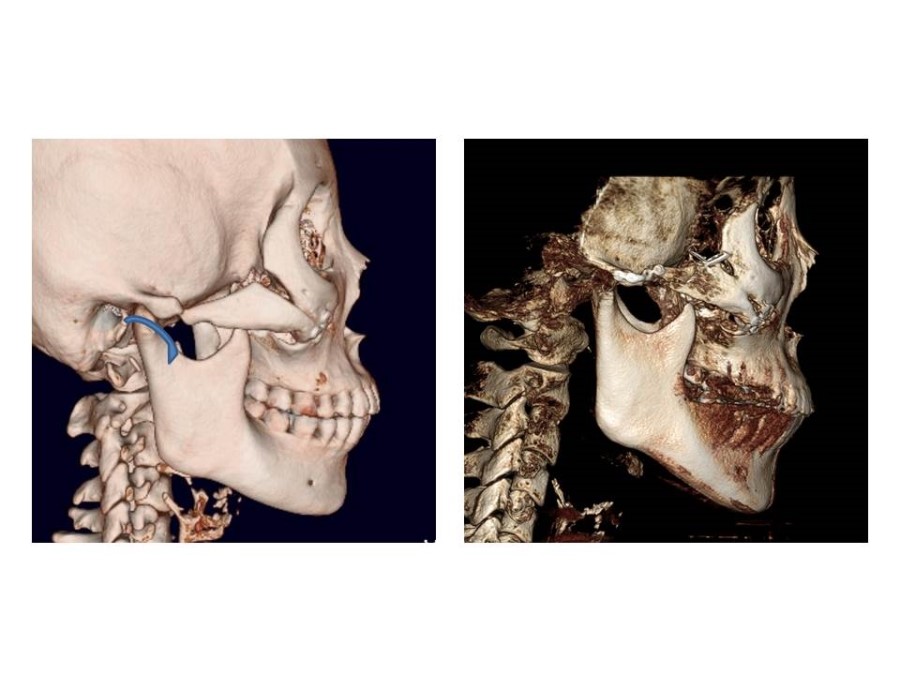
Below is a preoperative and postoperative 3D CT scan of a patient for whom I actually performed revision surgery for such a problem.
After zygoma reduction surgery at another hospital four years ago, the posterior portion of the zygomatic arch is observed to have sagged somewhat downward,
and when the mouth is opened, the temporomandibular joint moves by rotating in the direction of the blue arrow (clockwise).
The temporomandibular joint symptoms caused by the movement of the unfixed zygomatic arch interfering with this rotational movement of the temporomandibular joint
were resolved after accurately fixing the zygomatic arch upward and inward.