Among facial contouring procedures, the most commonly performed are square jaw surgery and V-line square jaw surgery.
I will explain, in a comfortable way, everything from fairly basic information to the questions I often hear in the clinic.
For some time, I had refrained from posting overly detailed articles because, while they certainly have advantages, I also thought they could bring unexpected side effects in various ways.
However, I have also felt that misinformation has become excessively widespread, and even during consultations in the clinic,
it is difficult to explain the same points one by one each time, so I would like to explain them in detail based on our experience.
Among the facial contouring surgeries that change the shape of the face, the most commonly performed is square jaw surgery.
Square jaw surgery is a procedure that refines the contour of the lower jaw when the lower face looks large and angular.
In general, when the facial contour below the line connecting the nose and the ear appears angular and overdeveloped, the face can look somewhat stronger in contour and may appear more mature than one’s actual age.
Therefore, when I counsel people who are considering changing their facial contour,
I recommend giving priority to reducing the contour of the lower face when the midface and lower face are overall large.
The standard square jaw surgery is
a procedure that refines the angular portion of the lower jaw, including the more developed-looking body of the mandible.
However, if the chin contour is somewhat wide, long, protruding forward, short, or set back, then the chin contour must be properly refined for the frontal appearance to improve significantly.
A surgery that refines the contour of the lower jaw, including the chin, is commonly referred to in a way that is easy for the general public to understand as
V-line square jaw surgery.
Among the methods used to refine the front chin area,
it is most important to understand exactly what each method involves and what advantages and disadvantages it has,
and then compare and analyze them to choose the surgery that is appropriate for one’s own chin.
Among the methods for refining the chin area,
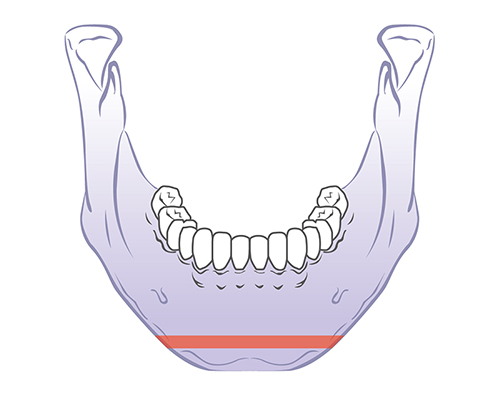
there are various techniques in use, such as rotational shaving, which reduces the overall outer contour of the chin area by shaving or cutting away the perimeter,
T-osteotomy, modified T-osteotomy (a bent Y-shaped osteotomy),
and what I personally think is a somewhat comical S-shaped osteotomy.
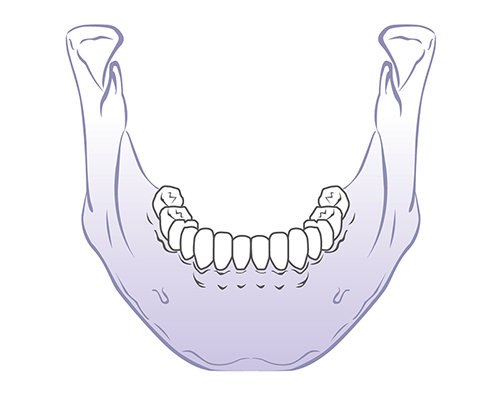
The following are schematics that make the various surgical methods easier to understand.
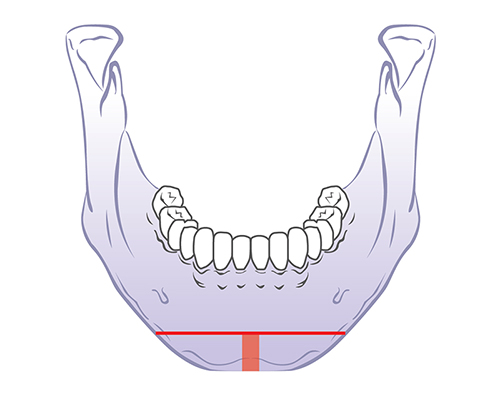
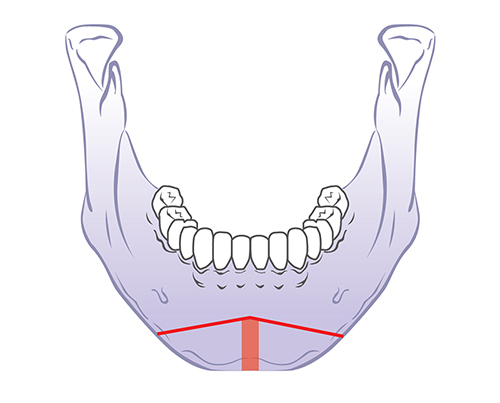
This is T-osteotomy for the purpose of reducing the width of a broad and heavy-looking chin area to make it somewhat sharper and more compact.
In the schematic, the rectangular bone in the central area is removed, brought together, and fixed.
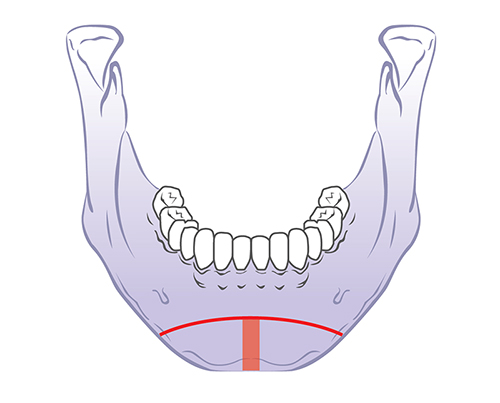
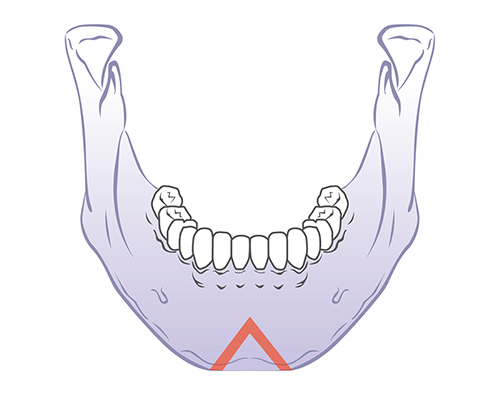
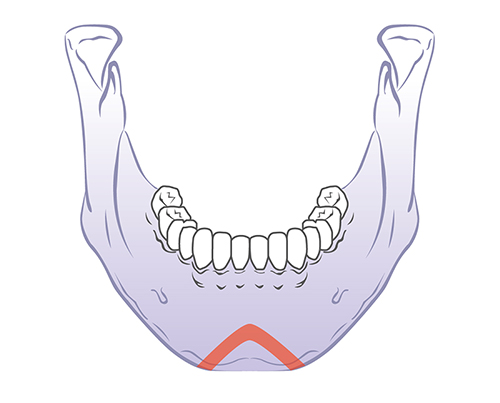
As a variation of T-osteotomy, the horizontal osteotomy line is modified into a somewhat curved shape to reduce the volume of the chin bone converging toward the center, and this is the method I commonly use when performing T-osteotomy.
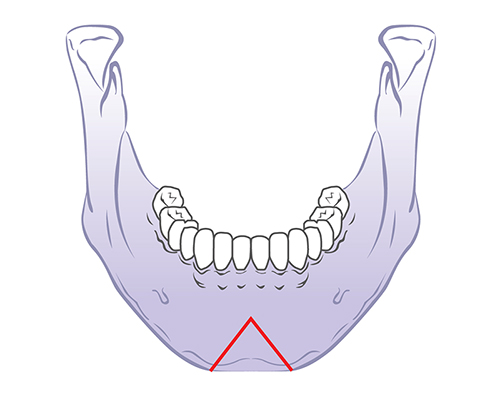
As a variation of T-osteotomy, this is a bent Y-shaped osteotomy designed to make the symmetry of the horizontal osteotomy line easier to achieve.
Although it was devised as a method to reduce the length and width of the chin bone, I think that in actual surgical results it can produce somewhat crude outcomes. Its simplicity is better than T-osteotomy or modified T-osteotomy, and I think it is relatively stable, but I believe the actual results may fall short in many cases.
It is important in clinical practice to analyze the actual surgical results that arise from this theoretical background.
Surgery is not always performed exactly like a schematic, because there are many variables involved.
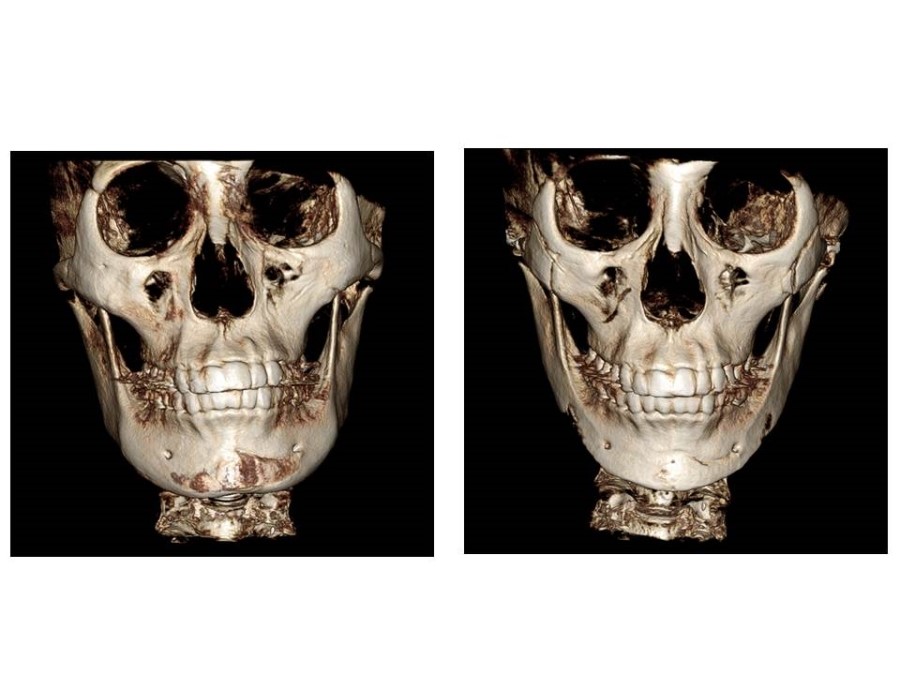
Below are actual bone images of patients who came to me for revision surgery consultation after undergoing surgery by various methods.
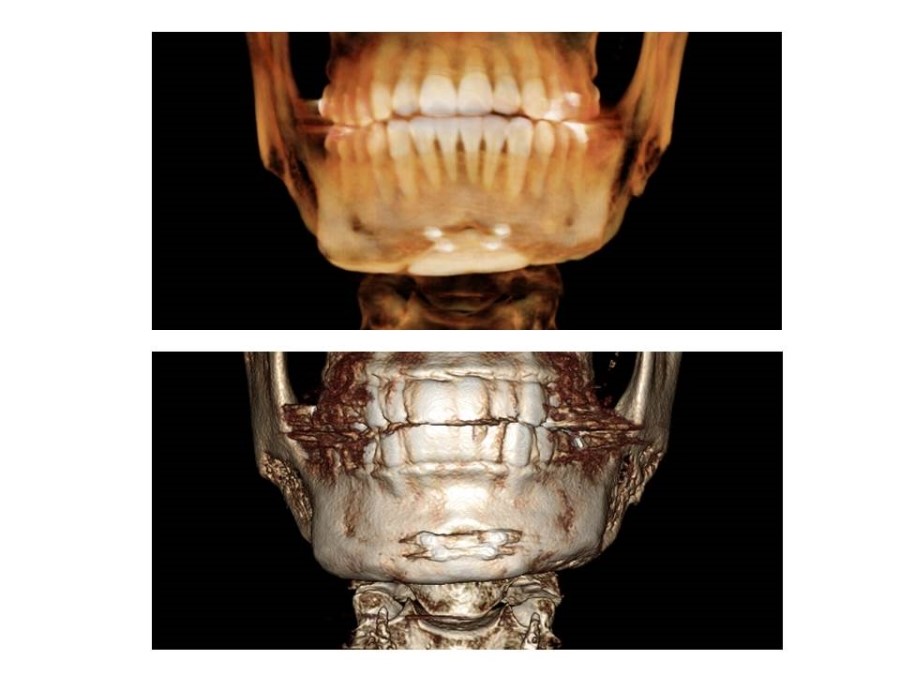
This is a 3D CT scan of a patient who underwent cortical bone resection and an S-shaped chin osteotomy at a dental clinic in order to make the lower jaw contour smaller and more refined, but came to me for revision consultation because of the heavy-looking contour of the front chin and an uneven jawline with a secondary angle.
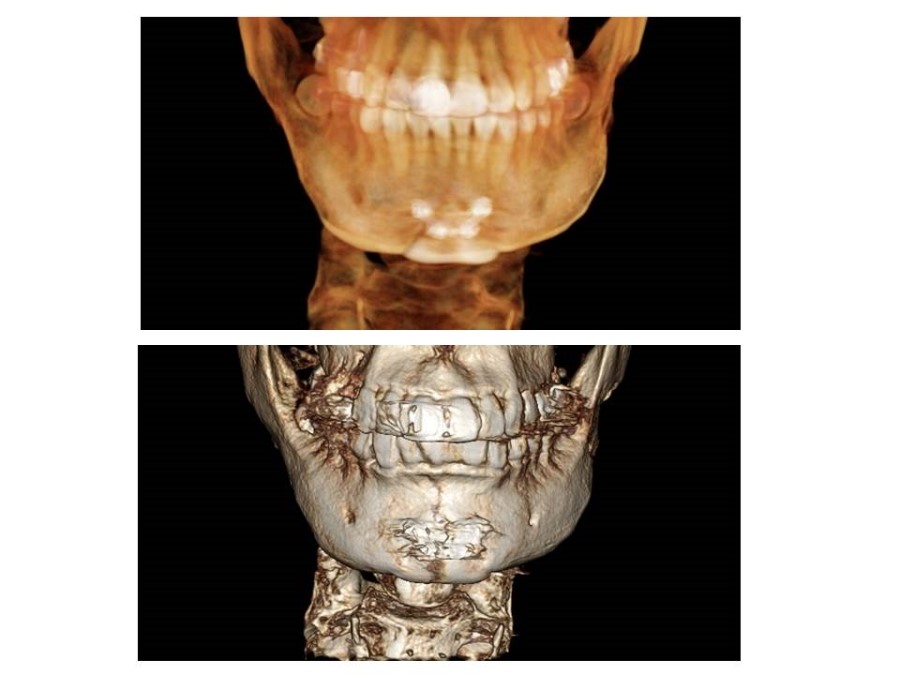
This is a 3D CT scan of another patient who underwent a similar procedure and came to me for revision consultation.
After cortical bone resection, the jawline contour is uneven, and after the S-shaped chin osteotomy, the chin contour can be seen to look somewhat heavy.
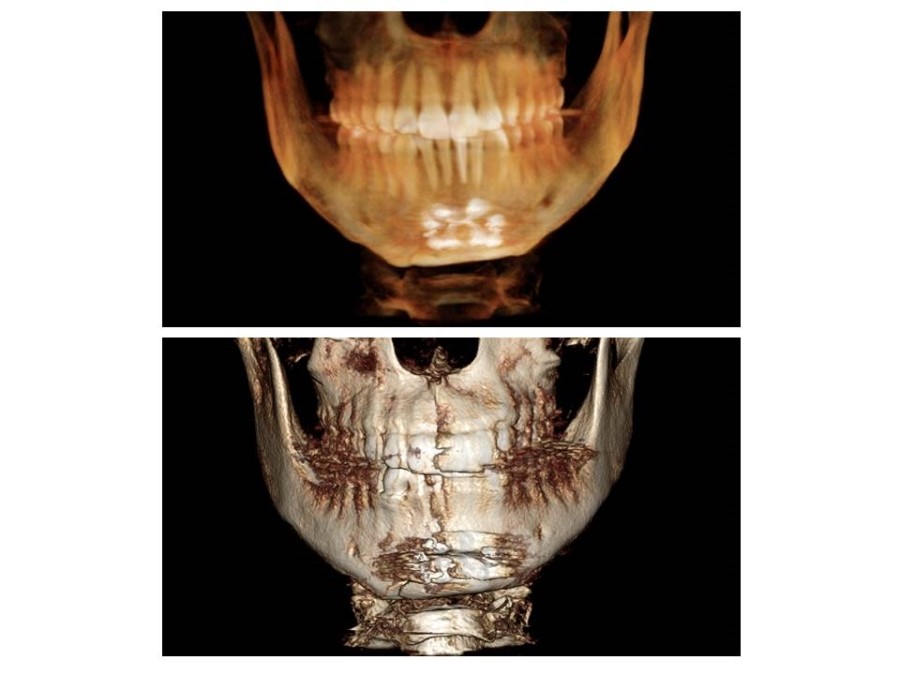
For a patient who underwent square jaw surgery and an S-shaped chin osteotomy at a plastic surgery clinic, the chin contour was not refined into a slender shape, and asymmetry on both sides can be observed.
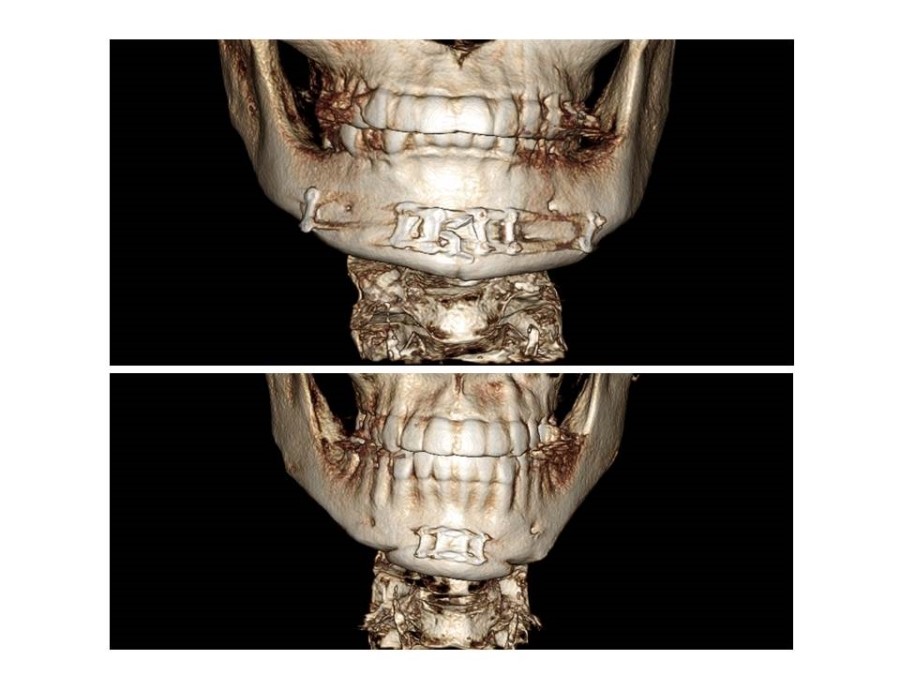
The above 3D CT scans are of a patient who wanted V-line square jaw surgery and underwent T-osteotomy of the chin at a plastic surgery clinic.
Below are preoperative and postoperative 3D CT images of patients whom I treated using rotational shaving and T-osteotomy.
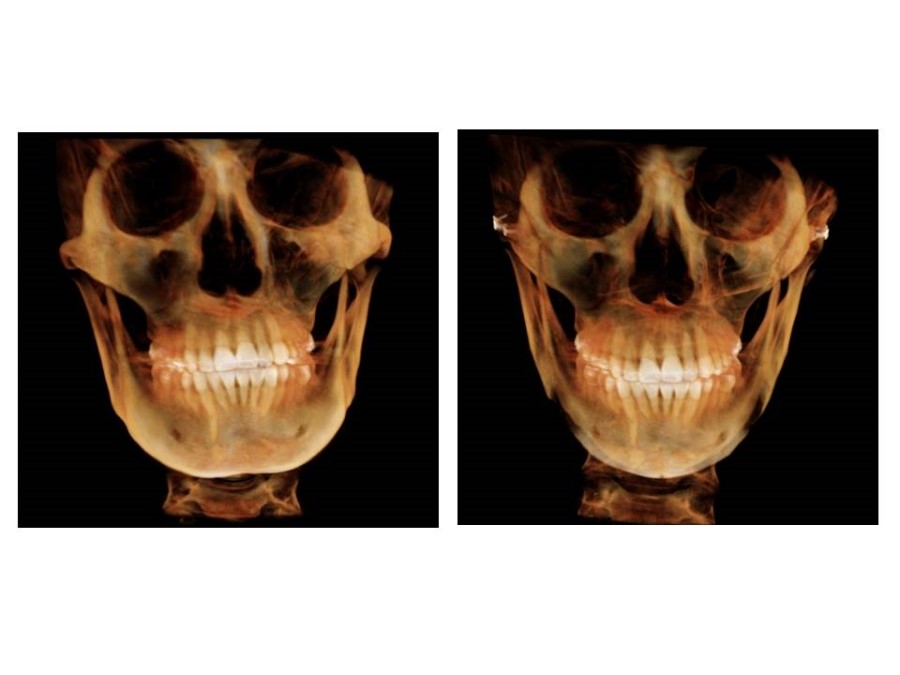
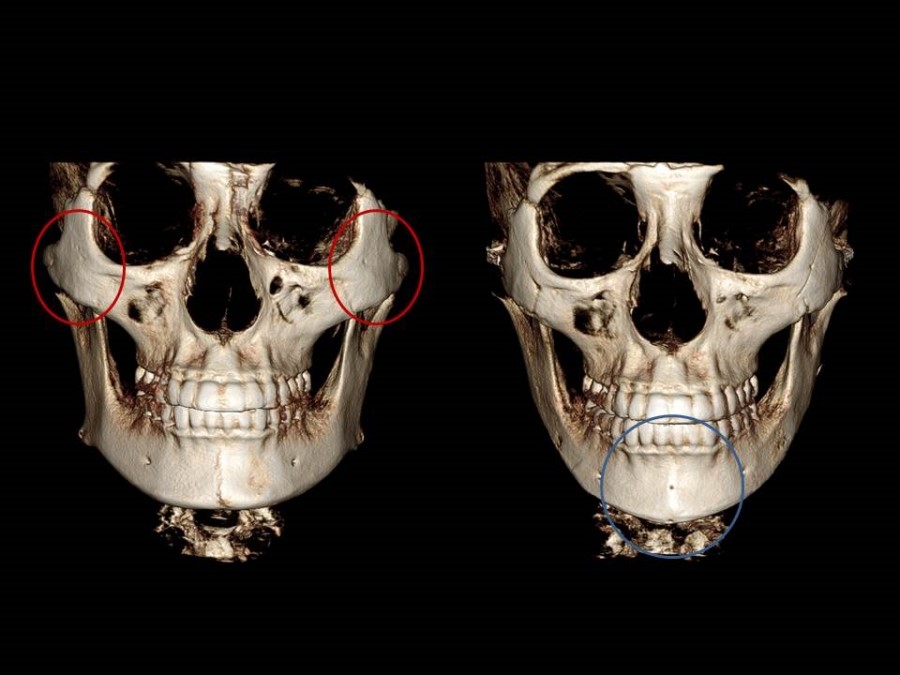
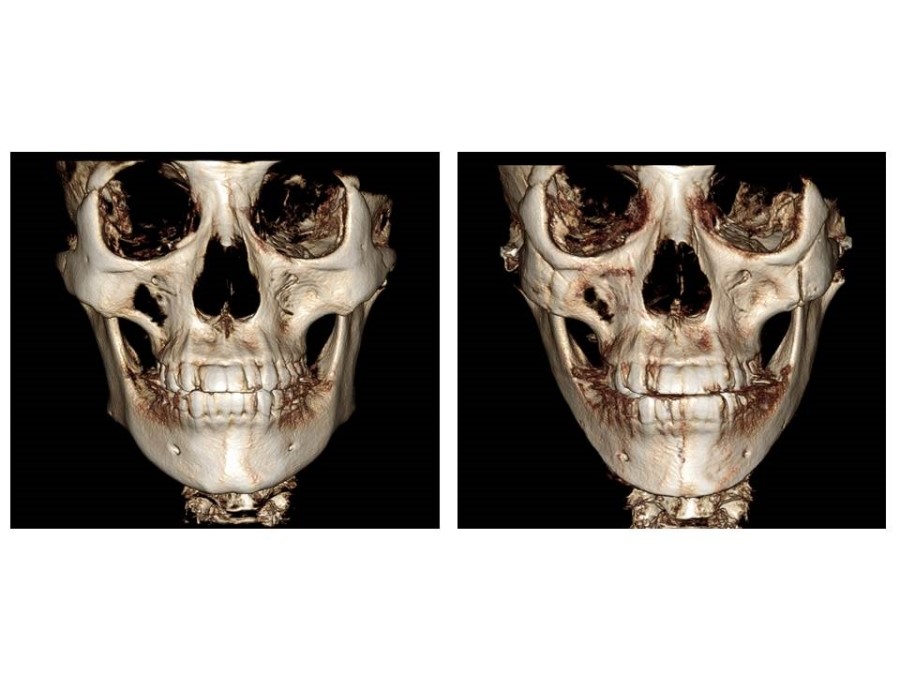
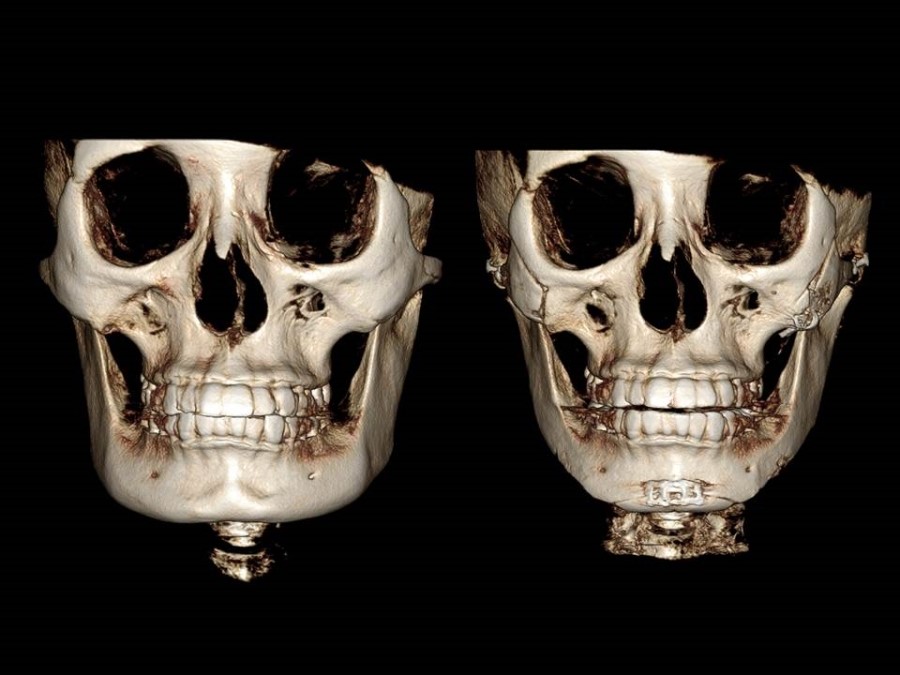
The above 3D CT scans show the preoperative and postoperative images of patients whom I operated on, and they are the preoperative and 2-week postoperative 상태 of patients who underwent square jaw surgery along with T-osteotomy of the chin.
To make the chin contour smaller and more refined, I prefer rotational shaving or the bent Y-osteotomy, which is a variation of T-osteotomy.
However, depending on the preoperative shape and position of the chin, it is absolutely necessary to apply the appropriate surgical method.
For example, if the chin contour is somewhat asymmetric, performing T-osteotomy or modified T-osteotomy may worsen the asymmetry,
and if the chin is long or appears to protrude forward, good results may be difficult to expect with T-osteotomy.