I’ve been so busy and disorganized that it feels like it’s been a very long time since I last wrote a blog post.
Even in the midst of the repetitive routine of everyday life, there are consultations and explanations about surgery and follow-up care in the clinic.
There are also replies to KakaoTalk consultations and to messages asking about the condition and well-being of people who have had surgery.
There are replies to online consultations as well.
Since I handle all of this myself,
as relationships build up, I feel like there is never enough time. That was how I felt last winter.
For the issues that many people are curious about, it is certainly necessary to explain them one by one to those who ask directly,
but being able to share them through the blog also feels very important.
What I will write about today is based on what I have learned through my own, not-so-short experience.
I am preparing more scientific data and planning to publish it as a paper in an overseas academic journal.
After square jaw surgery, I sometimes observe a phenomenon in which some bone grows back in the angled area.
In other words, after mandibular angle resection, part of the lower jaw’s angle area is newly formed over time.
This phenomenon varies from person to person, and I have observed it in cases where the masseter muscles are used a lot.
If, on the preoperative X-ray or CT, the mandibular angle area was flared outward, then after a certain period following surgery, the direction of bone formation also tended to appear outward.
If, on the preoperative X-ray or CT, the mandibular angle area was curled inward, then after a certain period following surgery, the direction of bone formation also tended to point inward.
The CT images below show the follow-up course at 1 year and 3 years after surgery in a patient I operated on, and then 1 year after I reshaped the angle area once more.
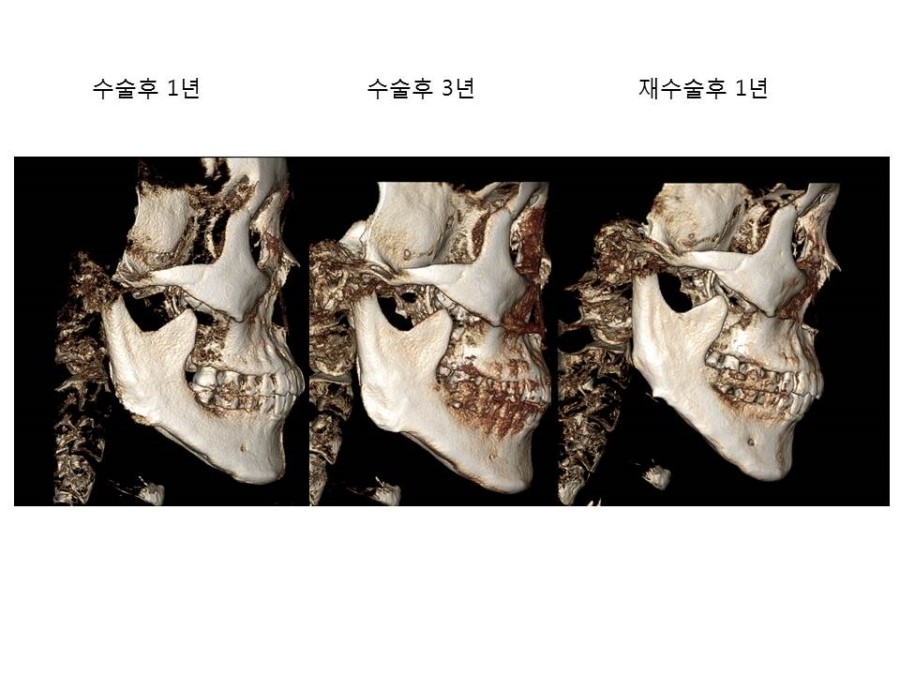
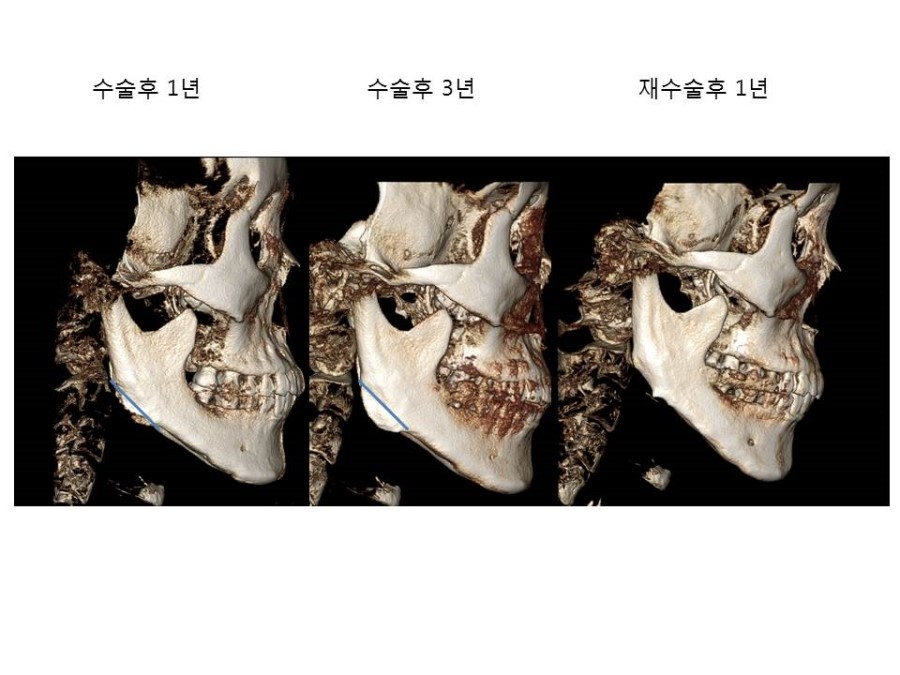
As you can see in the CT images above, around 1 year after surgery, a slight amount of bone formation was observed in the angled area of the lower jaw, and by the third year, the angle area had formed much more, making it appear somewhat more angular to the naked eye.
Accordingly, I reshaped the angle area once more and then observed the course for at least 1 year while reducing the action of the masseter muscles with Botox injections, and after that, no recurrence of bone formation in the angled area was observed.
Of course, in square jaw surgery, if the mandibular angle area is overcorrected to the point that the angle is carved in too deeply and the masseter muscles have difficulty functioning evenly, I think there is almost no bone formation in that area, and in actual clinical practice I often see such cases.
However, when some of the lower jaw’s angle area is left intact, in many cases the contour of that angle area becomes much more prominent over time, and I think there are also many people who end up considering revision surgery because of it.
There is more I would like to explain, but I will organize and explain it little by little in the future.