Entering the topic~~
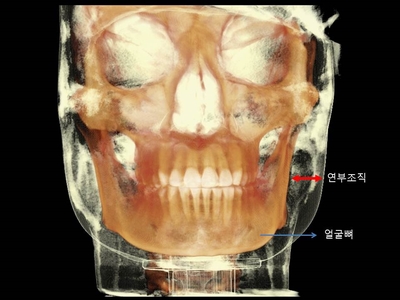
The contour of our face is largely formed by the underlying facial bones, and is additionally determined by the soft tissues surrounding the facial bones (muscles, fat, and skin).
If you hope to change the contour of your face, you first need an accurate understanding of which of the factors that determine facial contour you want to change.
For example, even if the lower jawbone that forms the contour of the face is angular and prominent, if you only change the conditions of the soft tissues surrounding the bone and expect the face to become a V-line shape, you may end up with considerable disappointment and unnecessary discomfort.
On the other hand, if the facial bones are small but there is a lot of soft tissue covering them, making the face look full and large, you need to consider ways to reduce the fat or muscle in the facial area covering the bones in order to expect a satisfying change.
In consultations in the clinic, I often meet people who come in with expectations that are far removed from the intended direction of the surgery because they do not fully understand buccal fat removal surgery. In such cases, if the preoperative consultation was insufficient, there is also a possibility that the postoperative result may cause conflict because the change is different from what the patient had expected.
The things people commonly say when they come for buccal fat removal include:
“I'm worried about the cheek fat that bulges out when I smile.”
Then I explain it like this: “The area that looks bulgy when you smile will definitely improve, but even when you are not making a facial expression, it may look a little more sunken or gaunt than it does now.”
“Ah~~~ that wouldn't be goodㅠㅠㅠ”
Logically, if the area that bulges when you smile is reduced, wouldn't the volume also be less than before the fat removal even when you are not smiling???
“I'm worried about cheek tissue getting bitten between my teeth inside my mouth.”
This is the concern I can answer with the most confidence: “If you have buccal fat removed, the cheek tissue that gets bitten inside the mouth will definitely improve.”
“I'm worried about jowls, so I'm thinking of getting buccal fat removal.”
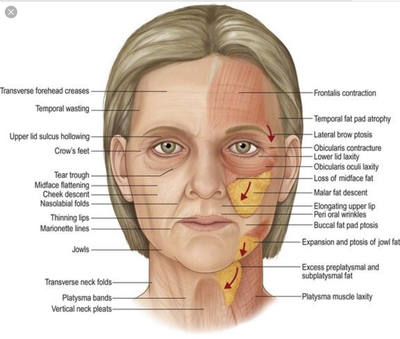
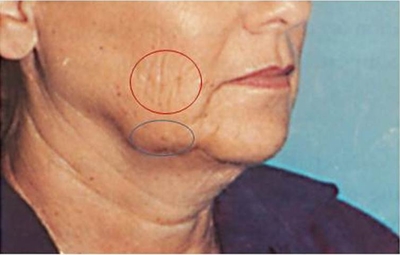
My answer is: “The jowl area is not caused by buccal fat; it is a phenomenon that appears because subcutaneous fat and skin elasticity have somewhat decreased, so you cannot expect an improvement from buccal fat removal alone.”
Looking back on the consultations with people who came to me with the various concerns above, I think the most important thing is to accurately understand the exact location of the buccal fat and the areas where changes occur when buccal fat is removed.
Location and structure of buccal fat
Most of the fat in the face is composed of subcutaneous fat, but there is also fat that is located unusually deeper than the facial expression muscles or chewing muscles, and this is called buccal fat.
Unlike subcutaneous fat, it is called buccal fat because it is located deep within the face, and its medical name is the Buccal Fat Pad (Bichat’s Fat Pad) because it is in the cheek area.
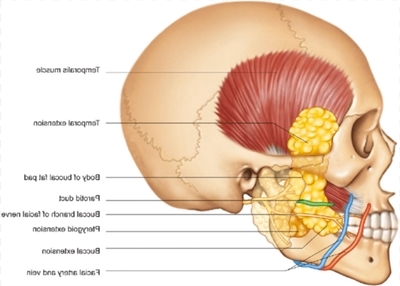
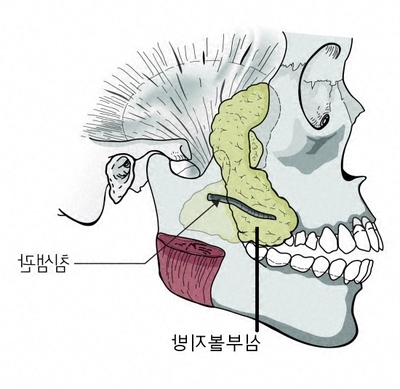
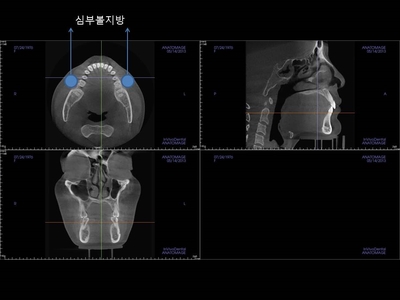
As shown in the figure below, the location of the buccal fat (Buccal Fat Pad) is deeper than the chewing muscles, and it is composed of a body portion and three tails (Temporal, Buccal, and Pterygoid Extension).
There can be a lot of individual variation depending on the person, and statistically, the average amount is said to be about 9 cc on one side.
Also, I think it is absolutely necessary to first explain the surrounding contour elements that should be considered together with the location of buccal fat and the areas where changes appear when buccal fat is removed.
Before buccal fat removal, double chin treatment, or cheek liposuction, the following points should be considered.
Accurate understanding of the conditions of the facial bones and soft tissues
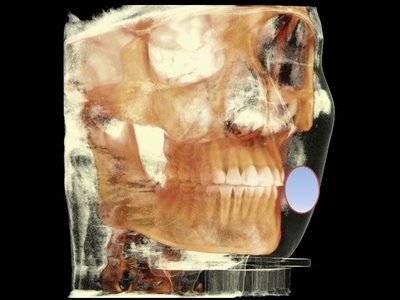
To help with understanding, it can be useful to analyze various conditions through 3D CT.
Facial contour surgery that does not involve the facial bones
Buccal fat removal
Double chin and cheek liposuction
Temple reduction
Botox treatment for the square jaw
Among the soft tissue conditions, the location of each and the method of improvement
When the muscles are well developed – they can be reduced through Botox injections in the chewing muscle area.
When there is a lot of subcutaneous fat – improvement can be expected through subcutaneous fat liposuction via the skin.
Buccal fat – effect can be expected by making a small incision inside the mouth (1 cm) and removing the fat sac as a whole.
Overall outline of buccal fat removal
Buccal fat removal is a method in which, when the area outside the lips looks bulging, a small incision is made inside the mouth and the buccal fat pad is brought out.
As shown in the figure below, the average amount of buccal fat is about 9 cc on one side, and it has a structure connected from the cheek area to the temple.
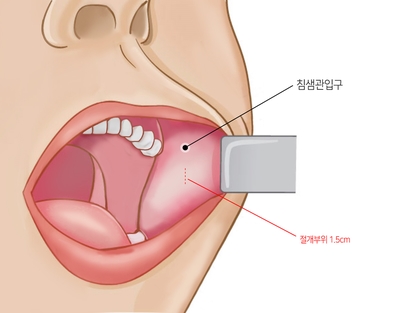
In general, through an incision of about 1.5 cm at the inner corner of the mouth, the fat pad is brought out, and it is appropriate to remove about 4–5 cc of fat from each side.
The surgery takes about 10 minutes, and because it is removed through the inside of the mouth, there are no external skin scars, so daily life is possible immediately after the surgery.
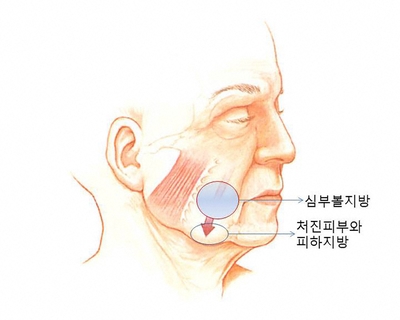
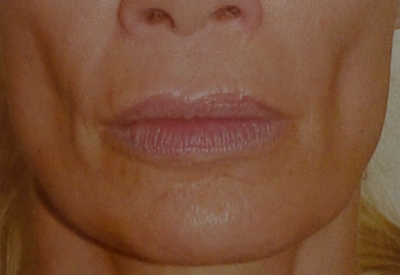
If buccal fat is removed excessively, it can result in the area outside the lips appearing sunken, as shown in the photo.
Buccal fat removal surgery method
Buccal fat removal surgery is performed by making an incision of about 1–1.5 cm inside the mouth and bringing out the fat enclosed in the sac.
Subcutaneous fat is reduced by suctioning small fat particles with a cannula, but buccal fat consists of a large fat mass and cannot be removed by suction. Therefore, the surgery must be performed by removing the fat enclosed in the sac as a whole in order to promise accurate and definite results.
The surgery takes about 10 minutes, and it is important to adjust the amount of fat removed according to the individual and by considering the difference in volume between both cheeks, but in general about 4–5 cc of fat is removed from each side.
The appearance and amount of buccal fat
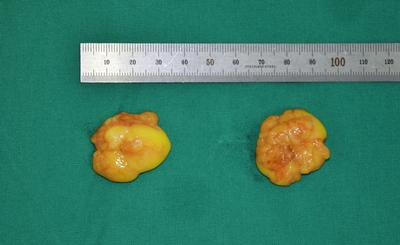
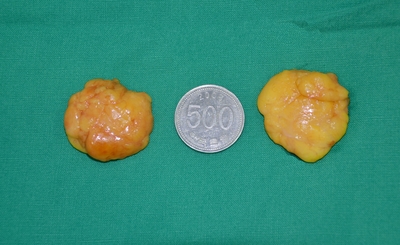
The actual removed buccal fat looks like the photos below, and depending on the individual and the degree of difference between the two cheeks, the amount removed may vary slightly.
Areas where changes can be expected after buccal fat removal surgery
As shown in the figure below, the area where changes in facial contour can be expected after buccal fat removal is the cheek area between the chewing muscle and the lips.
If the chewing muscle is developed and the face looks square, or if there is a lot of subcutaneous fat in the cheek area and the face looks generally full, or if you are expecting improvement in contour due to sagging skin and accumulation of subcutaneous fat, it is appropriate to consider methods other than buccal fat removal.
Recovery period by postoperative stage
In all surgeries, swelling reaches its peak between 48 and 72 hours after surgery.
Sometimes, people say they heard from another medical institution that if buccal fat is removed, it can be clearly reduced by the very next day. In such cases, I clearly advise that a place that says such things is telling lies during the consultation process, and that it should be the first place to exclude when deciding on surgery.
Complications associated with buccal fat removal surgery
Buccal fat removal surgery is a very easy and simple procedure from the perspective of an experienced surgeon, but it requires anatomical knowledge of the surrounding salivary ducts and facial nerves.
The postoperative course is also a procedure with a low risk of major complications, but in some cases, inflammation or severe hematoma may rarely occur.
Even in cases of severe swelling, in most cases the swelling subsides to some extent within 2 weeks after surgery.
However, depending on the facial condition, if too much is removed, the cheek area may become excessively hollow, resulting in a sunken appearance.
If you have previously had orthognathic surgery or facial contour surgery, it is better to analyze the condition of the facial bones and soft tissues through 3D CT before performing buccal fat removal surgery.
Of course, if orthognathic surgery was performed previously, buccal fat removal may be somewhat difficult because the soft tissues at the surgical site can adhere and scar formation may have occurred.