Entering the topic~~~
The contour of our face is largely based on the facial bones, and it is additionally determined by the soft tissues surrounding them (muscle, fat, and skin).
If you hope to change the contour of the face, you first need a precise understanding of which of the conditions that determine facial contour should be changed.
Among the surgeries commonly performed to refine the contour of the facial bones, one of the most frequently performed procedures is square jaw surgery.
However, there are cases in which people undergo square jaw surgery but do not obtain a satisfying change, or in which the result after square jaw surgery makes the face appear more sagging and depressed.
The reason for such outcomes is that even in actual clinical practice, many doctors who perform contouring surgery lack sufficient understanding of square jaw surgery.
Therefore, I would like to explain the principles of square jaw surgery and what changes are made to which areas through square jaw surgery.
Square jaw surgery is a procedure that refines the contour of the lower jawbone (the mandible) through the inside of the mouth in order to change the contour of the lower face.
This type of square jaw surgery can be considered in two categories: 'long curved square jaw surgery,' which changes the contour from the angular area of the lower jaw to near the corner of the mouth, and 'V-line square jaw surgery,' which also changes the contour of the chin.
Common questions from people who come in for consultation about square jaw surgery include:
“Is cortical bone reduction included during square jaw surgery? I heard that cortical bone reduction is the most important factor if you want an effect from the front view.”
Then I explain it this way:
“That is not exactly wrong, but I do not think it is being understood precisely.”
The biggest reason why mistaken understanding about the square jaw and cortical bone is so widespread is, in my opinion, due to the lack of experience and incorrect understanding among both the clinics that actually perform the surgery and the people responsible for marketing.
To understand this part, it is necessary first to relate the actual appearance of the face to the shape of the lower jawbone.
It is also important to understand what area the cortical bone is, and from which area of the cortical bone reduction should be performed in order to expect good results.
Components of the lower jawbone and names by region
In order to understand square jaw surgery and cortical bone reduction, an explanation of the components of the lower jawbone and the names of its regions must come first.
The lower jawbone consists of the angle, body, and chin, as shown in the figures below.
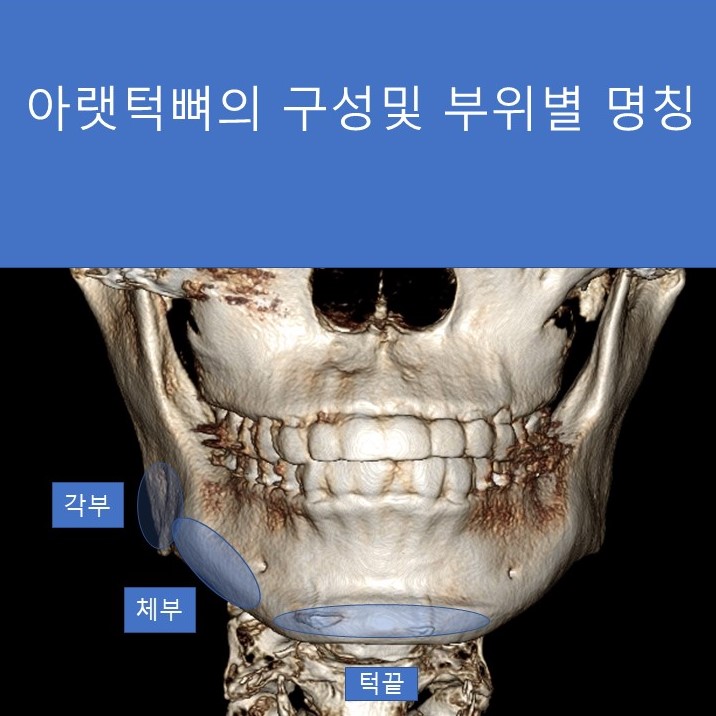
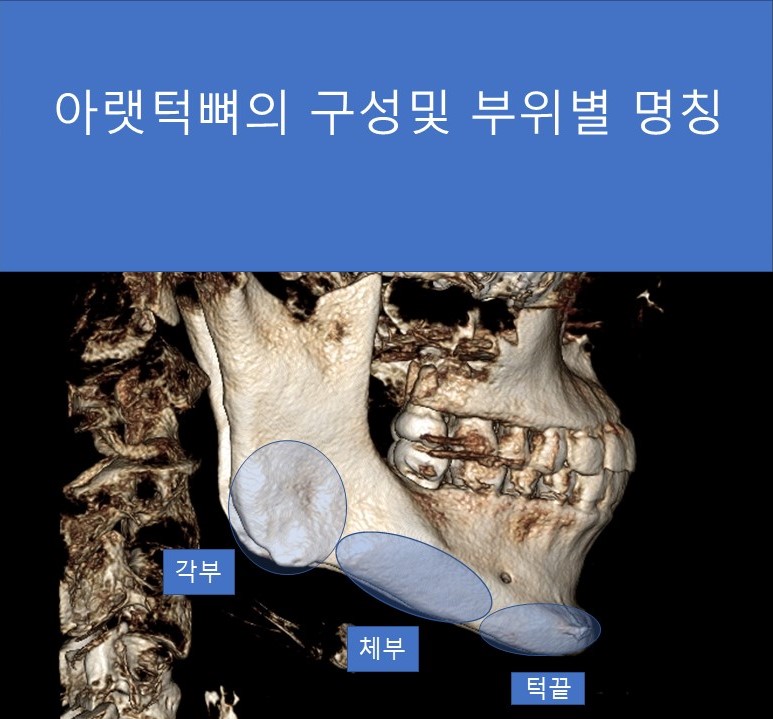
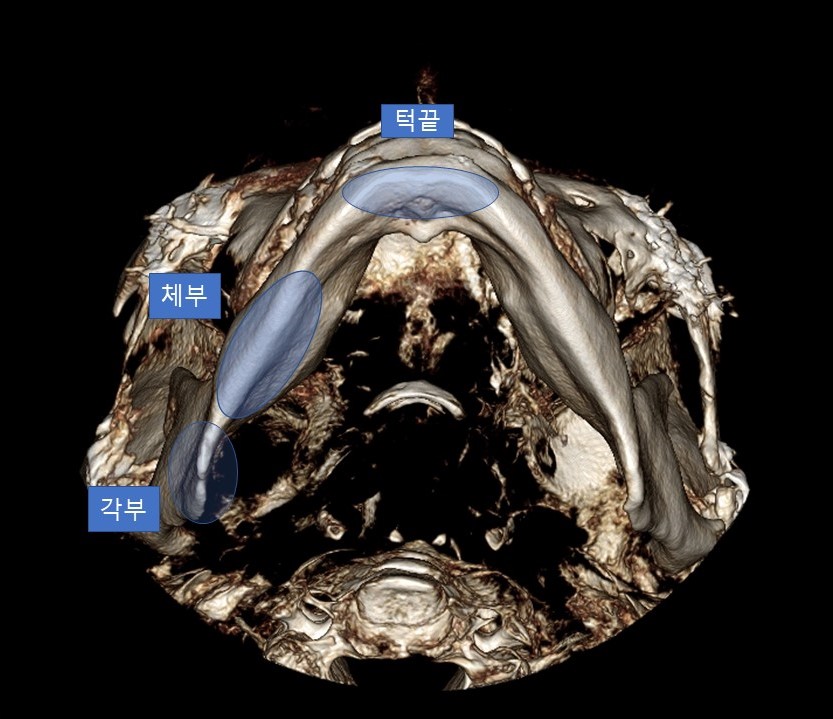
The 3D CT images above show the bone of a patient who came to see me for revision surgery after having cortical bone reduction and chin advancement surgery elsewhere. Aside from the chin being advanced, the square jaw area had hardly changed at all to the point that it was difficult to tell whether any surgery had been performed there.
In any case, these images clearly show the angle, body, and chin regions of the lower jawbone divided by area.
What is cortical bone?
Generally, the lower jawbone is made up of dense 'cortical bone' and 'cancellous bone' enclosed by the cortical bone.
To make it easier to understand, if you cut out part of the lower jawbone and look at the cross-section of the bone, you can see that it consists of outer cortical bone, cancellous bone, and inner cortical bone as follows.
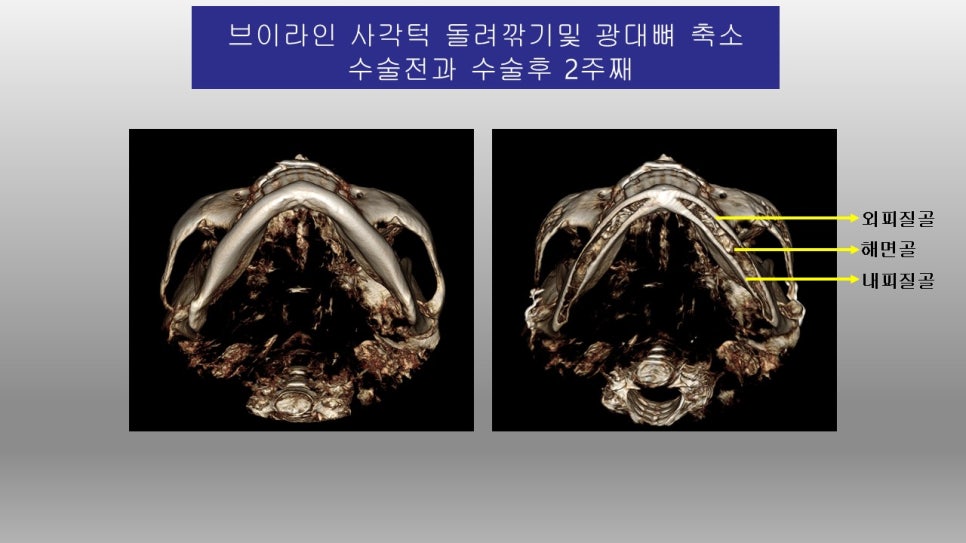
As you can see in the reference image above, the thickness of the lower jawbone increases as it transitions from the back toward the front.
Therefore, in square jaw surgery,
- For a strong effect from the front view
- For a harmonious contour of the lower jawline
The most important point is to reduce the cortical bone in the thick areas as much as possible.
Which area of cortical bone should be reduced to expect an effect from the front view?
As explained earlier, the thickness of the lower jawbone increases as it transitions from the back toward the front.
Also, the area forming the posterior angle of the lower jaw is much thicker in terms of the masseter muscle and subcutaneous fat layer than in terms of cortical bone thickness.
The photo below is a comparison image between a case in which part of the cortical bone forming the angular region of the lower jaw was removed and a case in which the thick cortical bone in the front part of the lower jaw was shaved down and reduced.
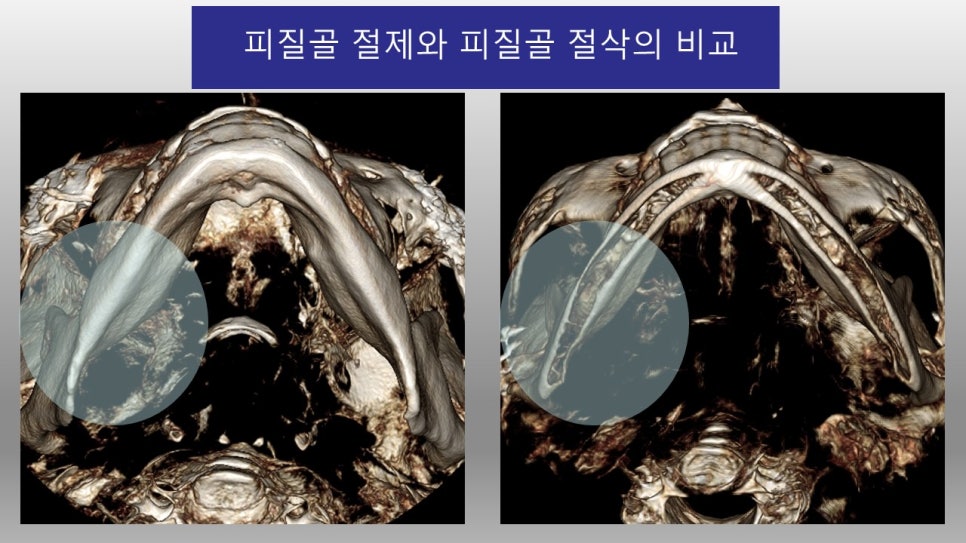
"On the left side of the image above"
This is a 3D CT image of a patient who underwent surgery using the cortical bone removal method and came to me for revision surgery consultation.
Although the cortical bone forming the posterior angle was somewhat thinned, removing about 3–4 mm of cortical bone in an area where the masseter muscle and subcutaneous fat layer are much thicker did not produce a significant visible change.
"On the right side of the image above"
This is a postoperative 3D CT image of a patient for whom I performed square jaw long curved resection surgery and also reduced the thick cortical bone in the front by shaving it down together.
If the content feels difficult or hard to understand, please refer to the video below, which explains it somewhat more easily.
https://youtu.be/1k5Y_zKX9bA
Are square jaw surgery and cortical bone reduction separate procedures?
When discussing square jaw surgery, this is a question many people ask me.
"During square jaw surgery, is cortical bone reduction also performed?"
In square jaw surgery, I believe that the process of reducing the cortical bone should naturally be included as part of the surgery.
For example, just as in square jaw surgery, we would not think of making the incision inside the mouth, refining the bone, and then suturing the incision as separate procedures...
I think that some more commercially oriented places hook people by promoting square jaw surgery at a low cost, and then when patients actually go for consultation, they explain that cortical bone reduction is a separate process and an important step for changes in the front view, adding extra charges. That may have created incorrect knowledge among many people.
Is cortical bone reduction the best way to expect an effect from the front view?
Of course, for changes in the front view, good results can only be expected when cortical bone reduction is combined with all the other processes of appropriately cutting and reducing the angular part of the lower jaw.
As in the images attached above, there may be cases in which only the cortical bone is removed during square jaw surgery and therefore almost no effect can be expected from the front view.