To reduce the side cheekbone, it is necessary to accurately understand the anatomical structure and principles of the bones that determine the contour of the side cheekbone.
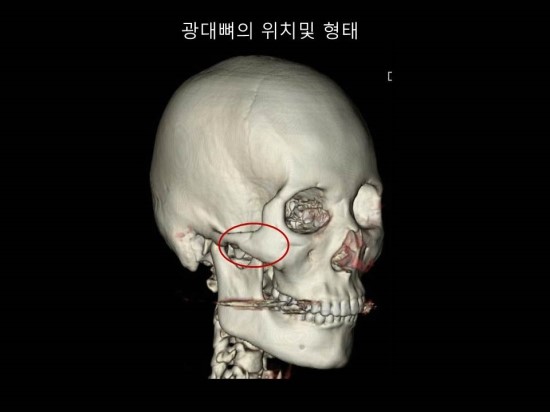
The cheekbone has a structure that starts from the maxilla at the front and connects to the temporal bone at the back, and it can be considered as being divided into the body portion and the arch portion.
The front body portion is responsible for the contour of the front cheekbone, or the 45-degree cheekbone, while the cheekbone arch that connects from the body portion to the temporal area at the back is responsible for the contour of the side cheekbone.
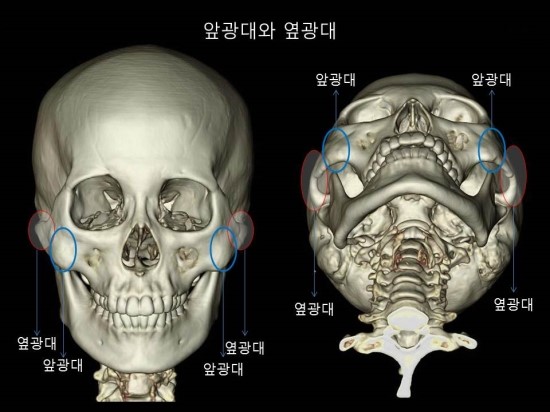
Figure 1. – Front cheekbone and side cheekbone
To reduce the contour of the side cheekbone from the cheekbone, a procedure is needed to bring inward the cheekbone arch portion, which is splayed outward toward the back.
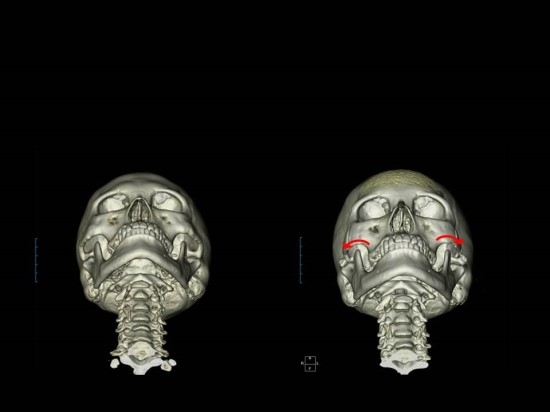
Figure 2. – Internal osteotomy method
The most important part of this type of procedure for side cheekbone reduction is that the continuity of the cheekbone running from the front to the back must be maintained.
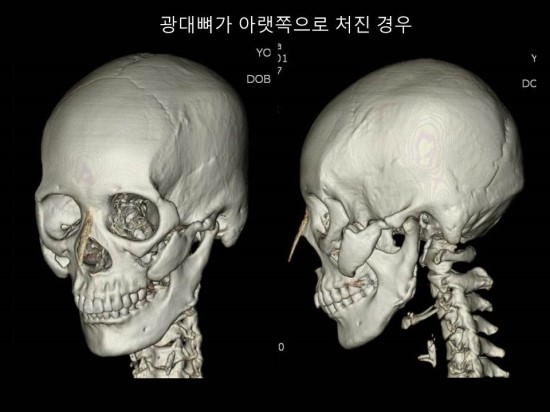
Figure 3. – Cheekbone gap
If continuity is not maintained at even one point, it can lead to part of the area appearing sunken, the front cheekbone appearing wider due to spreading, or the cheekbone sagging in the direction pulled by the chewing muscles, making the face look droopy.
By maintaining the continuity of the cheekbone that connects from the front cheekbone to the back while appropriately bringing the cheekbone arch inward, the width of the face can be reduced while appropriately preserving the volume of the front cheekbone, making it possible to expect a more three-dimensional and lively, youthful facial change.