This is a response to the questions from someone who contacted me several times through online consultation.
At first, I thought the questions were so specific and numerous that it would be time-limited to answer them one by one personally.
Instead, I thought it would be a good idea to share answers to the parts that many people are curious about all at once, so I organized everything and posted it on the blog so that many people could share it.
Many people have various questions about zygoma reduction surgery and ask me similar questions during consultations, but the parts I consider important in zygoma reduction surgery are as follows.
Whether to use a drain after zygoma reduction surgery, or whether to finish the surgery within a short time, are in some ways nothing more than very superficial and commercial marketing points.
What I think is important in zygoma reduction surgery are the following two things.
First, from the moment the surgery is completed, all responsibility for the course and postoperative appearance lies with the surgeon. Immediately after surgery, ordinary daily life (such as sleeping on one’s side or doing mouth-opening exercises) should be sufficiently possible, and the surgery should be performed in a stable and precise way so that such actions do not affect the result. That is my view.
Second, it should be possible to promise a course in which the contours of the midface gradually become more harmonious and attractive over 6 months to more than 1 year. If one is too focused on reducing the zygoma, then from immediately after surgery to 3 months later, it may feel as though the zygoma has been reduced a lot, leading to high short-term satisfaction, but as time passes, the area connected to the outer corners of the eyes may appear hollow, or the volume of the front cheekbone may disappear, resulting in a flatter appearance.
_________________________________________________________________________________________________________________________________________________________
Hello, Dr. Jeong Jae-young,
I contacted you a couple of times before on the online board..
Each time, I was grateful that you always replied so kindly!
Unfortunately, I lost the notes where I had organized your previous answers...
I’m sorry that you’re busy, but I’m sending this inquiry again after adding some additional questions.
I am currently living overseas, so this is the only chance I have to ask in detail online, so I would really appreciate it if you could answer, even if it is a bit inconvenient ~ ^^
- Questions about the surgical method
(i) Is it impossible to prevent the step-off that appears when reducing the side cheekbone?
(ii) I saw on the website that you shave the front cheekbone (including the 45-degree area).. Does that mean only the cortex is shaved while the medullary bone of the cheekbone is left intact? If so, wouldn’t the cortex regenerate and eventually make the reduction effect disappear?
In zygoma reduction surgery, there are two major effects to expect.
First, to soften the contour of the area that protrudes forward
Second, to bring the outline of the side cheekbone, which appears wide below the temples, inward to reduce the width of the face.
Among the two effects above, the most important part is bringing together the prominent contour of the side cheekbone.
In zygoma reduction surgery, if too much of the front cheekbone is reduced, the face may feel smaller immediately after surgery, but over the 6 months to 1 year that follow, the important volume of the front cheekbone can be lost, causing the face to gradually become flatter and look tired and older.
Therefore, it is most important to maintain some of the volume of the front cheekbone while refining the contour of the overly prominent area.
The side cheekbone should be narrowed as much as possible to reduce the width of the face that appears wide below the temples, so that a more three-dimensional facial shape can be expected after surgery.
My answer to your question is as follows.
If, in side cheekbone reduction surgery, the step-off does not occur at the farthest posterior part of the zygomatic arch, then there is almost no movement of the arch, so there is no change in facial width, and there is a risk of a pyramid-shaped deformity in which the face appears wider toward the back.
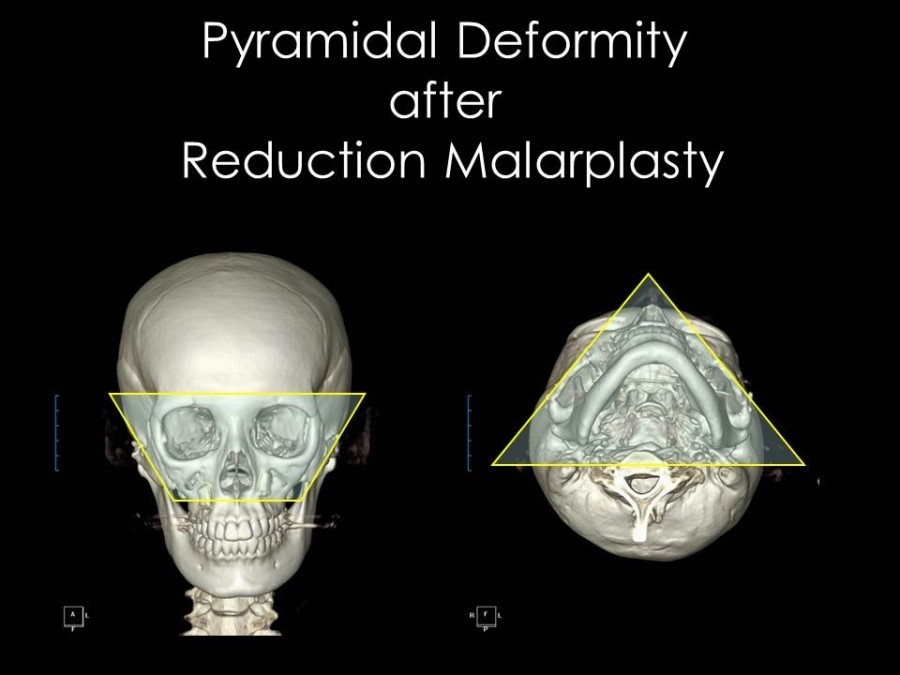
Pyramid-shaped deformity after cheekbone surgery - If only the three-dimensional and important front cheekbone is excessively reduced in zygoma reduction surgery, the face may appear more sagging and flatter over time.
In side cheekbone reduction surgery, what matters is osteotomy at the farthest posterior part of the zygomatic arch. If the zygomatic arch is cut in front of the sideburn area and a step-off occurs, a very noticeable and visually bothersome step can be seen.
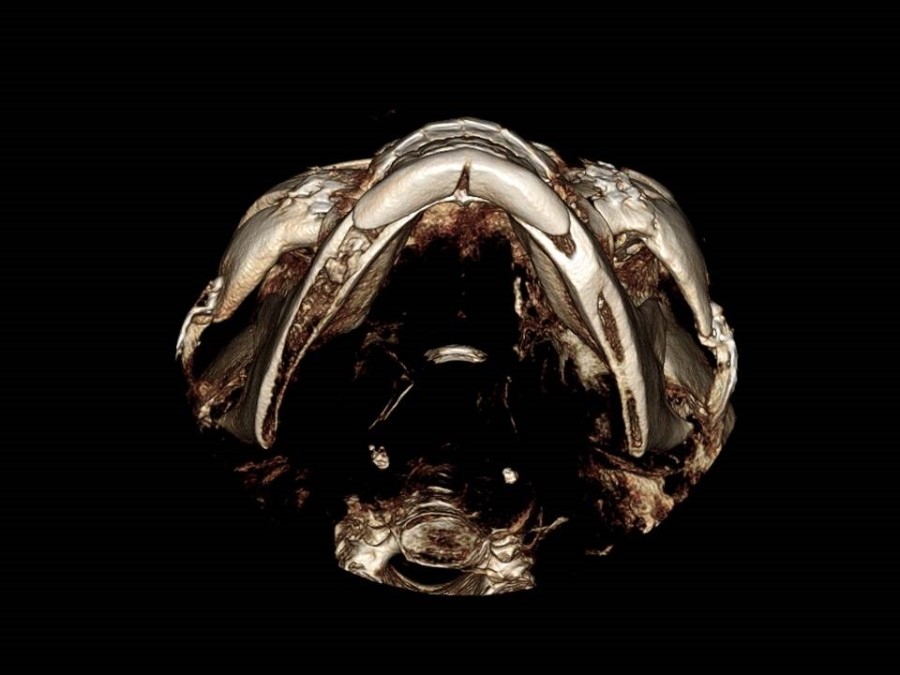
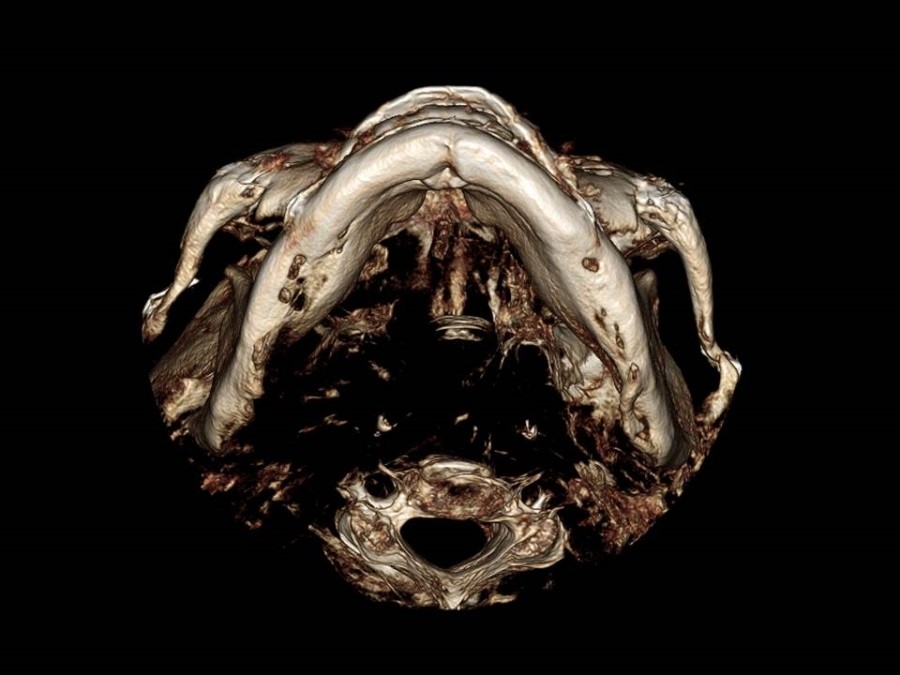
When the middle part of the zygomatic arch is cut - on 3DCT it may actually look as if the cut was made quite far back, but if a step-off is felt in front of the sideburn and a visible level difference appears, it is often the case that the farthest posterior part of the zygomatic arch was not cut.
Only when the step-off occurs behind the sideburn can facial width be reduced while maintaining continuity of the zygomatic arch without being visually noticeable.
For the front cheekbone and 45-degree cheekbone area, only the prominent parts are shaved, and based on the anterior osteotomy line, the prominent parts move inward, creating a reduction effect.
If the prominent cortical bone of the front cheekbone is shaved, the cortex does not regenerate 100%; rather, the exposed medullary bone is covered to the extent of a thin layer of cortical bone.
- After surgery, does the durability of the cheekbone itself become even slightly weaker than before surgery? Or is the durability the same as before surgery?
(i) If the front cheekbone and 45-degree cheekbone are shaved, does the bone become thinner than before and cause durability problems?
(ii) If the osteotomy is incomplete, does the osteotomy line itself cause durability problems? You said that even the osteotomy line disappears after 2 to 3 years—does that mean the durability is weak until then?
Shaving off an overdeveloped area in the front cheekbone does not cause any problem with the durability of the bone.
The weakest part of the zygomatic complex is the middle part of the zygomatic arch. In general, when the zygomatic bone receives traumatic impact, the part that breaks is the middle part of the zygomatic arch. Therefore, the most important part of zygoma reduction surgery is to maintain the continuity of the zygomatic arch, and the osteotomy should be performed at the farthest posterior part, not at the weakest part of the zygomatic bone.
After incomplete osteotomy, even after only 2 weeks, the incomplete osteotomy site of the zygomatic bone has already united by more than half. Therefore, I explain that immediately after zygoma reduction surgery, sleeping on one’s side or practicing mouth-opening exercises causes no problem at the surgical site.
Below is a 3DCT taken 12 days after surgery of a person who received zygoma reduction surgery from me.
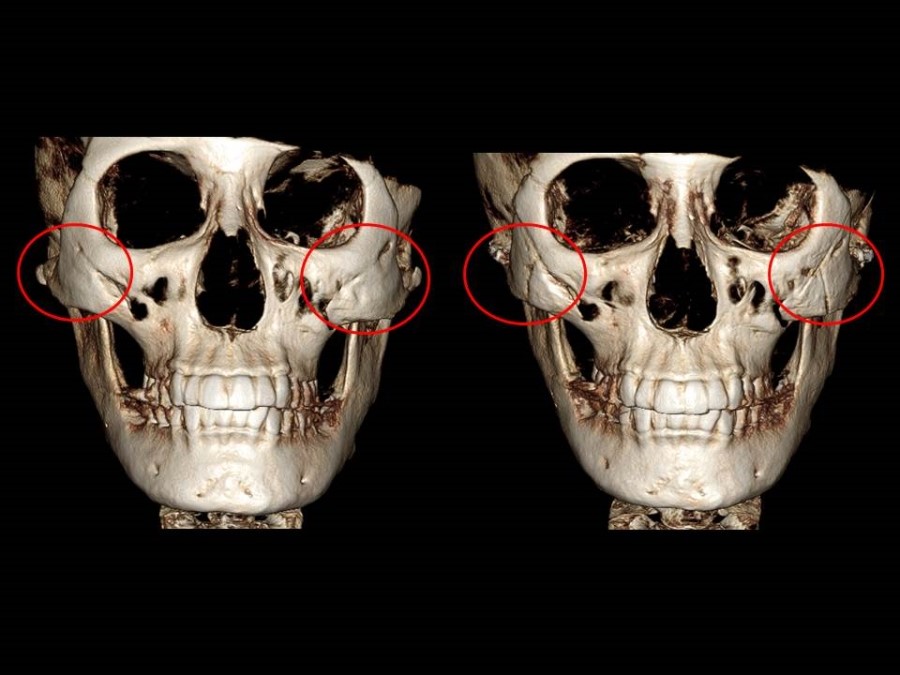
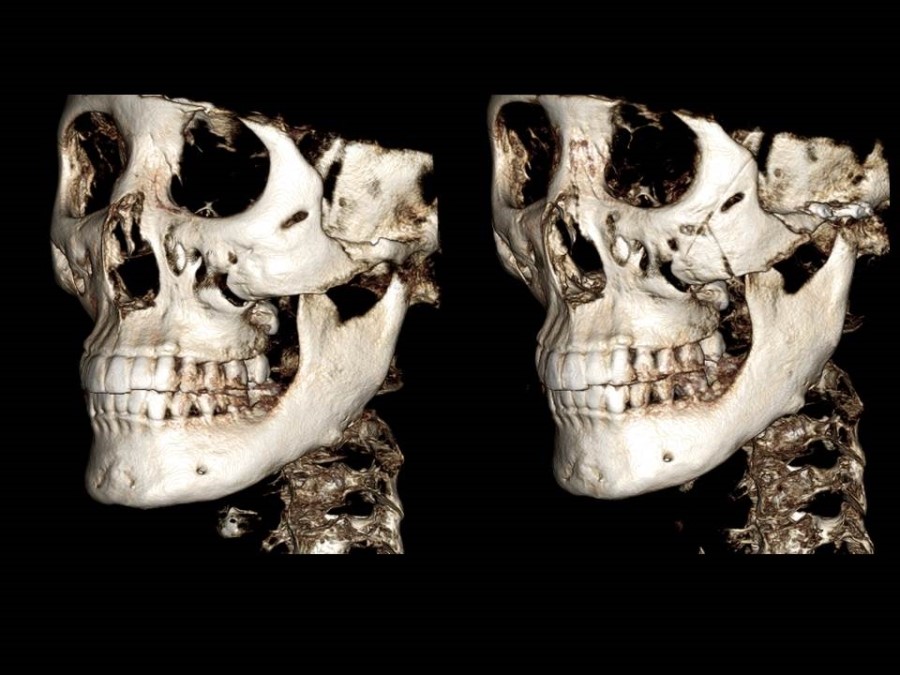
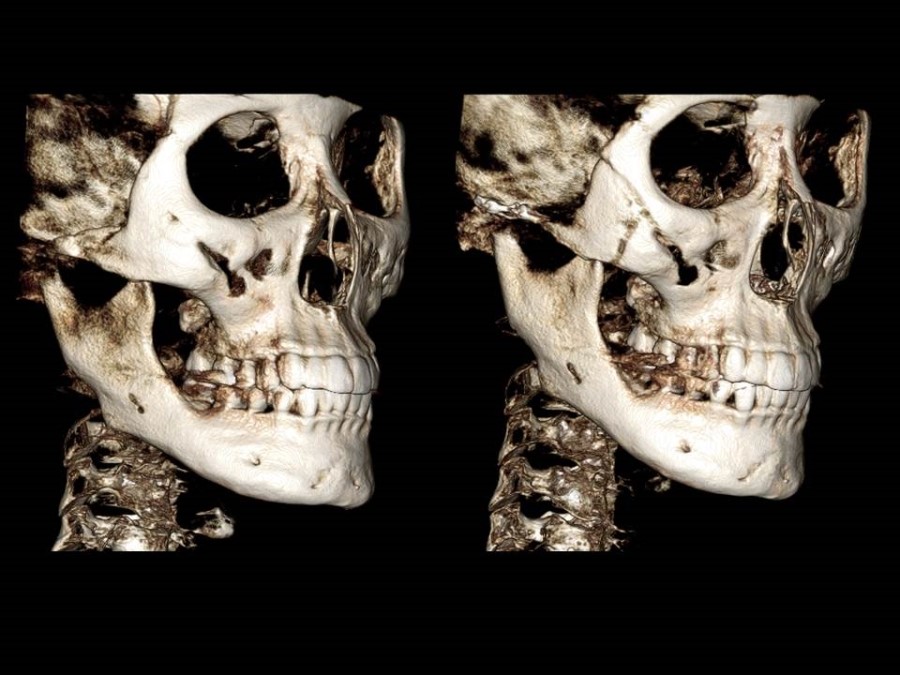
These are the preoperative and 12-day postoperative 3DCT images of a person who had undergone zygoma reduction surgery at another clinic 2 years earlier but came to me for revision surgery because the side cheekbone reduction effect after surgery was minimal. You can observe that the so-called 45-degree cheekbone area (inside the red circle in the frontal view) has moved inward based on the osteotomy line, and even on postoperative day 12, the anterior osteotomy site is connected very stably with bone.
- How long do I need to stay in Korea to undergo the surgery? In order to confirm that bone union has been completely and successfully completed, after how many years should I return for follow-up?
If this is your first zygoma reduction surgery with me (not revision surgery), a one-week stay is sufficient.
You do not need to worry at all about bone union.
- How much does the surgery cost? 5. Is there an additional consultation fee?
(i) Is the cost of the CT taken during consultation and follow-up included? I would like to have a CT first and then receive the consultation..
(ii) How much is the additional medication cost?
My current zygoma reduction surgery cost is 5 million won, but from winter I plan to increase it to 6 million won.
The surgery fee includes all costs, such as hospitalization, anesthesia, and 3DCT imaging during follow-up, and the only additional cost is the medication purchased at the pharmacy when you are discharged after surgery.
I think the additional medication cost will be about 30,000 to 40,000 won.
For first-time surgery rather than revision surgery, I do not take a 3DCT during consultation.
This is my treatment philosophy, based on concern about the overly indiscriminate use of 3DCT these days. If you still want to have a 3DCT taken before consultation, the imaging fee is 50,000 won, and if you decide to proceed with surgery, it will be included in the surgery fee.
- How long does swelling last?
Postoperative swelling varies greatly from person to person, and the typical swelling lasts about one week to ten days.
In about 30% of the people I operate on, there may be bruising around the eyes after surgery, and if bruising around the eyes occurs, it disappears cleanly within 3 weeks after surgery.
- How large is the incision site? Will there be a scar left at the incision site?
My zygoma reduction surgery is performed through an intraoral incision and a sideburn-area incision.
The sideburn-area incision is about 2 cm long, and most of it is located inside the sideburn. After 3 to 6 months, even I, the surgeon, have difficulty finding the surgical mark.
- When should postoperative union be checked? Will it be checked with CT?
If you take a follow-up CT 2 weeks after surgery, you will see that there is no need to worry at all about the condition of the bone at the surgical site.
- When should the final union check after surgery be done? Will it be checked with CT?
I think this is a repeated question from the previous ones, so I do not think a separate answer is necessary.
- When will I be able to chew enough to eat regular meals? When should I start mouth-opening exercises?
I recommend drinking milk or juice, or other drinks without solids, for about 3 days after surgery. After 3 days, eat soft foods such as porridge or rice gruel, and from the 5th day, start practicing regular meals that are easy for you to digest.
Mouth-opening exercises are best done comfortably starting on the 5th day after surgery.
- When can I chew without any restrictions as before surgery?
Depending on the individual, their adaptation and effort, but in general this is possible in about 2 weeks to one month.
- Will I be unable to speak properly for a while after surgery? How long does it take before speaking becomes comfortable again?
Speaking is fine from immediately after surgery, and if you make the effort yourself, there is no problem at all.
- When can I start going to the gym (including lifting heavy weights)?
I think it is fine to go to the gym, including heavy weight lifting, from about 1 week to 2 weeks after surgery.
- Arch fixation screws
(i) Is there any possibility that the fixed screws will shift or go wrong?
(ii) What kind of screws are used for fixation?
(iii) I live overseas and need to visit Korea, and I tend to fly frequently. If metal screws are used, will they be detected at airport security? I think it would be awkward to explain every time at the metal detector..
(iv) Can dissolvable screws be used? Are dissolvable screws safe?
I use metal fixation devices made of titanium for the arch fixation area, and because I check the exact position and fix them firmly, you do not need to worry about the fixation going wrong.
The metal fixation material in the arch area does not cause any problem at metal detectors or airport security checkpoints.
Dissolvable fixation devices do not have enough strength to firmly fix the zygomatic arch in the correct position.
- Will there be bruising on the face after surgery? If so, how long does it take to go away?
If bruising occurs after surgery, it will disappear within 3 weeks after surgery.
- Will I need a facial compression band, a drain, or a urinary catheter after surgery?
If only cheekbone surgery is performed, I do not use a facial compression band, but if you want one, there is no harm in using it.
In all surgical procedures, it is standard to use something called a drain to prevent blood from collecting internally in order to reduce swelling and infection at the surgical site.
If you want, you do not have to wear a drain, but the swelling may last a bit longer; however, I use a drain for about one day based on principle.
My view is that not using a drain is somewhat of a shameful sales tactic.
I do not use a urinary catheter.
- I heard that there may be problems with nerves and facial sensation after surgery.
(i) Is there a 100% chance that sensation after surgery will not be the same as before surgery?
(ii) Are there cases where sensation does not return? (iii) How long does it take for sensation to return?
In zygoma reduction surgery, the terminal branches of the sensory nerves that connect from the cheekbone area to the skin are cut and then grow back over time.
After surgery, sensation in the skin of the front cheekbone area may become dull for a certain period, but in most cases it recovers after about 3 to 6 months.
- Is the pain severe after surgery?
Sensitivity to postoperative pain varies greatly from person to person.
Some people say that even 2 to 3 hours after surgery, when asked, they feel no pain at all, while others say that the surgical site and throat hurt a lot.
Pain may exist to some degree for about one night.
Shaving the bone does not cause any sensation or pain from the bone itself.
Rather, it is pain felt due to swelling at the surgical site.
- Besides the before-and-after photos on the website, are there any additional before-and-after photos you could send or show me? ^^
Sorry to trouble you with such detailed questions ㅠ I’m asking like this because I want to minimize the time needed for consultation and similar matters when I visit Korea ㅠ
Thank you always for your kind answers.. I will come see you when I visit Korea ~
Thank you very much