Many people who are concerned about facial contouring surgery worry about one thing in particular: cheek sagging.
Then, is cheek sagging an inevitable phenomenon after facial contouring surgery?
What causes cheek sagging?
Can it be prevented?
I will explain these points below.
In general, when performing facial contouring surgery to change the contours of the facial bones, the periosteum surrounding the bone is peeled off (separated from the bone), and then the bone contour is refined.
This periosteum is connected to the muscles, subcutaneous fat layer, skin, retaining ligaments, and various connective tissues.
After the shape and position of the bone change, as the swelling settles over a certain period, the separated periosteum is covered back over the bone.
Even if the size of the facial bones has been reduced, if there is a proper change in position in the right direction, the muscles may shrink again during the process of periosteal reattachment, and elastic fibers in the dermis may also act so that the skin area can be reduced to an appropriate extent.
This process is called redraping, in which the soft tissues covering the bone are repositioned over the changed shape of the facial bones.
Therefore, if facial contouring surgery is performed in an appropriate direction, cheek sagging is relatively rare.
Then, I will explain the causes of cheek sagging that can occur after facial contouring surgery.
In facial contouring surgery, when the actual position of the bone is moved to a lower level than its original position
In facial contouring surgery, when the amount of bone volume reduced is greater on the lower side
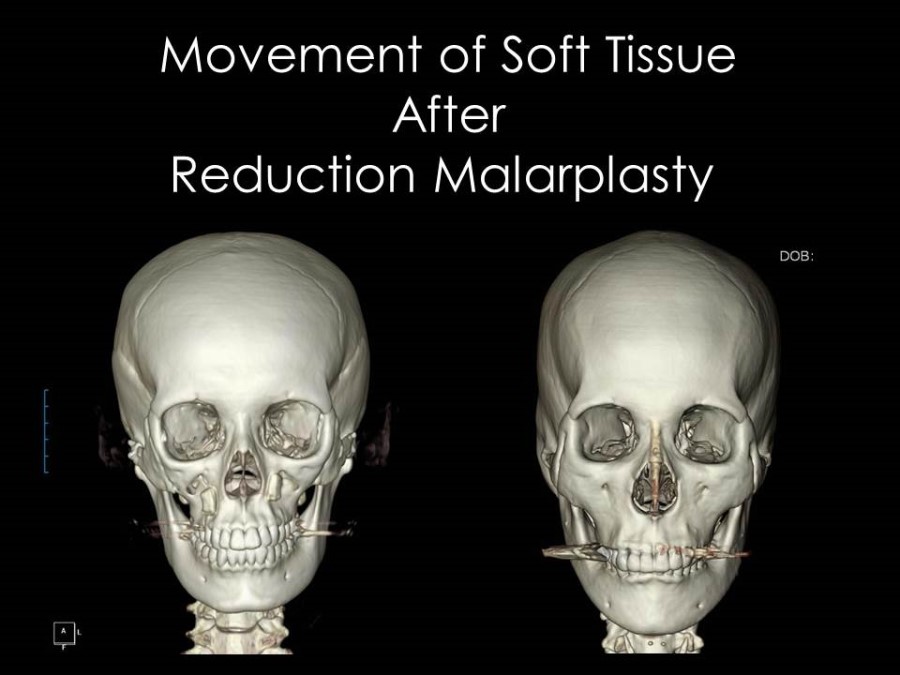 The 3DCT above is an image taken after zygoma reduction surgery, showing the state of the bones after surgery performed by different methods.
The 3DCT on the left shows a state in which the 45-degree zygoma, including the front cheekbone, has been cut away significantly and reduced forward.
The 3DCT on the right shows a state in which the volume of the front cheekbone has been preserved while the lateral cheekbone (the posterior part of the zygomatic arch) has been moved inward significantly.
If the position of the bone changes in these different ways, the direction in which the soft tissues covering the bone move over time is as follows.
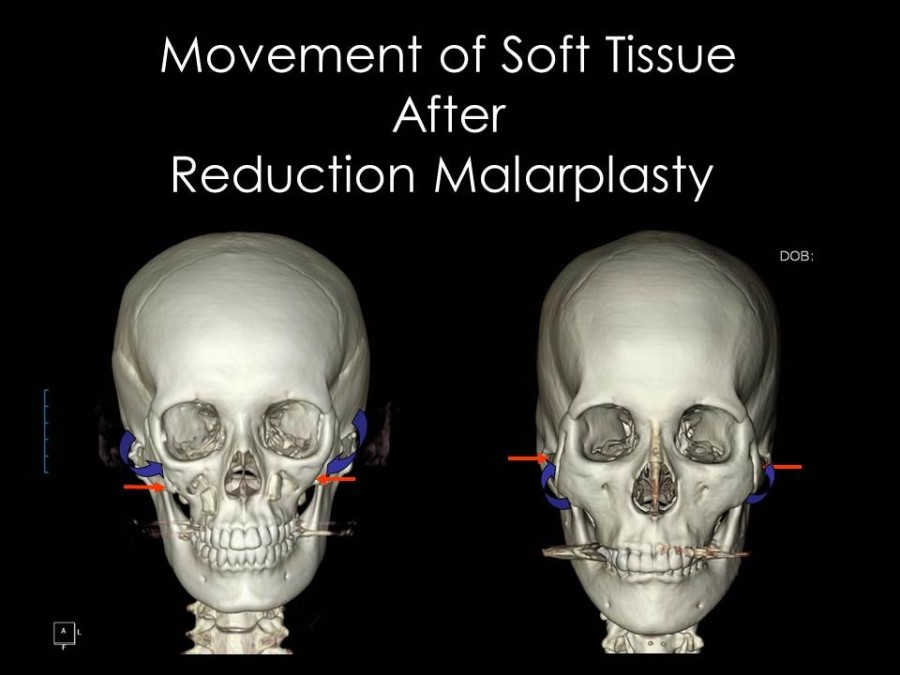
If the front cheekbone area is reduced too much, when light falls on the face, there is a risk that the prominent, rounded volume of the front cheekbone may be reduced too much, making the face look flat and planar. In this case, as shown in the left image, the direction of movement of the soft tissues covering the bone shifts to the anteroinferior direction (forward and downward).
However, if the widest part of the zygomatic arch, the posterior area, is moved inward as much as possible, the soft tissues will move posterosuperiorly (backward and upward) over time.
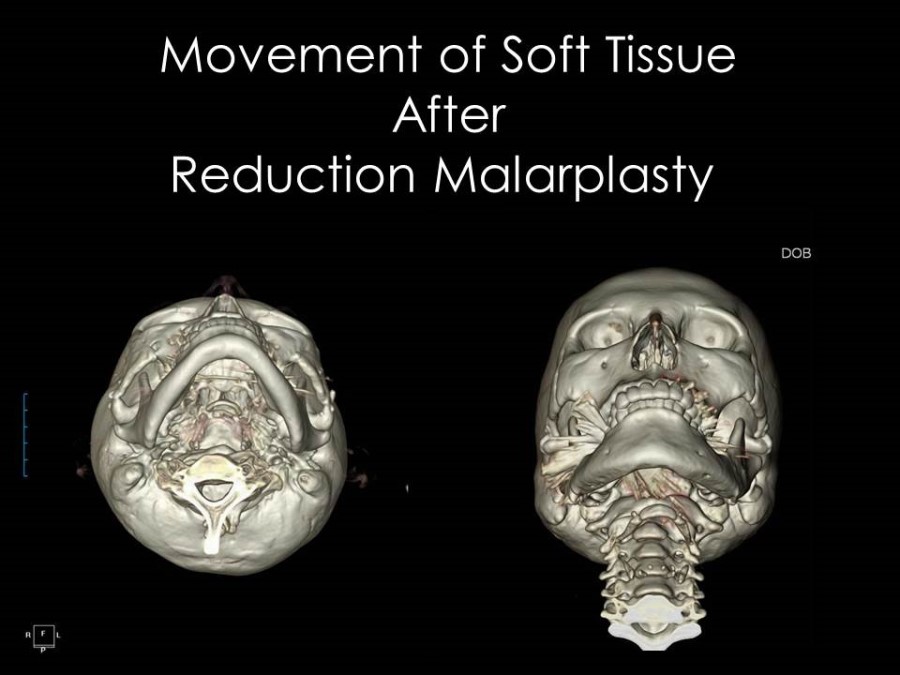
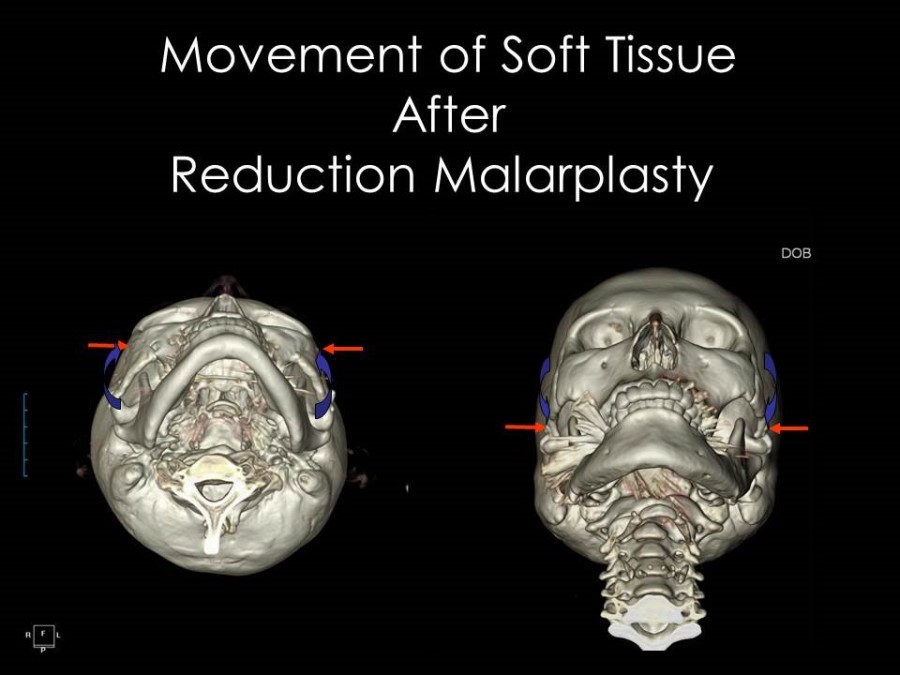
In facial contouring surgery, when the contour line of the bone is not smooth and continuity is broken
Therefore, to prevent cheek sagging after facial contouring surgery, it is important to maintain the continuity of the facial bones, and a proper understanding of the direction of bone movement (vector) is necessary.