A Step Away from the Trend
Aesthetic direction
When I chose the location around Gyodae Station in Seocho-dong for my dental clinic, what I had in mind was a strong wish that, while running a dental practice, I would not become too dependent on advertising. Of course, it is impossible not to advertise at all, but I thought that relying on advertising would eventually pull us into a swamp of price competition rather than quality, and that it would be swept up in a passing trend. Because my own aesthetic direction is closer to classic than trend, and I prefer natural beauty over artificial beauty, I decided to set up just a step away from Gangnam Station.
For the same reason, I visited buildings in the Apgujeong, Sinsa, and Cheongdam-dong commercial areas, but the reason I finally settled near Gyodae Station was also because of that. Geographically, I also liked the location for its heritage as a traditional affluent area, Seocho-gu, rather than Gangnam-gu.
At present, the trend in aesthetic treatment in Korea is led by "pure white" and "no-prep veneers," and the places I mentioned earlier, rather than Gyodae Station, are more sensitive to trends and also fit the consumption context of the general consumer base, so as an aesthetic dentist pursuing beautiful treatment results, I could not leave those places out of consideration. However, I also had a fundamental question: is so-called "aesthetic" treatment in Gangnam Station really truly "aesthetic"? Is it treatment that meets my standards?
I think subtle cosmetic work, subtle beauty, is harder to achieve than meeting an artificial and mechanical standard of aesthetics. That is why, as a medical professional, it is even more rewarding. Throughout history and across cultures, there have always been efforts to define beauty by a universal and uniform standard, but there seems to have been little reflection on whether an arithmetic rule derived from the "average" of a beautiful face, like the golden ratio, is truly beautiful. I think it is more natural and beautiful to find "balance" in the relationship between each person’s facial shape, smile, and arrangement of teeth.
But a place that does not stagnate
Why I took the risk of competition
The reason I like resin treatment is that I enjoy directly creating every stage of the dental treatment process in front of my eyes—from designing the tooth shape, matching the color, reproducing the anatomical form, to adjusting the occlusal pattern. In other words, it allows me to feel, to the fullest, the sense of self-efficacy that comes with being a medical professional and specialist in the oral-maxillofacial-facial area. Anterior resin buildup has a long learning curve and requires highly skilled hand technique, so it is also a treatment that dentists either strongly like or strongly dislike. That is what makes it even more appealing to me.
I am good at resin, but that does not mean I think resin is always the best method. When orthodontics is the first choice, we plan treatment with orthodontics; when a crown is needed, we use a crown; when a veneer seems appropriate, we plan veneer treatment. In this way, although our clinic is a step away from Gangnam Station, opening a practice not too far away while taking on the risk of excessive competition also clearly had the purpose of interacting with capable directors, getting stimulated, and ensuring that we do not stagnate. I thought it matched my usual personality, which is always searching for better methods and thinking things through instead of becoming arrogant and believing I am the best.
I think the Gangnam location has become, in a conceptual sense, a place where you can encounter the latest technology the fastest. This applies not only to medical technology, but also to the consumer expectation that almost all trends in Korea will be reflected there as quickly as possible. To some extent, I agree with that as well. I think I, too, benefit from that image to some degree. Just by being in Gangnam, I am exposed to so many things and can easily access new developments. Fortunately, as I hoped, I am also learning a great deal from senior directors.
Medicine should not end as a passing trend.
Treatment philosophy
In the book The Sense of Work, I read that a brand must have a "philosophy." I have also always believed that if a brand is to be loved for a long time, then more than simply wrapping things up neatly so they look pretty, the owner’s approach to the "business" must be infused with a philosophy of life. Like many directors, I also have various principles and ideas about dental treatment, but one that fits today’s topic is this: "Medicine should not end as a passing trend."
A few years ago, the Apgujeong area was in an uproar over a clear aligner clinic scam, and not long ago there were also cases where several implant clinics near Gangnam Station suddenly closed. When you look at how they all persistently pushed customers into prepayment by promising steep discounts until the day before filing for closure, it is truly infuriating. The reason the same thing keeps happening is the limitation of dental clinics that rely on advertising inducement through excessive discounts. A clinic sustained only by advertising has no choice but to suffer a major blow when a competitor appears, its profit structure deteriorates rapidly, and it inevitably moves toward closure.
This happened long before I met her, but my wife was also a victim of the clear aligner scam, so even more strongly I came to believe that medicine should not drift in that direction (toward depending on advertising). That is not only for the patients who will meet me, but also for myself. After all, the greatest beneficiary of running a financially stable business is the business owner himself. At the same time, there is no need to separately explain that this is also a good thing for patients who trust me for a long time and entrust their health to me.
The work of continuously proving myself
The owner's attitude
These thoughts of mine must ultimately be proven through results. And in every moment of life, they must maintain consistent continuity.
It is not [refutation; 反證] but [circumstantial evidence; 傍證]—meaning, "evidence that does not directly prove a fact, but indirectly helps prove it by clarifying the surrounding situation; or that evidence itself." It is a way for people to help infer the answer to the question, "What kind of dentist are you?" through the attitude I show in everyday life, not just as a dentist.
From this position, I will keep proving myself over a long period of time. It is hard, but I think it is worthwhile.
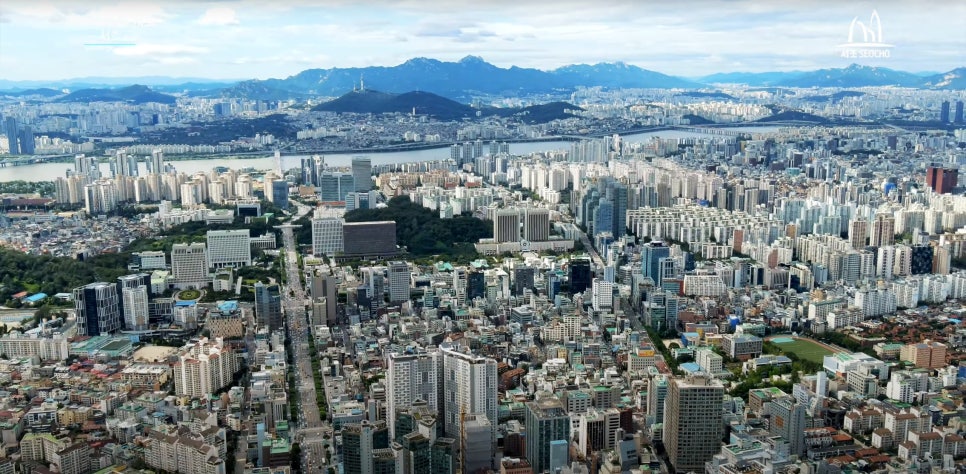
Drone aerial photo of the Seocho-dong area