I think all the doctors reading this have probably had the same experience.
I used to think I was pretty good at this too, but one day while studying different cases and looking at case photos, I found myself wondering, “How on earth does this person do it?” I was the same way. So this weekend, I attended a lecture and hands-on workshop by Dr. Felipe, a world-renowned lecturer on resin restorations.
In fact, since opening my practice, I have devoted a great deal of time to resin restorations. Rubber dam isolation, adhesive protocols, internal structure design for restorations (layering), and contouring to reproduce form. It took a long time to understand that flow as a single system, and now I treat patients with a certain level of confidence.
So why did I still go to another lecture?
Many doctors naturally laugh and say, “Doctor So-and-so, what more are you trying to learn by coming all the way here?” But the funny thing is, those doctors are all highly skilled themselves. I think going to lectures to study is not about “confirming that I already know everything,” but about “discovering what I do not know.”
If you stay only in the treatment room, you become trapped in your own way of doing things. You start thinking your habits are principles, and your cases are the standard. That is why I try not to neglect learning. If I want to show my clinical work to others and persuade them, I have to keep reviewing and reflecting. In the end, the process of attending lectures becomes the biggest form of study for myself.
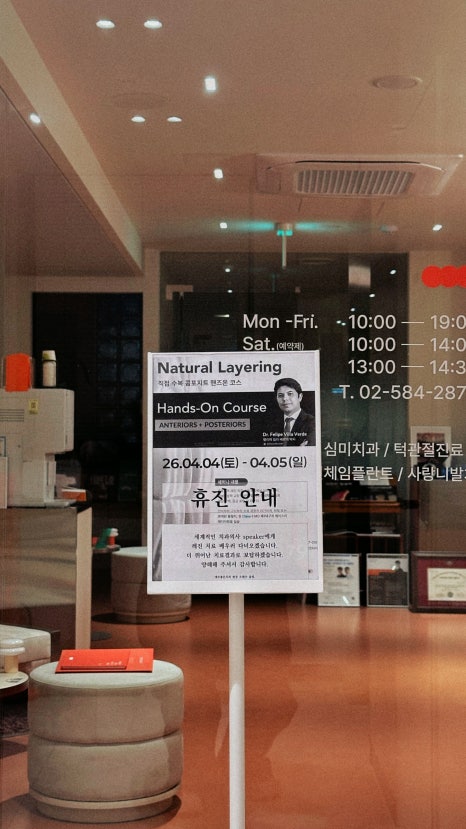
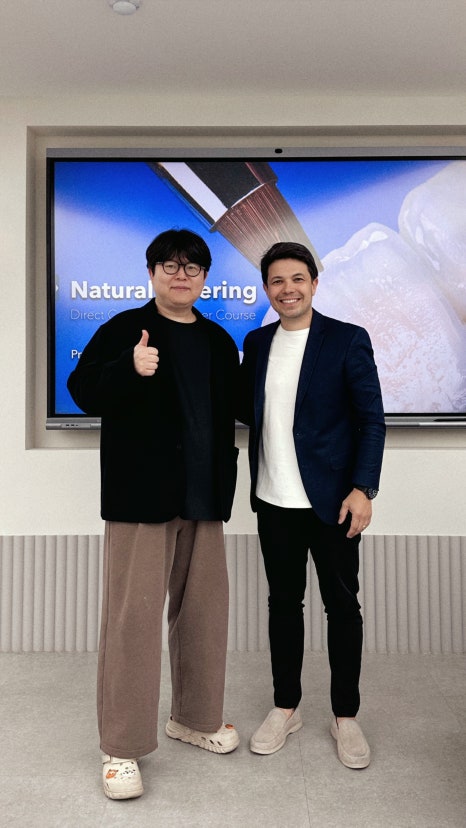
In fact, I gave up my Saturday clinic to attend the lecture. It was a really difficult decision to take a day off from patient care. A world-class lecturer had come to Korea to give a talk, and I did not want to miss even a single thing.
What did I actually gain from Dr. Felipe’s lecture?
The lecture was divided into two main parts. Saturday morning was theory, and the afternoon was a hands-on session where we tried it ourselves.
What impressed me most in the theory session was the perspective of viewing resin restoration not as a “material problem,” but as an “observation problem” or a “process problem.” When people are disappointed with the result of a resin restoration, many blame the material. They ask, “Is this resin a bit off in color?” or “Is the bond the problem?”
But in reality, most of the time, something somewhere in the process has collapsed.
Isolation may not have been perfect, the bonding layer may not have been sufficiently established, or only the shape may have been built up without an internal structure... And more fundamentally, the real issue may be that too much attention was not paid to the step of “observing” the natural tooth. I truly related to this part.
Dr. Felipe emphasized a step-by-step protocol for resin restorations: first, identify and decide what needs to be considered, complete that stage properly and on time, and then, while moving on to the next step, no longer worry about the previous one. I also think the same way and have worked in that manner to some extent, of course, but Felipe seemed to be even more exact about separating each STEP.
The lecturer’s demo was especially good.
Actually trying with your own hands what you have only understood in theory is an entirely different experience. I always feel that understanding something in my head and remembering it with my hands are separate things. It is like being able to read sheet music does not automatically mean you can play the piano.
Being able to stand next to a world-class lecturer, watch how he moves his hands, how he holds instruments, and how he times his handling of the materials, and then try to imitate it yourself is a valuable experience that can never be replaced by video.
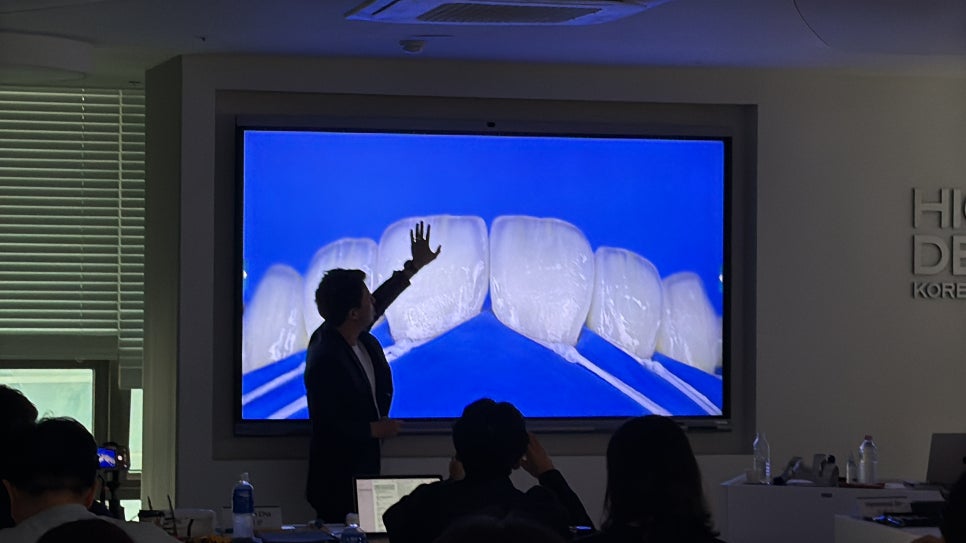
From the lecture that continued from the morning of the second day, I watched Felipe create the detailed translucent layers of an anterior tooth, and the way he applied coloring with a fine brush really looked like the work of a “craftsman” or an “artist.” I had already thought that what I do is similar to the work of an artist, but when I saw the beautiful internal structure of the tooth completed with delicate brushwork, I could not help but be impressed.
I came back after the weekend deeply inspired, and from now on I want to keep working even harder to create resin veneers that are even more like natural teeth.