Hello, I am Dr. So Hyun-soo, director of Jaejoo Good Dental Clinic.
I am a dentist who is deeply committed to preserving natural teeth.
Have you experienced a situation like this?
I feel frustrated too whenever I say this to patients in the treatment room.
You received internal bleaching three times at another dental clinic, but your tooth did not brighten at all.
You may have been concerned for a long time about your front tooth becoming dark after root canal treatment.
You found the courage to visit a dental clinic and decided to receive bleaching treatment.
Once, twice, three times. But when you felt that nothing had changed, you may have felt completely lost.
I know that feeling because I often see it in the treatment room.
“Is my tooth the only one that cannot be treated?” “Is this tooth simply impossible to brighten?”
Some patients clearly come to see me having given up halfway, while still holding onto some doubts.
To give you the conclusion first, there was a reason the treatment had not worked.
And if we can identify that reason, we can also address it.
Let me explain that today.
Why does bleaching fail?
To understand why internal bleaching—bleaching the inside of a non-vital tooth that has undergone root canal treatment—did not work, we first need to understand how this treatment works.
The reason a front tooth that has undergone root canal treatment becomes dark is that debris remaining inside the root canal may decay, or pigments may penetrate into the internal structure of the tooth.
Internal bleaching works by placing bleaching medication directly into the space inside the tooth, whitening the discolored material from within.
The principle is similar to filling the inside of a stained cup with a cleaning agent to remove the stain.
But there is a key point here.
The bleaching medication must properly reach the inside of the tooth.
If something is tightly blocking the inside of the cup, the cleaning agent cannot reach the stain.
Internal bleaching works the same way.
If the resin placed during root canal treatment—the filling material—is not removed sufficiently, the bleaching medication cannot reach the discolored areas inside the tooth.
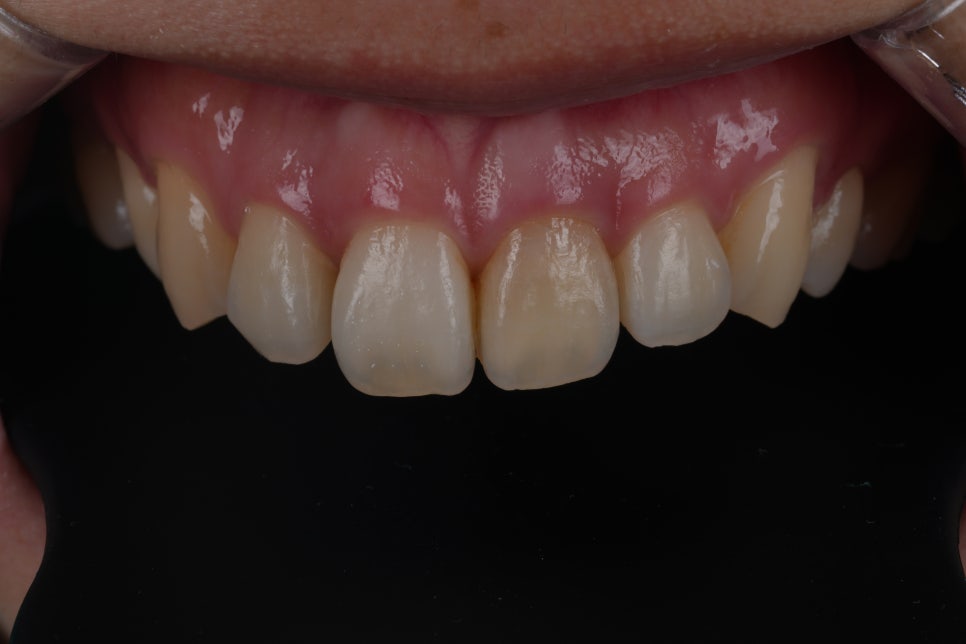
What was the real reason it did not work even after three treatments?
When I first saw this patient, I had an intuition because the tooth had already undergone root canal treatment.
The patient had received internal bleaching three times at another dental clinic, but there had been no improvement at all.
And the tooth had previously undergone root canal treatment?
This was not a tooth that could not be bleached.
Rather, the bleaching medication was not reaching the proper location.
The most likely cause was residual core resin.
After root canal treatment, a small opening is made in the back of the tooth to treat the root canal, and the opening is then sealed with resin.
To perform internal bleaching, that opening must be reopened and enough of the resin inside must be removed to create space for the bleaching medication.
However, even when the resin appears to have been completely removed to the naked eye, it is more common than expected for some to remain in various corners.
Residual resin that cannot be seen with the naked eye had been acting as a barrier preventing the bleaching treatment from working.
What does it mean to check for residual resin using Q RAY?
When treating this patient, I used a device called Q RAY.
When a special fluorescent wavelength of light is directed at the tooth, Q RAY allows restorative materials such as resin—the filling material—to be distinguished in a different color from the natural tooth structure.
Simply put, just as fluorescent marks become visible under ultraviolet light, the location and extent of residual resin that cannot be seen with the naked eye can be visually identified.
When I checked this case with Q RAY, the findings were exactly as expected.
Resin remained deep inside the root canal treatment space without having been removed.
The resin was blocking the space where the bleaching medication needed to go.
So, while checking with Q RAY, I carefully removed the residual resin.
Once the space had been sufficiently cleared, I filled it with bleaching medication, and this time the result was different.
I replaced the bleaching medication while checking the tooth at one- and two-week intervals, and the tooth gradually began to brighten.
How is internal bleaching performed?
Unlike conventional bleaching, internal bleaching takes place from inside the tooth, so the process is somewhat different.
First, the opening made for root canal treatment is reopened, and the inside is cleaned. Residual resin, remaining nerve debris, and discolored material are removed as thoroughly as possible. At this stage, it is important to use Q RAY to confirm that no residual material remains.
Second, the inside is filled with bleaching medication and sealed with a temporary filling. The patient can simply leave the clinic afterward.
Third, the patient returns about one week later, and the bleaching medication is replaced. This is usually repeated two to four times, although the number varies depending on the condition of the tooth.
Fourth, once the tooth is considered sufficiently bright, the bleaching is finished and we wait another one to two weeks. This waiting period is necessary because the bleaching medication works by generating oxygen. If oxygen remains inside the tooth when the resin is bonded, the resin may not adhere properly to the tooth.
Finally, after the oxygen has dissipated, the opening is permanently sealed with resin.
The entire process may take as little as four to six weeks, while some cases take approximately two to three months. This varies depending on the condition of the tooth, so it is difficult to give a definite answer in writing. It must be assessed in person.
What comes next if something still feels lacking after internal bleaching?
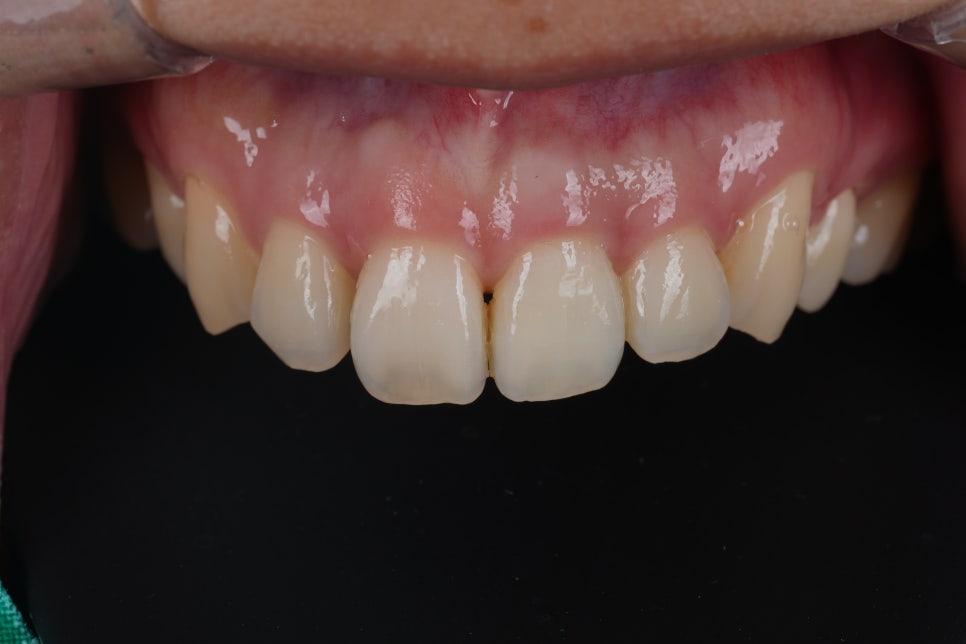
In this case as well, if you look at the photos after the bleaching was completed, you can see that the color matched the surrounding teeth quite well.
However, in some cases, even when the bleaching has worked well, the shape of the tooth may already be somewhat altered, or discoloration may have developed along the margins of an old resin restoration.
In such situations, a resin veneer—a treatment that recreates the shape and color on the front surface of the tooth with resin without reducing the tooth—may also be considered.
For this patient as well, we had discussed treating the tooth with a resin veneer if the bleaching did not work this time either.
But as you can see,
The treatment was completed with internal bleaching alone.
In closing
The content of today’s post is not a medical advertisement. Nevertheless, it was written in compliance with the Medical Service Act and the Ministry of Health and Welfare’s guidelines for medical advertising. This valuable material was prepared to help dental clinic directors understand the subject and to provide accurate information. Please decide on a specific treatment plan or diagnosis only after having a thorough consultation with your treating medical professional. The reason internal bleaching was ineffective may differ depending on the tooth and the condition of previous treatment, so a thorough diagnosis—including checking for residual material—must come first. Rather than making a decision based only on information from the internet or cases involving people around you, we recommend finding the most suitable approach for your situation through a careful diagnosis.
There have also been cases of confusion due to recent issues related to the Medical Service Act. However, we plan to pursue legal action together with our attorney if false reports or complaints without a basis are filed. We will continue to do our best to provide reliable information.
Today’s summary
In one sentence: The biggest reason internal bleaching fails is that residual resin inside the opening made for root canal treatment has not been removed, preventing the bleaching medication from reaching the inside of the tooth.
| Item | Details |
|---|
| Why is internal bleaching ineffective? | In many cases, the resin inside the root canal treatment space has not been removed sufficiently, so the bleaching medication cannot reach the inside of the tooth. |
| What role does Q RAY play? | It is a device that uses fluorescent wavelengths to visually identify the location and extent of residual resin that cannot be seen with the naked eye. |
| How many internal bleaching treatments are needed? | The medication is usually replaced once a week for two to four sessions, but this varies depending on the condition of the tooth and requires an individual diagnosis. |
| Why can’t resin be bonded immediately after bleaching is completed? | If oxygen generated by the bleaching medication remains inside the tooth, it can interfere with resin bonding, so we wait one to two weeks. |
| What can be done if the color is still unsatisfactory after bleaching? | If the shape or color remains unsatisfactory after internal bleaching, a resin veneer may additionally be considered to improve the front surface of the tooth. |