Multiple diastema resin restoration in the mandibular anterior region —
How to Allocate the Space
I am Dr. So Hyun-su of 재주좋은치과.
Today, I would like to discuss a type of case that I encounter fairly often in my practice, but that is more challenging than it initially appears when you actually attempt to treat it.
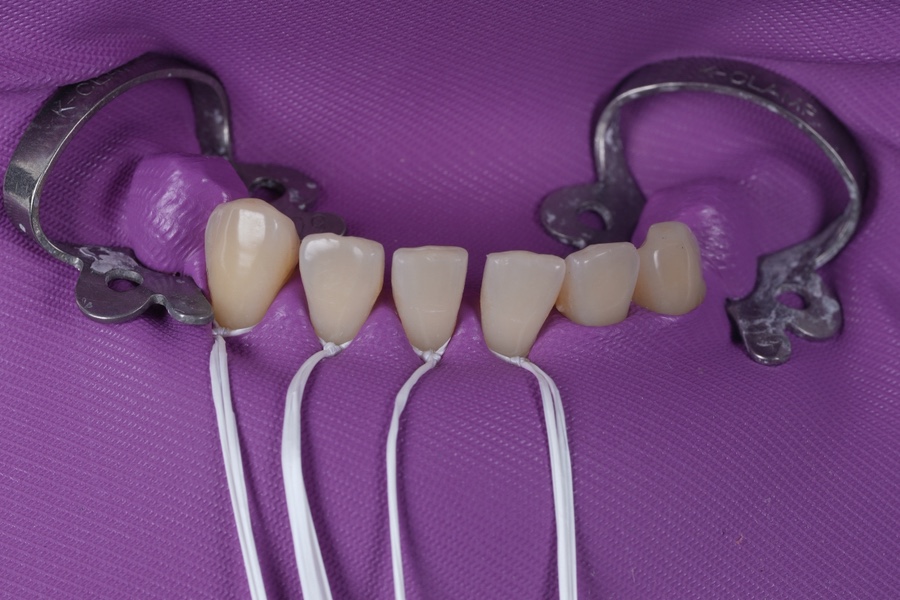
This is a case involving multiple spaces between the lower front teeth.
When you first encountered a case like this, how did you approach it?
At first, you probably viewed it quite simply.
> “There are four spaces, so wouldn’t it work to fill half of each one from the teeth on either side?”
That kind of mechanical approach is certainly quick and easy.
However, when you look at the result, there is always something that feels slightly awkward.
The spaces are closed, so why does it look strange?
That question bothered me for a long time.
Why doesn’t the method of filling each side halfway work well?
Our brains perceive teeth in a much more sophisticated way than we might expect.
Especially when small, narrow teeth are lined up together, as in the mandibular anterior region, we unconsciously detect the width ratio of each tooth and the symmetry of the overall dentition.
If you mechanically divide and fill the spaces in half like Lego blocks, the proportions of each tooth become awkward.
It is like forcing pieces together in a two-piece puzzle.
The mandibular anterior region is particularly important because there are four lateral incisors grouped together, and the teeth located between the central incisors and the canines are naturally relatively small.
If you simply fill the spaces halfway, teeth that are already narrow may become even smaller, or may become awkwardly wide instead.
So how should you begin allocating the space?
The starting point is to first visualize the completed result in your mind before treatment.
> “What proportions should these teeth ultimately have to look natural and symmetrical?”
Only after answering this question can the space be allocated meaningfully.
When I examined this case, the first thing I did was calculate the total amount of space.
Rather than looking at each space individually, I assessed the total amount of excess space in the entire dentition.
I then worked backward to determine how much each tooth needed to be widened to achieve natural proportions.
Instead of simply using “half of the adjacent space,” the first step is to determine “how many millimeters wide should this tooth ultimately be to look natural?” and then distribute the space accordingly.
Why Should the Canines Be Used Strategically?
This is the point I would most like to emphasize in this post.
The canines occupy a rather unique position among the teeth.
People generally do not find it particularly unusual if the canines are somewhat large.
This is because the canines naturally have an independent form and a pointed, triangular shape. Even if they are made slightly wider, the brain tends to accept them as simply being shaped that way originally.
By contrast, even a slight change in the proportions of the small front teeth is immediately noticeable.
These characteristics can be used strategically.
The approach is to have the canines absorb as much of the total space as possible, thereby reducing the proportional burden on the remaining small front teeth by that amount.
Even if the canines are restored slightly wider, they do not look unnatural, so the overall dentition can ultimately be finished in a much more natural shape.
That is exactly what we did in this case.
By actively using restoration of the proximal surfaces of the canines, we reduced the space burden on the smaller teeth toward the center.
How Was the Shade Matching Done?
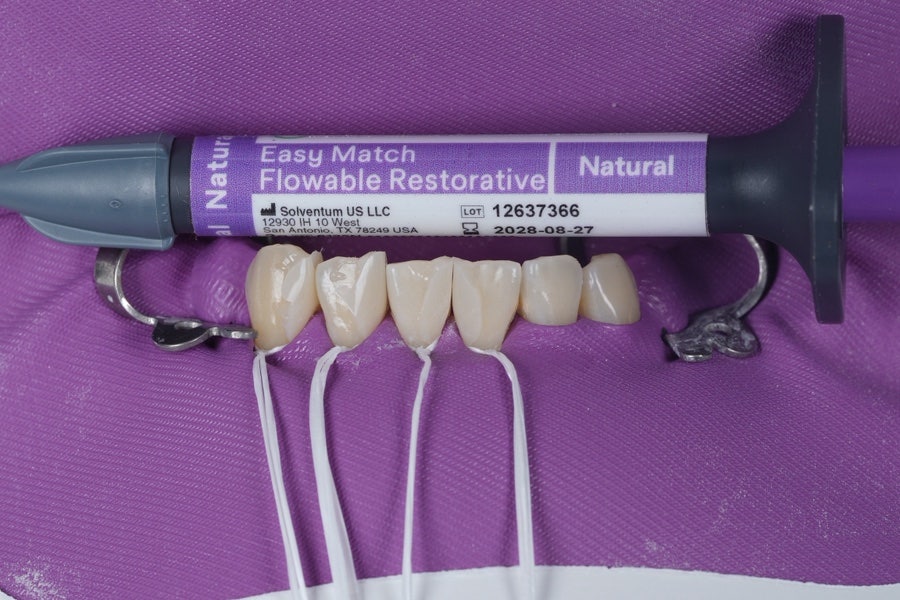
As you can see in the photographs, we used Easy Match’s Natural shade for this case.
Because the teeth in the mandibular anterior region are small and thin, harmony with the surrounding shade is especially important.
The reason for using flowable resin is that it is advantageous for naturally blending the margins in narrow, delicate spaces such as those between teeth.
In cases like this, the technique commonly known as the Snowplow Tech., which combines flowable resin and packable resin, is particularly useful.
However, no matter how well the shade is matched, the result will look awkward if the space is allocated incorrectly.
Matching the color is a necessary condition, but it is not a sufficient one. Please remember this order carefully.
Plan the space allocation first, and then match the shade.
Rubber Dam and Moisture Control Are Essential in This Case as Well
As you can see in the photographs, we also placed a rubber dam before starting this case.
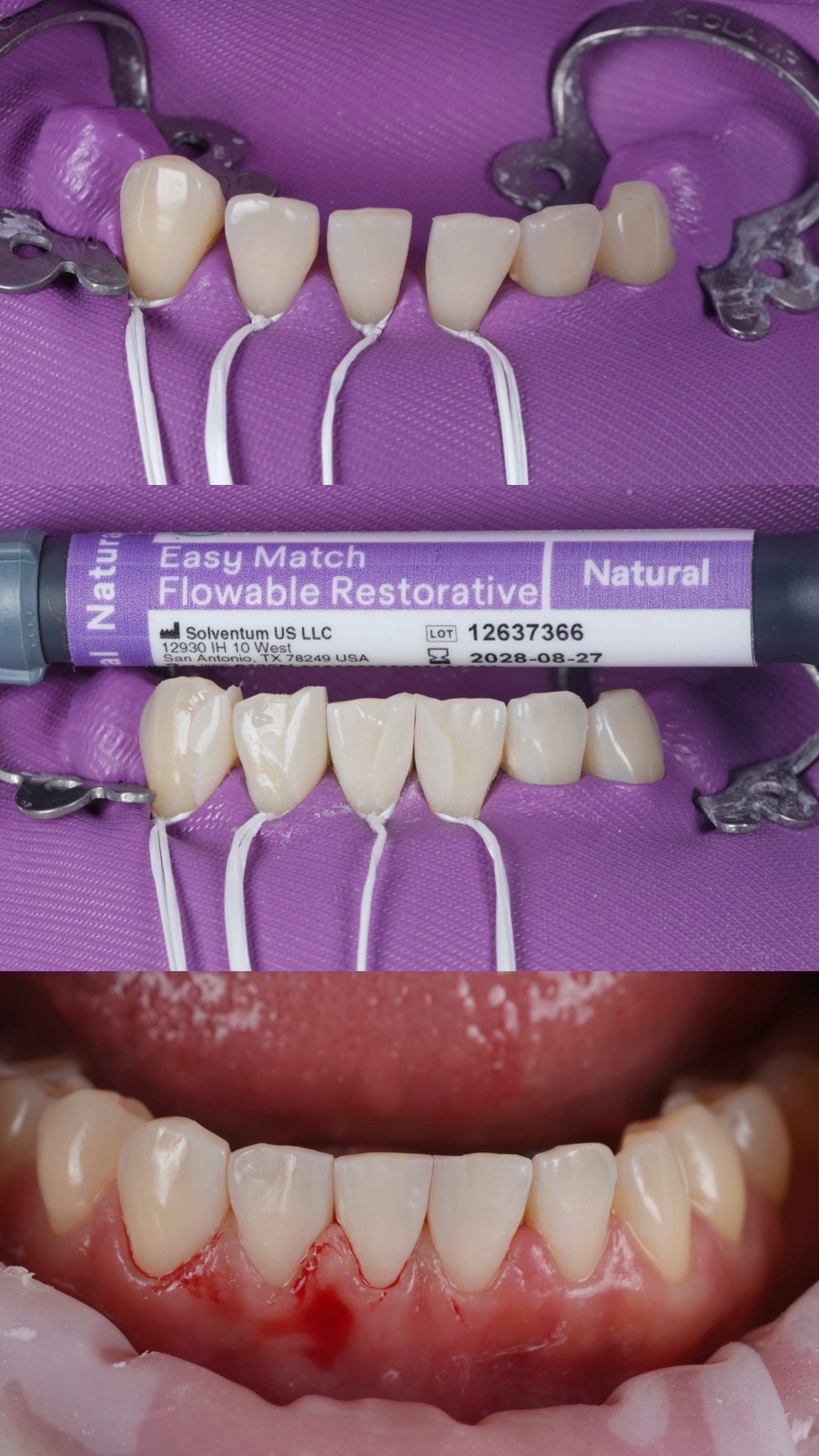
As I have mentioned several times in previous posts, resin bonding is a battle against moisture.
Just as Scotch tape will not adhere and instead slips when handled with wet hands, the bonding interface becomes unstable no matter how good the resin is when the tooth surface is exposed to moisture.
The mandibular anterior region is particularly susceptible to saliva contamination because it is located close to the tongue.
Of course, it is not possible to place a rubber dam in every situation, but moisture control should always be given extra attention.
Is Same-Day Restoration Actually Possible?
Yes, it is possible. We also completed this case on the same day.
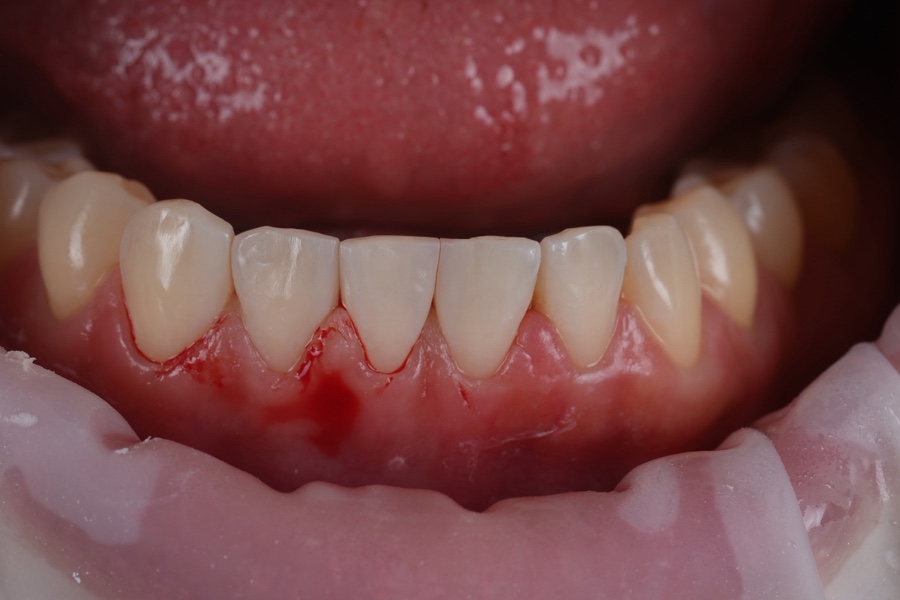
However, saying that it is “possible on the same day” does not mean that it is easy or quick.
Without sufficient planning, same-day restoration may be impossible or may produce unsatisfactory results.
The space analysis and planning of the final form must be completed mentally before treatment begins.
It is too late to start thinking about these things once treatment has already started.
The sequence is as follows.
First assess the total space → set a target width for each tooth → then proceed with the restoration from the canines toward the center. This is generally a stable approach.
Closing Remarks
The content of today’s post is not a medical advertisement. Nevertheless, it was written in compliance with the Medical Service Act and the Ministry of Health and Welfare’s guidelines for medical advertising.
This valuable material has been prepared to help dentists understand the subject and to provide accurate information. Specific treatment plans and diagnoses should be determined only after thorough consultation with the treating medical professional. In particular, because space analysis and symmetry planning largely determine the overall result in multiple diastema cases, it is important to conduct sufficient simulation before treatment. Rather than making a decision based solely on information from the internet or cases seen around you, we recommend finding the most appropriate method for your situation through a careful diagnosis.
There have also been many recent issues related to the Medical Service Act, and some cases have caused confusion.
However, we plan to pursue legal action together with our consulting attorney in response to false reports or complaints filed without grounds. We will continue to do our best to provide reliable information.
Summary of Today’s Content
In one sentence: In mandibular anterior multiple diastema cases, allocating space by working backward from the desired final symmetry while making use of the characteristics of the canines produces a much more natural result than mechanically dividing the space in half.
| Item | Content |
|---|
| Why does mechanical half-and-half allocation look awkward? | The proportions of individual teeth and the overall symmetry are ignored, causing the brain to detect something unnatural. |
| What is the starting point for space allocation? | Add up the total excess space, then work backward from the final form to set a target width for each tooth. |
| Why should the canines be used actively? | Canines have characteristics that keep them from being perceived as unnatural even when they are enlarged, making them useful for absorbing space. |
| Which is more important: shade matching or space allocation? | Space allocation comes first. Even if the color matches, the result will look awkward if the proportions are incorrect. |
| What is the prerequisite for same-day restoration? | The overall space analysis and the target width plan for each tooth must already be completed before the procedure begins. |