- The Price of Choice
Most patients tend to trust “large hospitals.” Even I find myself looking for a large hospital first when it comes to an area I do not know much about. When my wife became a high-risk expectant mother during her pregnancy, I remember looking for a nearby university hospital first and wondering whether we should go to Asan Hospital, Samsung Hospital, or Gangnam Severance Hospital for the delivery. If even I, as a medical professional, felt that way, it is only natural that patients would have the same tendency. Of course, dentists in the same specialty know very well that this is not necessarily the case.
Then why not simply open a large hospital? Exactly. That is why the average size of newly opened dental practices has increased so rapidly. However, all practice owners know this. As the scale grows, there are definitely things you have to give up. As I mentioned earlier, a larger practice has to see more patients, creating pressure to design systems that reduce the tasks taking up the owner’s chair time. Some practices sacrifice the quality of care, while others maximize leverage by delegating clinical work to nonmedical personnel.
However, aesthetic treatment involves many variables. You may book one hour, but the treatment could take two hours. That is to say, this happens more often than it does in a general dental practice. What is it like in a general dental practice? It is common to schedule two patients in a 30-minute appointment slot. In conventional insurance-centered care, it is common to assign around two patients to each 30-minute appointment slot. Depending on the treatment, some dentists may even see more patients simultaneously—for example, four.
As the practice grows, the system has to replace the owner. Here, “the system” refers to the work handled by the staff other than the owner. Protocols are created so that anyone can perform tasks at a consistent level, minimizing the work that the owner has to do personally. That is the only way to treat a large number of patients reliably.
Aesthetic treatment, however, is a little different. Decisions such as retaking photographs, matching the shade again, or making a slight adjustment to the line angle often remain the owner’s responsibility. In the end, aesthetic treatment is inevitably in a certain degree of tension with a “system for increasing efficiency.”
That is why opening a practice this way
is not a way to make a lot of money.
Because the owner’s individual time and judgment are the practice’s most important resources, there is an inherent limit to expanding revenue by increasing the scale and repeating the same model. In other words, aesthetic dentistry is less a business that leverages the owner’s time and more an art of using that time as meaningfully as possible. By “the value of time,” I do not mean “revenue per hour,” but rather “the artistry of the treatment” or “the value felt by the patient.” Those are entirely different things. Since dentistry is also a business, a practice must pursue profitability once it opens. Of course, pursuing “efficiency” by focusing on revenue per hour is important, but the greater emphasis should be placed on “providing greater value to patients.”
I think it is now clear that the “aesthetic dentistry” I am referring to here is not what practice owners commonly think of as a “veneer practice.” There is a clear difference between aesthetic and cosmetic. The “aesthetic” I am talking about has a different character from “cosmetic.” Cosmetic veneer treatment can be pursued more efficiently than traditional aesthetic treatment, and it has aspects that can be systematized. There are already quite a few practices providing treatment in that way.
That is why I have come to think that what I am saying here is not limited solely to “aesthetic dentistry,” but is applicable to the private practices of owners who pursue craftsmanship in any field.
When I opened my practice and considered its direction,
I saw two distinct paths for a dental practice.
The path of the businessperson
and
the path of the artist (craftsperson).
Most practice owners probably fall somewhere ambiguously between the two. However, if you call yourself an aesthetic dentist, I believe you must choose one of them. If you want to pursue business viability, then it is right to follow that path. If you want to pursue artistry, then it is right to follow the path of the craftsperson. These are not paths that should be criticized. They are completely different paths. However, if you choose the path of the craftsperson, you may always feel that the profitability is lacking. The FOMO that comes from comparing your revenue with that of other dental practices is the price of that choice. You must resist that temptation, redefine “value,” deliver it to actual patients, and pursue a direction in which that effort is reflected in your fees.
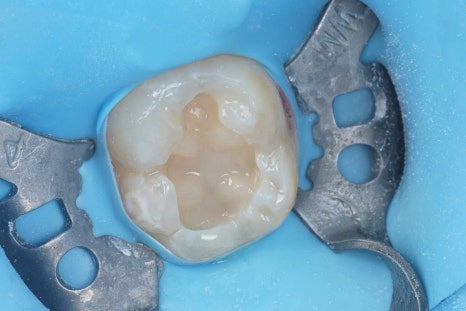
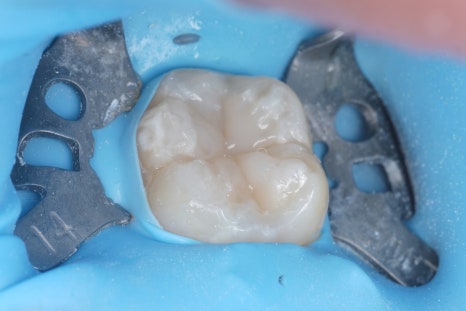
More practice owners are now saving teeth diagnosed for root canal treatment through biomimetic adhesive restorations, but it seems that many people still do not understand that resin buildup is not simply about imitating the shape of a tooth. On the left, dentin has been built up with SFRC (everX), and on the right, an enamel layer has been created over it using Grandio composite resin.
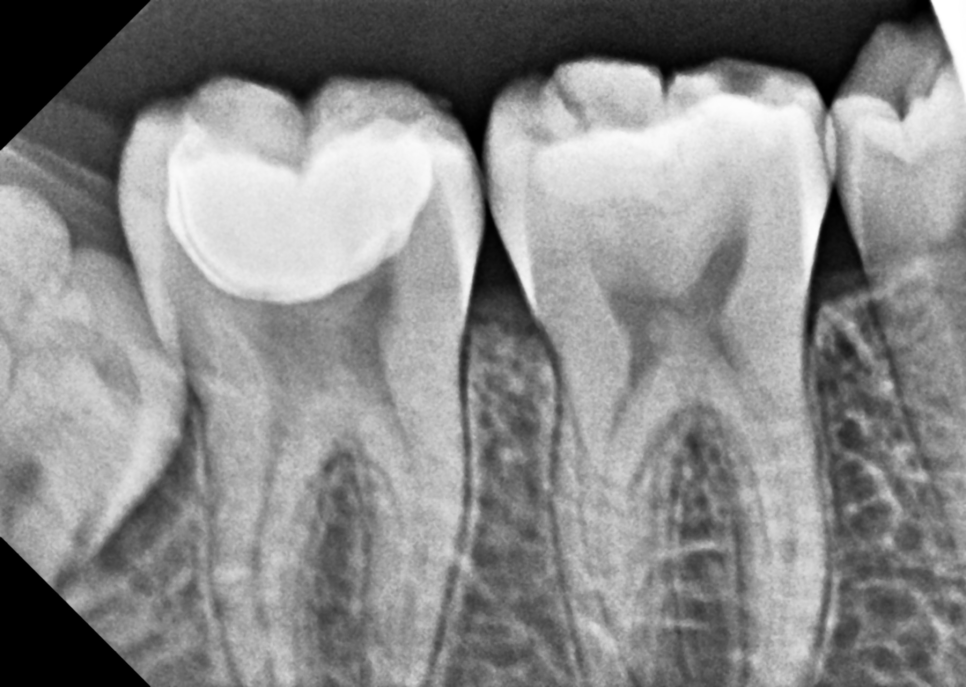
A radiolucent layer with UHMWPE placed underneath can also be observed.
This was an O-cavity case, so it was relatively easy. However, I believe that simply performing this kind of treatment routinely already means that you have set foot on the path of the craftsperson.