Upper eyelid surgery is the most commonly performed eye procedure among middle-aged patients, and satisfaction is very high. However, people often say that after surgery, their impression has become harsher and more severe. Did you know that among the procedures performed in plastic surgery, there is a method that can improve forehead wrinkles and frown lines at the same time while treating drooping eyelids in a way that does not look obvious? I will introduce endoscopic forehead lifting, also called forehead lift surgery or brow lift surgery, and look at the conditions under which it can be satisfying.

- What Is Endoscopic Forehead Lift?
Endoscopic forehead lift, or endoscopic brow lift, is a surgery that smooths forehead and glabellar wrinkles using an endoscope, and it is commonly considered a type of eye plastic surgery for middle-aged patients. In the past, forehead wrinkles were treated using a long incision across the hairline, but with advances in technology, endoscopic forehead lift is a minimally invasive cosmetic surgery that can improve not only the forehead, but also the brows and drooping eyelids, and make the thick skin around the double eyelids lighter, all through small incisions in the scalp.
- Advantages and Disadvantages of Forehead Lift and Patient Criteria
The main effect is lifting the forehead and brows upward, and the advantages, disadvantages, and ideal candidates are as follows.
- Advantages
-
Improves forehead wrinkles and glabellar wrinkles.
-
Improves the shape and contour of the eyebrows. (Turns angry-looking eyebrows into a gentler shape)
-
Improves drooping eyelids.
-
The result after surgery looks natural.
-
The scar is not visible.
- Disadvantages
-
It cannot change the shape of the double eyelids.
-
The forehead may become slightly wider. (0.3 cm)
-
Sensation in the forehead and scalp may be dull after surgery. (It recovers naturally)
-
There is a possibility of hair loss at the incision site. (The tissue must be handled carefully)
- Cases in Which Patients Are Satisfied
-
Those who want to smooth forehead wrinkles and glabellar wrinkles.
-
Those with angry-looking eyebrows.
-
Those with a narrow distance between the brows and the eyes.
-
Those with thick upper eyelids.
-
Those whose brows have descended, making the upper eyelid area look puffy.
-
Those who do not want it to look like they had surgery.
- Conditions in Which the Result May Be Less Satisfying
-
A convex forehead. (The surgical process is difficult)
-
Severe eyelid drooping. (Another procedure may also be needed)
-
Thick skin. (The amount of movement is limited)
-
A forehead that is firmly attached to the bone, so the skin does not move well.
- Surgical Process
- Preparation for Surgery
In the operating room, the nurses tie up or arrange the hair before and after the incision area. Shaving the incision site is not necessary in most cases, but if it occasionally interferes with surgery, a small shave that is not noticeable may be considered.
- Incision and Dissection
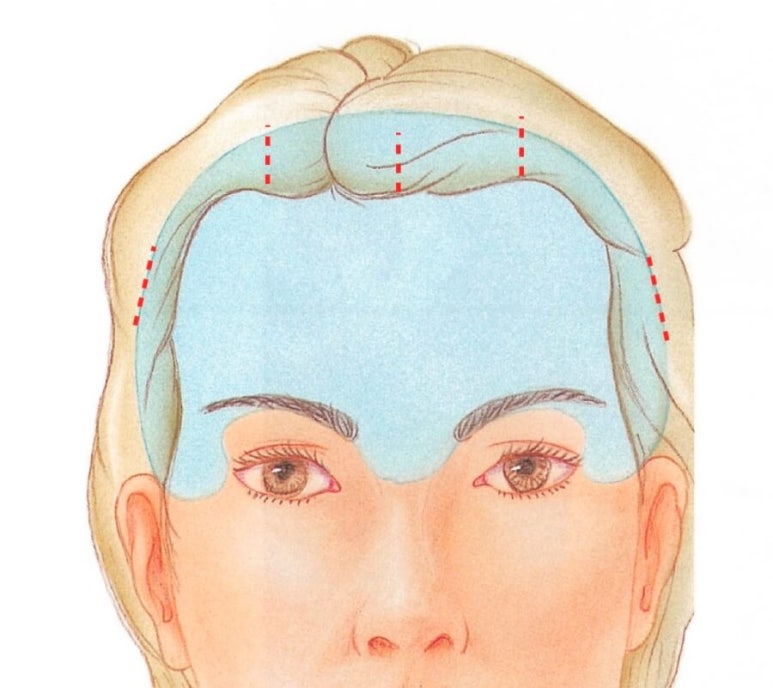
Red = incision line location. Light blue = dissection area
The surgery involves only 3-5 small incisions, each about 2 cm in length, along the hairline (the red dotted lines in the figure above). Then the forehead attached to the bone is separated (dissected) over the light blue area shown above. Dissection must be performed carefully so that the periosteum is not torn, and the space where dissection is performed has no blood vessels, so there is no bleeding.
- Manipulation of the Glabellar Muscles
The key that determines the surgical result is weakening the muscles that pull the brows downward. How well this is done determines the effect of the surgery and how long it lasts.
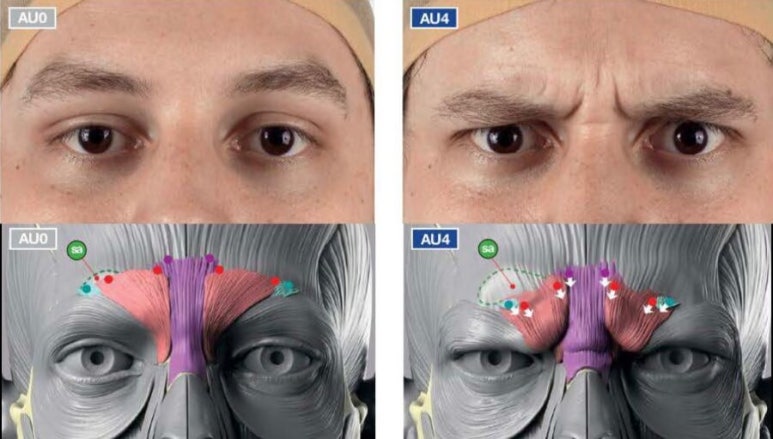
Glabellar muscles that contract when frowning: corrugator muscle (pink), procerus muscle (purple)
The glabellar muscles are extremely resilient, so even if a fairly large portion of the muscle is manipulated, some function returns. In other words, because the surgery does not eliminate facial expressions 100%, it can be performed without difficulty even in actors for whom facial expression is important. However, you should keep in mind that they do become somewhat weaker. For postoperative results after forehead lift surgery, please refer here.
Many doctors agree that this process of weakening the muscles is the key factor that determines how long the surgery lasts and how effective it is. The problem is that nerves and blood vessels are distributed among these glabellar muscles, so the muscles cannot simply be cut indiscriminately. That is why it is important to use an endoscopic camera to look carefully, preserve the important structures, and selectively cut only the muscles.
- Fixation
The lifted tissue is fixed using Endotine or sutures.
- Suturing
The hairline incisions are sutured, and in rare cases, a drain may be inserted or a compression bandage may be applied. The skin sutures are removed around 7 to 14 days later.
For more detailed information about endoscopic forehead lift, please refer here.