
- Introduction
There are several methods of facelift surgery to reduce nasolabial folds. Just as an onion is peeled layer by layer, facelift surgery methods are divided according to whether only the skin is dissected (separated) and tightened, or whether the tissue corresponding to the muscle layer (SMAS, SMAS) is also tightened. Please refer to the schematic diagram below for a better understanding.
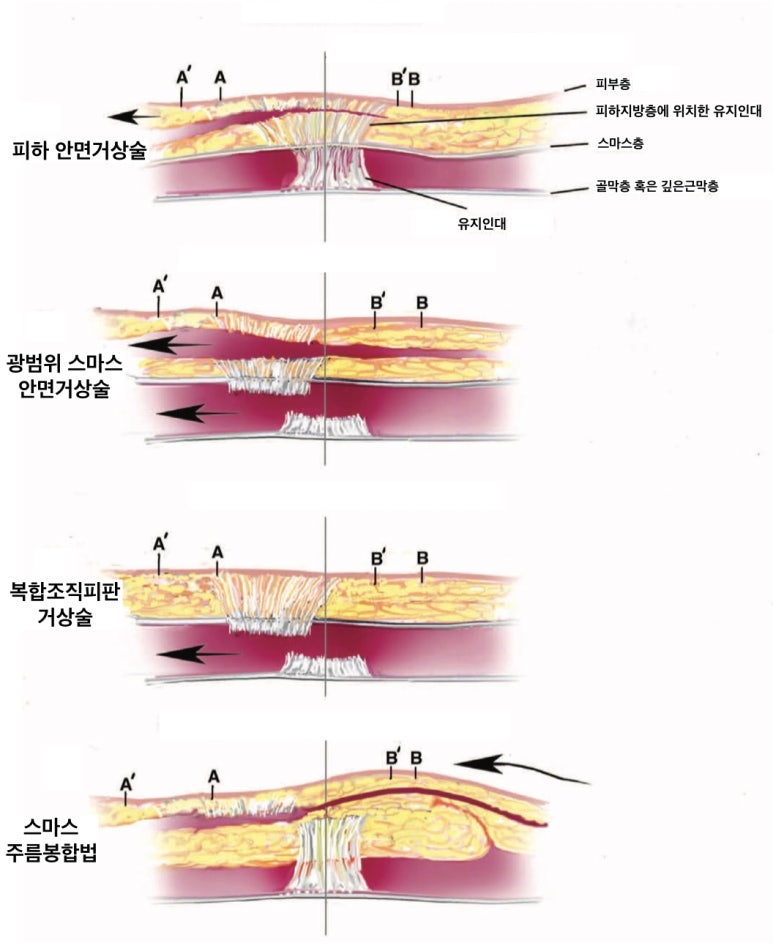
Various facelift methods
Naturally, the more complex and time-consuming the method, the more the facelift price will also differ. Let’s take a closer look at the various surgical methods in the figure above.
- Facelift methods
- Subcutaneous facelift (dissection of only the skin layer)�
This is a surgical method that lifts only the thinly dissected (peeled) skin. Because the duration of the facelift effect is short and there is concern about side effects, doctors who perform surgery this way are generally rare. Above all, if only the subcutaneous layer is dissected and lifted, and the deep tissue is not lifted...
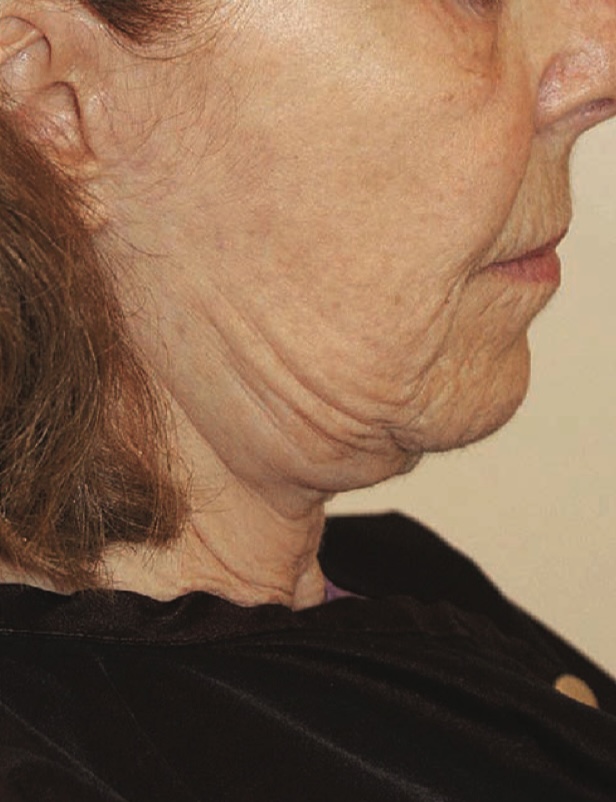
A postoperative view of a facelift that lifted only the skin layer
As shown in the photo below, only the area in front of the ear is lifted, while the middle part of the face remains sagging, creating what looks like a lateral sweep. The nasolabial folds and cheek sagging in the middle of the face, which are the very issues that need to be addressed, do not improve, while only the area in front of the ear, which does not need to be lifted, becomes tight.
- SMAS plication
After the skin is dissected, the SMAS is not separated from the underlying plane but is lifted and sutured so that it overlaps. The SMAS plication method introduced in textbooks is as shown in the figure below (the skin incision line runs from in front of the ear to behind it, and the dissection area is about the size of one hand).
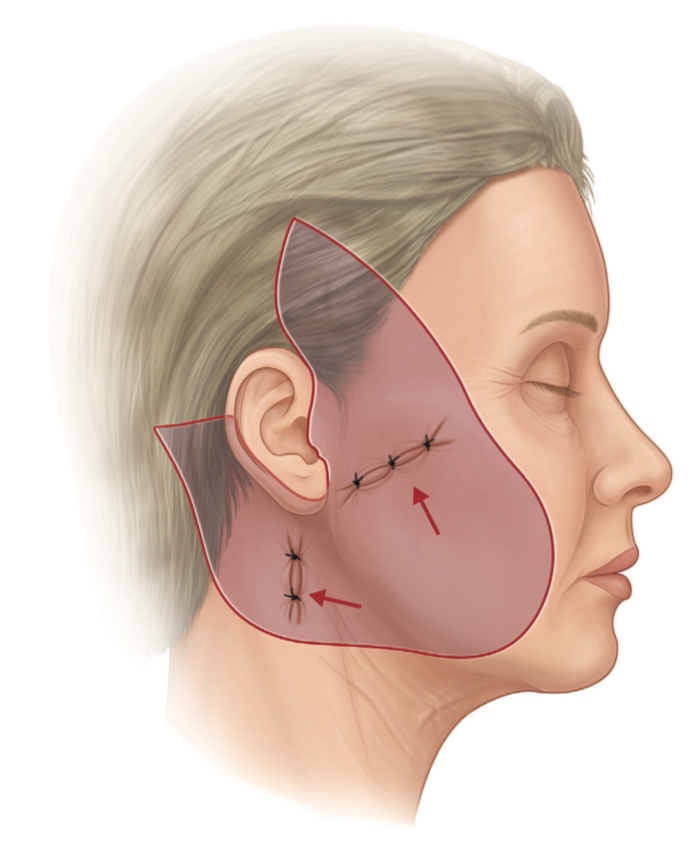
SMAS plication
A reduced version of the skin incision in this procedure is what is commonly referred to as a mini lift. However, because doctors have very different views on the specifics of mini lifts—such as where and how much to incise—it would be best to consult a specialist for a detailed explanation.
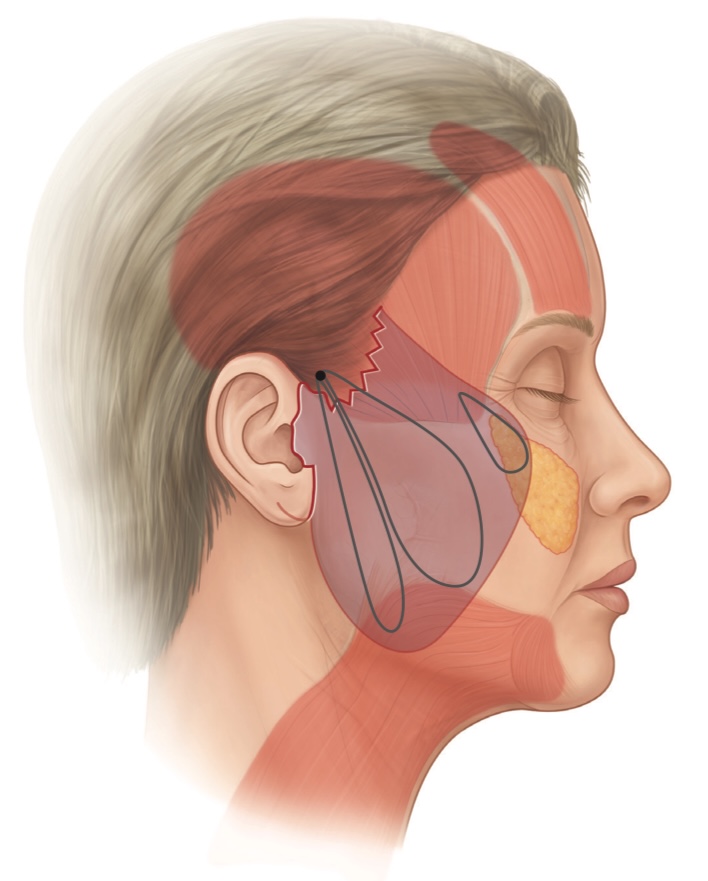
A schematic of the MACS lift, which is considered the original form of the mini lift
- Composite facelift
This is a method of lifting the skin and SMAS layers together as one without separating them individually. Among incision-based lifts, it has the advantage of being relatively easy and quick. However, as with any surgery, composite facelift surgery must be supported by detailed anatomical knowledge of the nerve pathways.
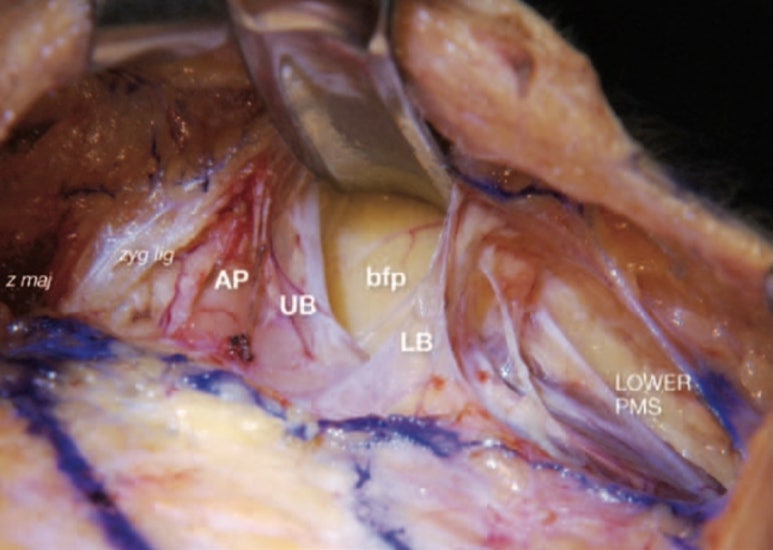
Composite facelift corresponding to the method of Australian doctor Dr. Mendelson
- SMASectomy
After dissecting one layer of the skin, this surgery removes the SMAS layer in an oval shape and sutures it, as shown in the figure below.
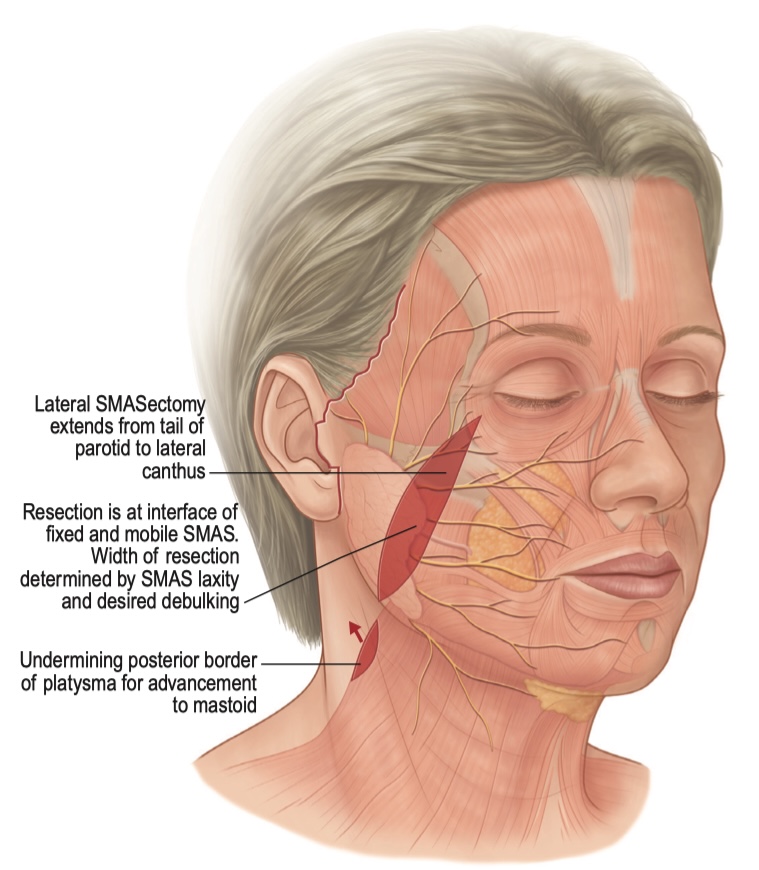
SMASectomy
It may be performed in cases where there is insufficient tissue from a previous surgery, or in patients who smoke or who have undergone many Ulthera or Thermage treatments, in order to improve the stability of the skin’s blood supply.
- Extended SMAS facelift
This is the method preferred by doctors who have accumulated a certain amount of experience. After dissecting one layer of the skin, the SMAS layer is also dissected, and the two tissues are pulled in different directions and to different degrees.
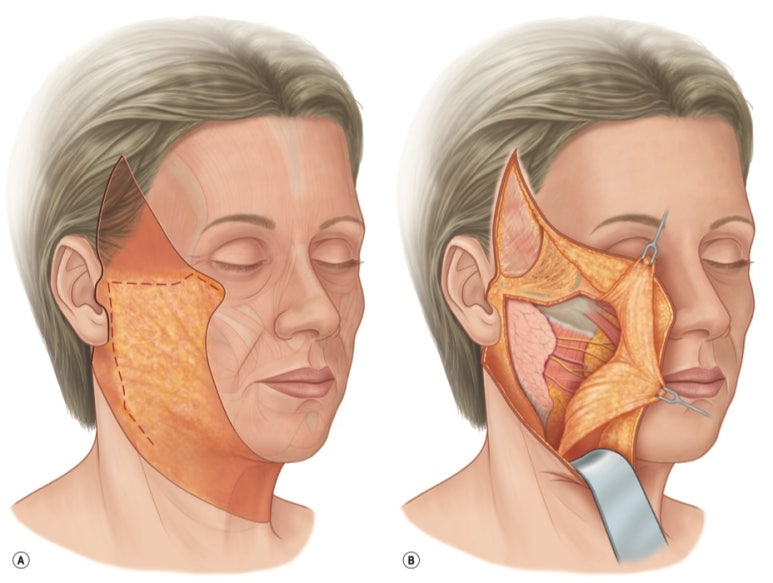
A method in which the skin is dissected first (left), and then the SMAS layer is also dissected (right) to lift the face
Unlike the previously mentioned methods, this technique is characterized by dissecting the face into two layers, and it corresponds to what is currently referred to in Gangnam plastic surgery clinics as SMAS facelift surgery.
- Conclusion on incision-based lifting surgery methods
Because each person’s facial condition is different, there is no single surgical method that is always the right one. For more detailed information about facelift surgery methods, please refer here.