If you are considering facelift surgery, you will often hear the term “SMAS.” In this post, I’d like to talk about what SMAS is and why it is important in lifting surgery.

In most lower mammals, the subcutaneous muscle observed under the skin appears only in the facial expression muscles of humans.... The subcutaneous muscle under the skin comes into contact with the surrounding dermis.
Gray's anatomy
- Introduction
This is a passage I saw in an anatomy book during my first year in medical school. Even though I did not know what it meant at the time, for some reason it seemed to reveal the greatness of the human face, so I copied that sentence into my diary. Now that I am a board-certified plastic surgeon, I think that sentence was actually talking about SMAS (SMAS)...
SMAS is an abbreviation for the English term superficial musculoaponeurotic system, and it was first used in 1976 by two French plastic surgeons, Mitz and Peyronie.
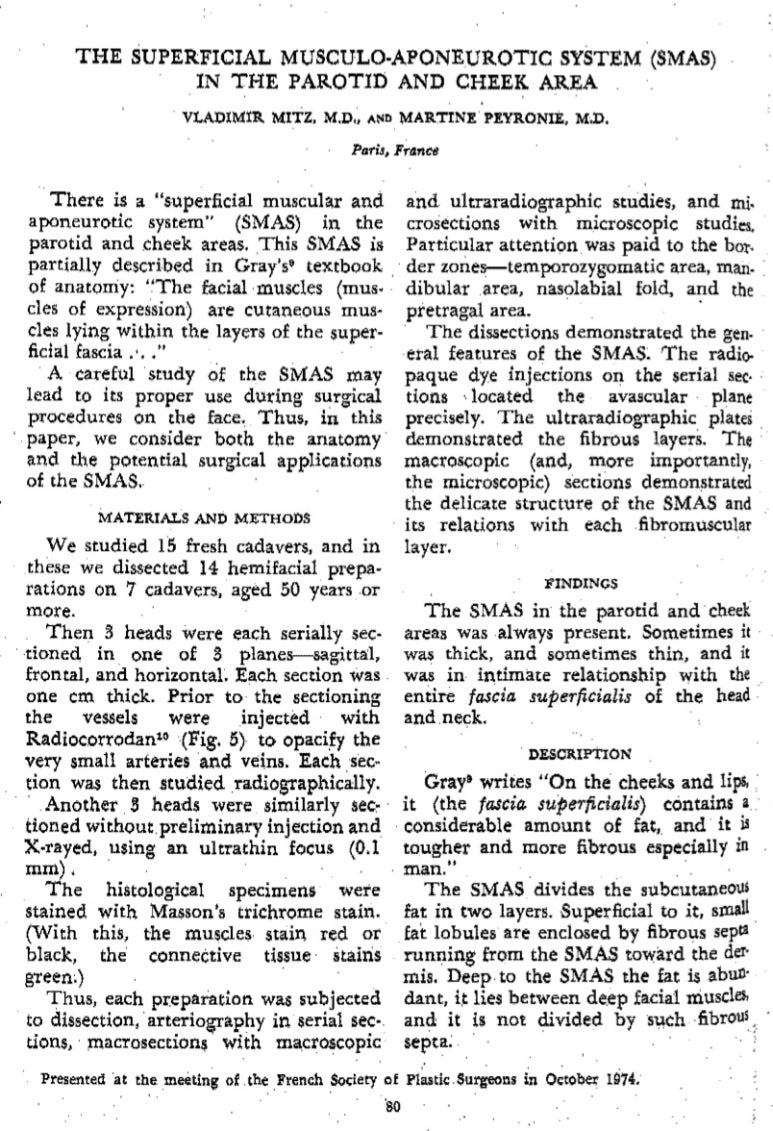
The first literature describing SMAS
- What is SMAS?
Recent anatomy books describe SMAS as “a tissue of the face, composed partly of muscle fibers and partly of fibroaponeurotic tissue,” and I think that is probably the easiest answer to the question of what SMAS is. When performing surgery, you come to feel that SMAS has a very close relationship with the facial expression muscles. Strictly speaking, it seems more accurate to understand it as a tissue located in a layer superficial to the facial expression muscles.
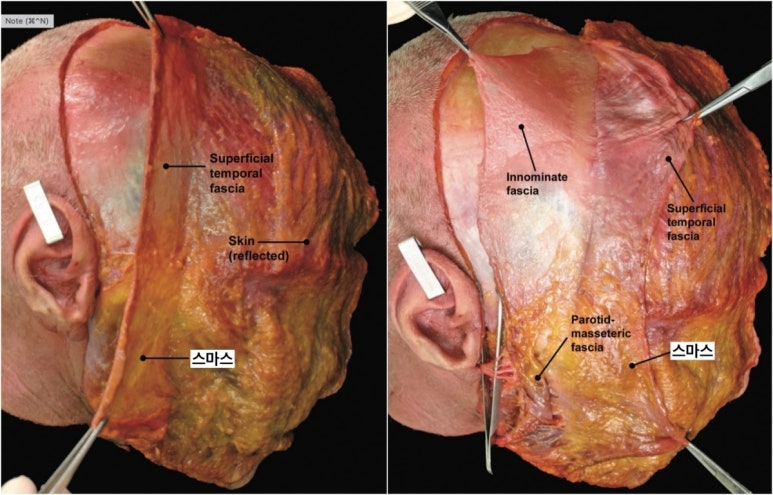
On the left side of the photo, what is being held with forceps is the SMAS layer, and on the right you can see that there is an additional layer beneath the SMAS layer, which allows surgery to be performed without injuring the nerves.
Since the 1980s, when the concept of SMAS became widely known, SMAS has become an important concept in pulling tissue during facelift surgery. Of course, there have been doctors such as Hamra who pointed out that it is merely an overused marketing term, and in practice there is also a tendency for the term to be used without even understanding its meaning... But one thing is certain: the prevailing view is that a facelift that does not manipulate the SMAS is not a proper facelift. However, whether a doctor can create a “proper SMAS flap” is another matter.
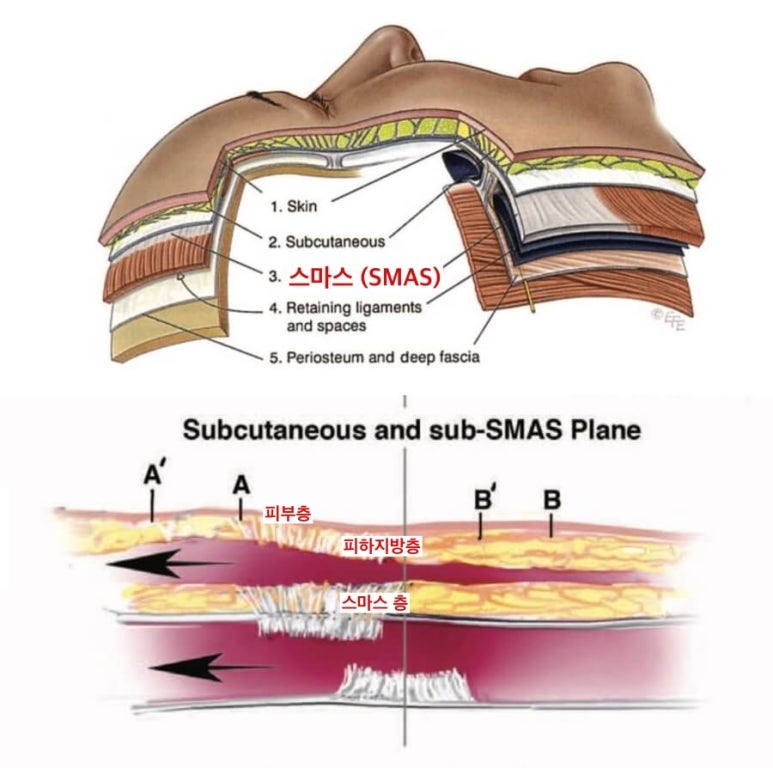
A schematic diagram of the SMAS layer and facelift using SMAS
From the perspective of modern anatomy, the face is divided into five layers (the skin layer, subcutaneous fat layer, SMAS layer, facial space, and deep fascial layer), and the tissue below the subcutaneous fat layer corresponds to the SMAS layer. Of course, when you actually perform surgery, it is not as simply divided as in the diagram. And the SMAS flap used in facelift surgery is not something that is discovered during surgery; it is more accurate to see it as a structure intentionally created by the surgeon.
- Why SMAS lifting?
There are various surgical methods for incision-based facelift surgery, but saying that a facelift is performed using SMAS broadly means lifting by pulling a deeper layer than the skin. This includes folding the SMAS (SMAS plication) or removing it (SMAS resection).
However, in a narrower sense, SMAS lifting refers to dissecting the face into two layers, as shown in the figure above, and separately pulling the SMAS flap. In other words, if SMAS lifting in the broad sense means pulling without cutting the retaining ligaments beneath the SMAS, SMAS lifting in the narrow sense means cutting the retaining ligaments beneath the SMAS and then pulling.
The disadvantages of not performing surgery by dissecting into two layers are:
- The duration of effect is shorter
- The risk of scarring increases
- The pulling direction cannot be tailored to the patient’s facial shape or individual needs
On the other hand, when the deep tissue called SMAS is pulled after dissection into two layers:
- The surgical effect can last longer
- Tension on the skin can be reduced, minimizing scarring
- A customized procedure appropriate for each individual becomes possible
For these reasons, many people promote two-layer dissection and SMAS facelifts.
However, using an SMAS flap in surgery to produce visible results rather than just the appearance of doing so does not seem to be something just anyone can do, even with the term being overused. First of all, it takes more time. Facelift surgery also costs more. Above all, creating a strong SMAS that lasts a long time requires a great deal of experience. If you have decided to undergo an SMAS lift, it is a good idea to confirm the following during consultation.
- Checklist for SMAS Facelift Surgery
- Thickness of the skin flap: it should be thin.
A facelift is a surgery that lifts sagging tissue against the direction of gravity. In order to lift sagging tissue and maintain the effect for a long time, the SMAS flap must be thick and strong. For that reason, the first and most important thing is to be able to dissect the skin thinly. This is necessary because only then can a strong SMAS be created and the effect of the surgery be maintained for a long time. Looking at surgeries performed by less experienced doctors, there are many cases in which, from the moment the skin is dissected, the SMAS that should not be included has already been included in the skin layer. The surgeon may think they have used the SMAS, but in fact the first step of the surgery was already wrong.
That said, blindly dissecting the skin too thinly is not necessarily good either. The thickness of the skin flap should be adjusted appropriately according to the patient’s medical history and the types of procedures they have previously undergone. In particular, many people who decide on a facelift have been managing their appearance for a long time. Among them, patients who have undergone lifting procedures such as Ulthera or Thermage multiple times may increase the risk of skin necrosis if surgery is performed with very thin skin dissection. Hypertension, diabetes, and smoking also affect skin blood circulation, so the pros and cons must be considered. Whether the patient has previously had a facelift also has an effect. If surgery using SMAS would carry a higher risk of side effects for that patient, sometimes it is more desirable to boldly avoid using SMAS. Therefore, the medical team needs to ask in detail about the patient’s medical history and procedure history before deciding on a plan.
- The extent of SMAS dissection is important: the retaining ligaments must be sufficiently released.
The retaining ligaments that hold facial contours in place are distributed throughout the deep and superficial layers. And to perform proper SMAS lifting, releasing the deep retaining ligaments that hold the SMAS is essential. The problem is that important structures such as the motor nerves responsible for facial expression and the salivary glands exist in the base layer of the SMAS, so one cannot simply dissect widely and deeply without caution. If too wide an area is dissected indiscriminately:
- The SMAS becomes thinner toward the front and may tear
- The risk of nerve damage increases
- The surgery becomes more difficult
Therefore, the extent of dissection should be approached by comprehensively considering the patient’s needs and facial characteristics.
- Pulling direction and degree of pull
As mentioned above, SMAS facelift in the narrow sense is a surgery in which the face is dissected into two layers and the skin and SMAS are pulled in different directions. The most important reason for separating the skin and SMAS instead of pulling them together as one layer is that it allows the direction (vector) and amount of pull for the skin and SMAS to be adjusted differently. And depending on the patient’s goals and facial shape, the direction and length of the pull should be adjusted.
- Fixation position
One might think that the more medial the fixation position is, the better the lift will be, but the tension of the SMAS differs between the medial and lateral sides of the face. If you perform a difficult surgery and the fixed area stretches out like sticky rice cake, reducing the effect of the SMAS flap, that would be disappointing for both the doctor and the patient. Therefore, the flap should be designed by selecting a location where the SMAS stretches less.
- Conclusion
We have discussed the definition of SMAS mentioned in facelift surgery and how it is used in surgery. In reality, there is a wide variation in experience among doctors regarding SMAS, and because it is not something a patient can directly check immediately after surgery, it can be difficult to judge. However, to become a wise consumer amid the temptation of excessive advertising, I think you need to have proper information in order to develop good judgment. I hope this article has been helpful in achieving a satisfying result.