
This article explains where the incision sites are placed in facelift surgery and why those locations are chosen. Since where the incision is made is closely related to how well scars and signs of surgery can be concealed, I think it is worth reading if you are interested in surgery.
- Incision sites in facelift surgery
One of the arguments made by doctors who advocate mini facelifts is that short incision lines make scars less noticeable. That is certainly not wrong. However, a board-certified plastic surgeon who was properly trained from the beginning in incision placement, suturing methods, wound healing, and scar management may think differently.
Because a mini facelift is inherently based on short incisions, it is difficult to achieve good results. Of course, making the incision longer does not automatically guarantee a better result, but if the incision is placed in a location that is not easily noticed by others, the risk of visible scarring from a long incision can be somewhat reduced.
I will divide the incisions used in facelift surgery into three areas and explain the considerations for each.
- Temple area: inside the hairline vs. along the hairline
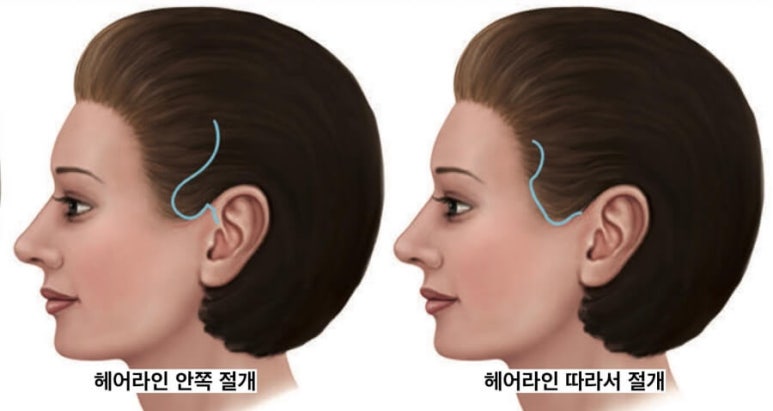
Inside the hairline vs. along the hairline
2-1) Inside the hairline
Making the incision within the hairline has the advantage of completely concealing the scar. However, in patients with a large amount of skin movement (that is, in cases with significant sagging), performing surgery this way can cause the hairline to become distorted, sideburns to disappear (male in the photo below), or the temple area behind the outer end of the eyebrow to become lengthened, creating an awkward appearance (female in the photo below).
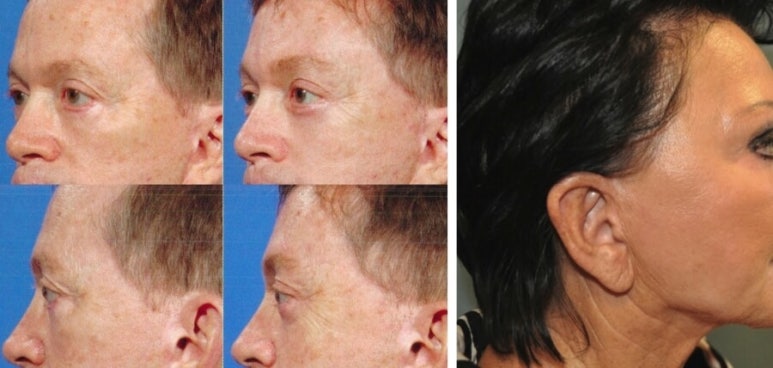
Loss of sideburns and a widened temple area
Therefore, making the incision inside the hairline is an appropriate method when aging has not progressed as much, or when the skin does not need to be pulled very far.
2-2) Along the hairline
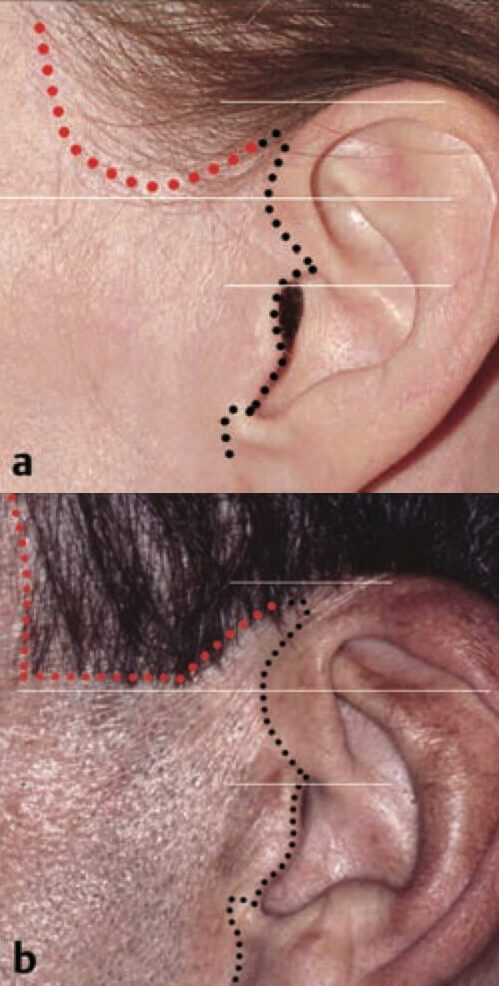
An example of an incision made along the hairline
The advantage of making an incision along the temple hairline is that it allows the stretched skin to be pulled as much as possible and improved, without worrying about the temple area becoming longer or the sideburns disappearing. This is an advantage that cannot be obtained when the incision is made inside the hairline. This method is considered for patients with significant skin sagging and for men with sideburns. The downside is that if the incision is made carelessly, the scar may be slightly more visible. However, a doctor who is familiar with techniques such as trichophytic incision or beveling can further reduce the likelihood of a visible scar.
- In front of the ear: anterior to the tragus vs. posterior to the tragus
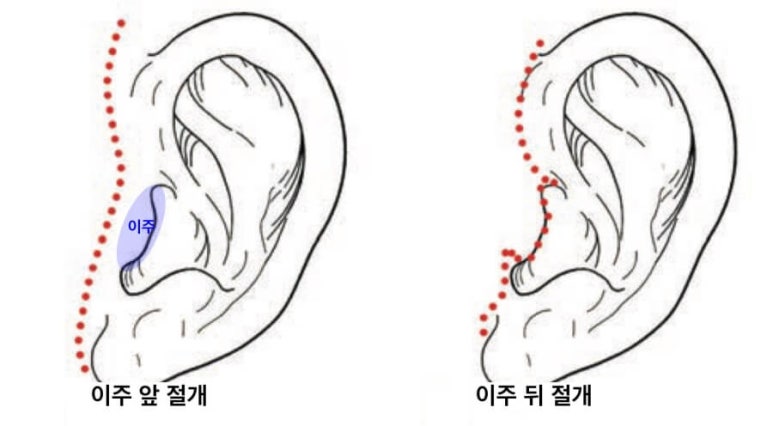
The square-shaped cartilage in front of the ear canal is called the tragus (耳柱, tragus). In facelift surgery, there have historically been many different opinions and arguments about where to place the incision in front of the ear, but recently doctors seem to prefer a post-tragal incision.
3-1) Incision anterior to the tragus
An incision anterior to the tragus has the advantage of being slightly easier to perform and of preserving the shape of the tragus well. However, it may increase the risk of scarring, and the clinic should also be capable of properly treating such scars.
3-2) Incision posterior to the tragus
The advantage of making the incision behind the tragus is that the scar can be concealed so that others are less likely to notice that surgery was performed. However, this approach is somewhat more dependent on the surgeon’s skill, so if the surgeon is not experienced, there is a risk that the shape of the tragus may be altered. Still, a surgeon who can apply the basic plastic surgery principle of Z-plasty may be able to prevent such deformity.
- Behind the ear
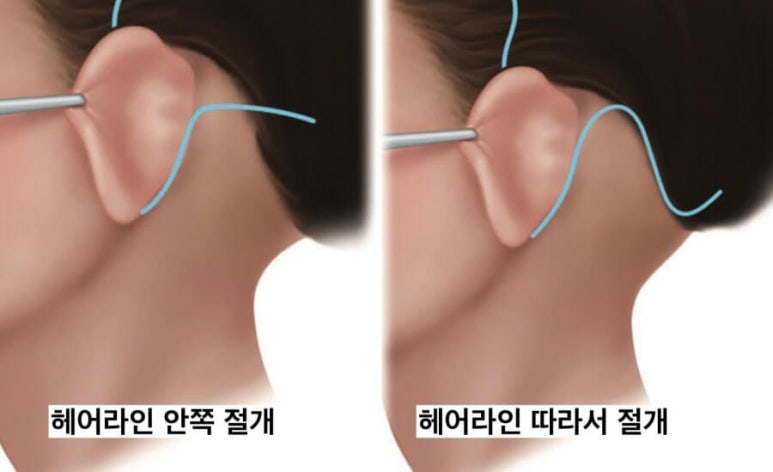
Selection of the incision line behind the ear
Behind the ear is also divided into either inside the hairline or along the boundary. However, just like choosing the incision site in the temple area, it is best to decide the location behind the ear based on the expected amount of skin movement.
4-1) Incision inside the hairline
This method was attempted often in the past because of the idea that an incision within the hairline would conceal the scar well. It can be selected when the amount of skin movement is not large.
4-2) Incision along the hairline
The advantage of making the incision along the hairline is that it can significantly improve sagging skin in the neck and under the chin. In some cases, the incision does not go high enough and the scar becomes visible; in particular, in male patients, the incision height should rise to the helix-hairline touch point (by Feldman).