Why does a mini facelift often fall short? There may be several reasons, but this article medically analyzes the limitations of mini facelifts. I hope it helps anyone interested in facelifts choose the surgery that is right for them.

- The Purpose of Facelift Surgery
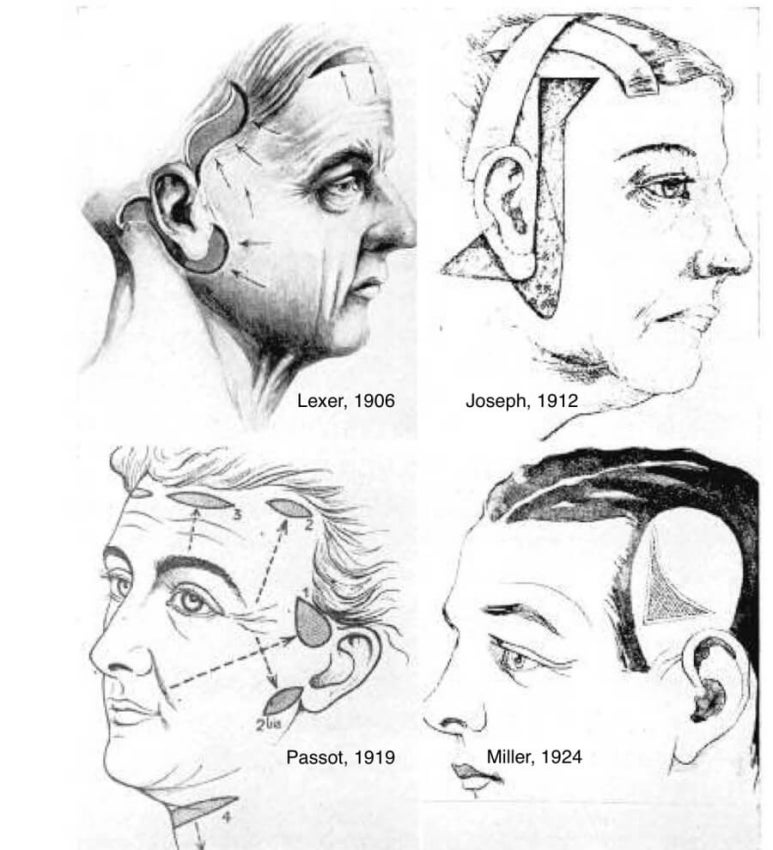
Various facelift methods performed since the past
Facelift surgery is an operation that rejuvenates the middle and lower parts of the face when the face is divided into three sections. This surgery has a history of more than 100 years, and various methods have appeared and disappeared repeatedly. In South Korea today, facelift surgery is performed in different ways depending on the doctor, so it is not easy to classify each one individually. However, based on the length of the incision, it can be divided into traditional facelift surgery and mini facelift surgery.
- Types of Surgery
- Facelift Surgery
In general, when people say facelift surgery, they are referring to an operation that lifts sagging tissue through a long U-shaped incision from the area in front of the ear to behind the ear. Although the surgery takes a long time (4–6 hours), if performed properly by a skilled surgeon, it is a procedure that can improve not only the jawline but also the neck. It takes about 2–3 weeks for swelling to subside and for daily life to recover, and the results can be evaluated only after at least 2–6 months.
- Mini Facelift
This is a modified method created to reduce the long incision and long surgery time of a traditional facelift. In some cases, only the area in front of the ear is incised, and in others, an incision is made inside the hairline at the temple area. Although it is called a mini facelift, depending on the surgeon, the incision may extend as far as behind the ear.
This is not a recently devised surgical method. There have long been attempts to maximize lifting effects using shorter incisions, but they have gone through repeated waves of popularity and decline. In Korea, around 2020, intensive marketing by a plastic surgery clinic in Gangnam made mini lifting something that anyone interested in surgery would have heard of at least once. Like laparoscopic surgery, it is certainly desirable for medical technology to enable minimally invasive procedures. However, the sweet promise of shortening the return to daily life through a small incision can mean that, even if recovery is short, the surgical result falls short of the patient’s expectations, wasting money and leaving them with something that may as well not have been done. Perhaps for this reason, many surgeons who have performed facelifts for more than 10 years are skeptical about the results of mini facelifts. A well-known surgeon overseas, often called a master, has criticized mini facelifts as having little benefit for most patients and causing problems in many cases, saying they are a method used by doctors who have not properly learned how to perform the surgery.
- The Principles of Lifting Surgery
As people age, aging progresses not only in the skin but also in the fat layer, muscles, and bones, so different approaches are needed for each.
-
There is aging in which the face looks hollow, with no fat, like a deflated balloon (fat grafting should be combined).
-
There are also faces in which the facial fat sags in a mass (after releasing the retaining ligaments, the tissue is moved upward, and liposuction may also be needed).
-
And if there is loose skin, it should be removed (excised).
So why is mini lifting criticized as having little benefit and many problems? Based on my personal experience and the opinions of several experts, the reasons I believe the surgical effect is limited are as follows.
- The Inherent Limitations of Mini Facelifts
Mini facelifts, which sound like an ideal method of dissecting a wide area through a small incision, reveal a gap between imagination and reality once the surgery is actually performed.
- The retaining ligaments cannot be properly released
Facial sagging mainly occurs in the central, medial part of the face. For this central part of the face to benefit from surgery, the retaining ligaments holding the medial tissue must be released. In a standard facelift or mini facelift, the incision is made around the ear. However, a mini facelift using a small incision has a limited field of view, making it very difficult to safely release the medial retaining ligaments. The claim made by mini facelift proponents—that with enough surgical experience, one can release the ligaments all the way to the medial side—is not entirely wrong. It is possible to release the retaining ligaments by working without direct vision, relying on the sensation transmitted through the instruments.
But the problem is that retaining ligaments are always accompanied by important nerves and blood vessels.
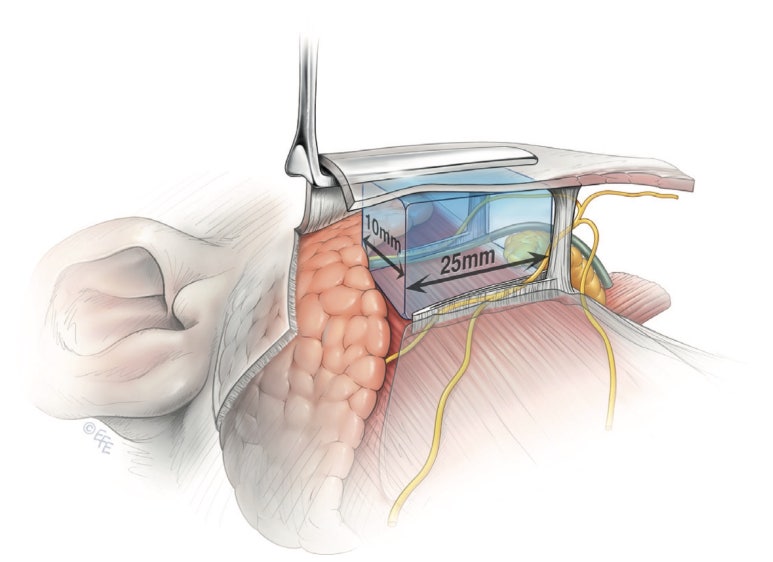
Facial nerves (yellow) running around the retaining ligaments (white pillars)
To perform the surgery properly, the ligaments must be released all the way to near the nasolabial fold. However, as the important structures (nerves, blood vessels) become progressively more superficial, operating without a clear field of view becomes very difficult, and because the risk cannot be accepted, the surgery may end up being done only superficially, with minimal effect.
- The effect on the SMAS is compromised.
The SMAS is the deep tissue layer that must be pulled during lifting surgery. Because the small incision of a mini facelift limits the surgical field of view, it becomes difficult to create an “effective SMAS flap.” If visibility is poor, the SMAS may tear. Because the narrow field makes it difficult to create a strong SMAS, the surgical effect may be reduced. Most importantly, important structures running beneath the SMAS (motor nerves, salivary glands) may be damaged.
Of course, some people with extensive mini facelift experience claim they can perform the two points above without any problems. Even if we generously assume that this is possible thanks to exceptional surgical skill, there is still what I consider the most critical limitation of mini lifting.
- Improper lifting direction
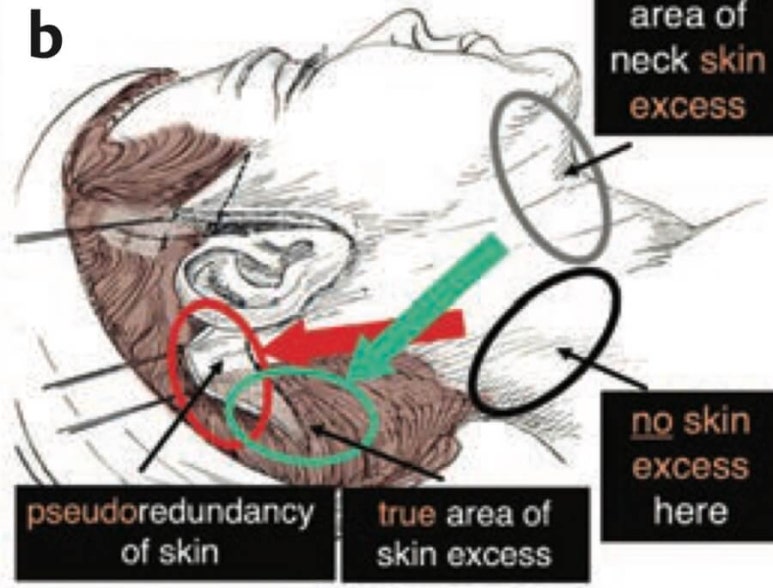
Gray circle: the actual sagging neck and jawline area.
Green arrow: the direction pulled in a traditional facelift.
Red arrow: the wrong direction
If you analyze an aged face and think logically about which areas are sagging, the answer to where and how to pull, and what to do with the excess tissue, is simple. However, mini lifting with a short incision inevitably moves the skin in a vertical direction, which means the basic premise is already wrong.
- Skin bunching
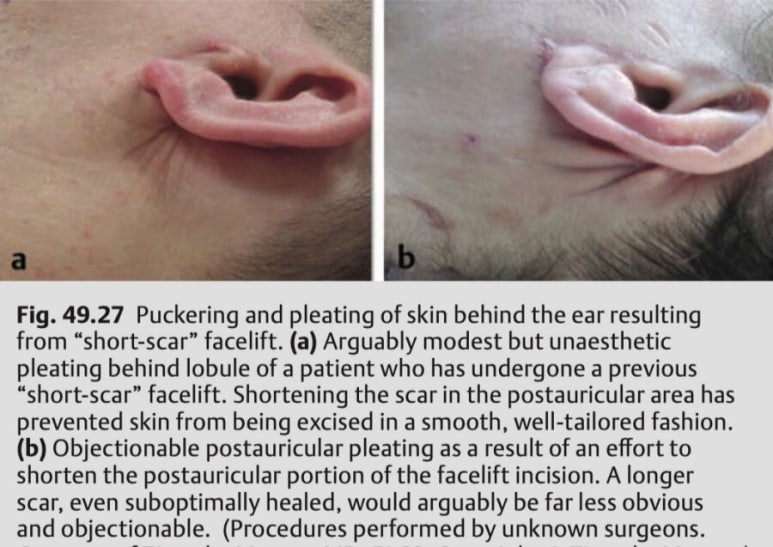
The skin left bunched up after a mini facelift.
The photo above is an extremely extreme case, even among operations performed by Western surgeons. In fact, Korean plastic surgeons are generally very skilled with their hands. Therefore, it is hard for a surgeon who creates such an extreme result to remain in this field. But if you closely examine the results of the average Korean surgeon’s mini facelift, post-operative skin bunching is unavoidable.
In a traditional facelift, if the incision is long enough, there is room to appropriately adjust the difference in length of the area to be sutured. But in a mini facelift, where the incision line is short, there is no room for such adjustment, so the skin inevitably bunches up or wrinkles along the incision line (which is why, at the end of surgery, the incision line is often made longer than originally planned in order to make it less noticeable). For women who wear their hair long, the bunching can at least be concealed, but for men, signs of surgery may never disappear.
- Cases in Which a Mini Facelift May Be Satisfactory
Mini lifting may be effective in faces with little progression of aging (roughly under the mid-40s). However, in this age group, thread lifting, Ulthera, Thermage, InMode, and similar treatments are also good alternatives. Achieving good results with minimal incision is something doctors should continue to pursue through effort and research, but the mini facelifts that have become popular in some circles are merely a repetition of the history of mistakes made during the development of facial rejuvenation surgery in the past, not a groundbreaking new method.
- Conclusion
Facelift surgery has a long history and comes in many forms. Even when the surgery has the same name, the technique differs from doctor to doctor, and small differences affect the outcome. If you search online, there is a lack of high-quality information about facelifts that non-specialists can understand, and perhaps because of the influence of marketing by various medical device companies and manufacturers, the current anti-aging plastic surgery market sadly tends to emphasize simple procedures and short recovery times first. These simple procedures are limited in the patients for whom they can be effective, and even when they do work, the duration of the effect is short. This is nothing more than a rehash of mini procedures like the once-popular-and-then-disappeared “lunch time lift” in the history of facelift surgery.
In our lives full of advertising, the first step toward becoming a smart consumer is to acquire the right information and develop the discernment to evaluate it properly. I hope this article helps you make wise decisions and achieve satisfying results.