An earlobe that is not rounded and hanging freely, but instead is attached to the cheek and stretched downward, is called an attached earlobe deformity. This can occur as part of the normal aging process, but it can also be a side effect of an improperly performed facelift. In this post, we will look at why attached earlobes develop and how they can be prevented.
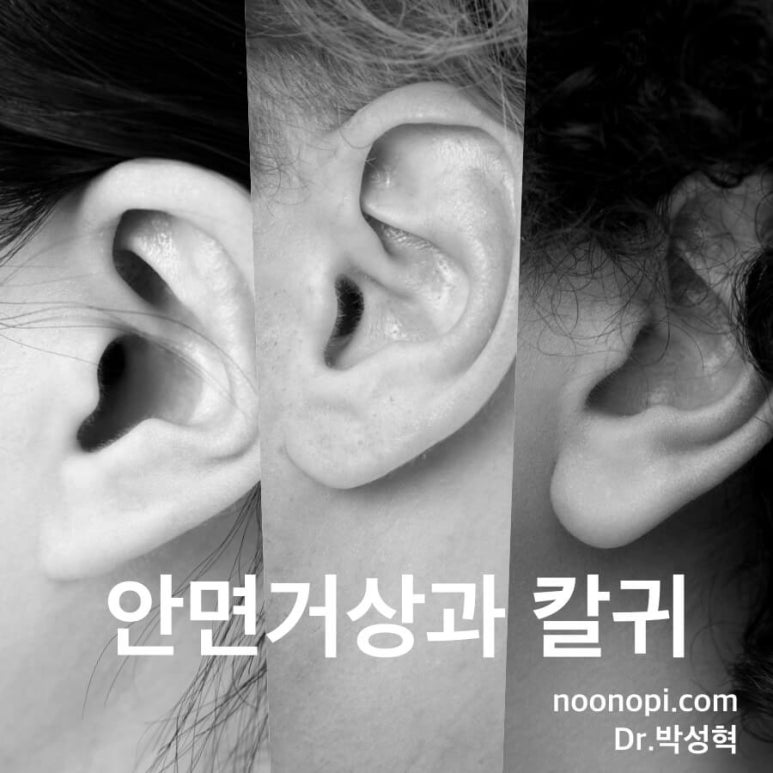
What kind of earlobe is attractive?
- The ideal earlobe shape
Have you ever paid close attention to the shape of young or beautiful ears around you? Beauty is difficult to define because it varies depending on era, culture, and personal preference.
However, according to Mowlavi et al., who have published many studies on earlobes, a freely hanging earlobe was reported in their statistics to be younger and more attractive (https://journals.lww.com/plasreconsurg/citation/2004/03000/earlobe_morphology_delineated_by_two_components_.60.aspx), and I also think so.
- Why attached earlobes occur in facelift surgery
A facelift is a surgery that lifts sagging facial tissue through incisions around the ears. However, if you become too focused on the result, or if only the skin is forcibly pulled without lifting the deep layer tissues, the earlobe will gradually descend over time, even if it may look fine at first after surgery. Human skin has a stretchy quality like glutinous rice cake, so as the cheek skin that was forcibly pulled tries to return downward, it pulls the earlobe near the suture line downward as well.
This does not happen simply because a facelift was performed. It occurs when the procedure is done improperly. Surprisingly, many patients seem not to notice that the shape of their ears has changed unfavorably. Since they do not complain, a surgeon with poor judgment may come to believe that their own surgery is excellent and continue doing it that way.
Even if the patient does not voice complaints, carefully observing the surgical results and evaluating both the good and the bad with a clear eye is important for a plastic surgeon’s growth.
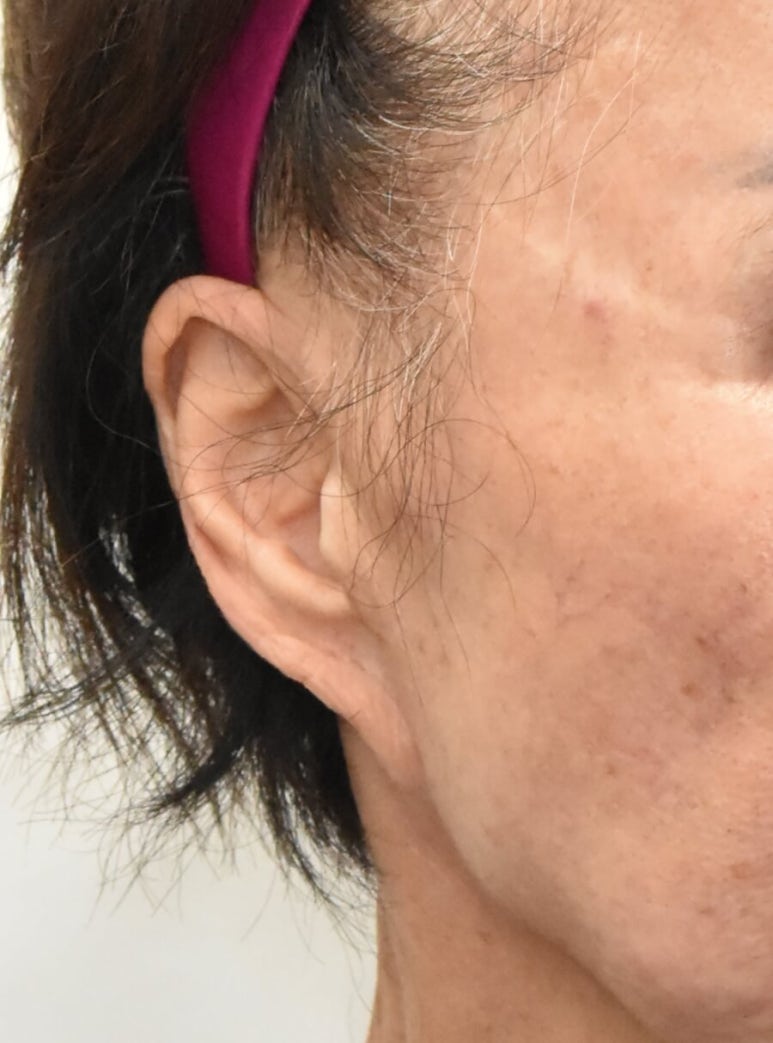
An attached earlobe in a 71-year-old patient who has already undergone three facelifts. A scar from an incision made 30 years ago when a foreign material was injected into the temple area is also visible.
- How can attached earlobes be prevented?
So how can attached earlobes be prevented?
There are many variables, such as the location of the incision line and whether or not the SMAS layer is used, but the most important thing is to suture without tension on both the SMAS layer and the skin layer. The phrase “without tension” may be easy to say, but each surgeon has a different idea of how much that means. You can only review your own surgeries and find the appropriate degree for yourself.
- How can an already formed attached earlobe be corrected?
If the SMAS is adequately pulled, the deep tissue supports the skin layer. Therefore, the prerequisite for correcting an attached earlobe depends on how much SMAS is available to be pulled. In the end, whether correction is possible depends on how the last surgery was performed by the operating surgeon.
If the previous surgeon did not work on the SMAS, improvement may be surprisingly easy. But if the surgeon worked very hard to pull everything properly during the last surgery and an attached earlobe still developed... it is very difficult to reverse.
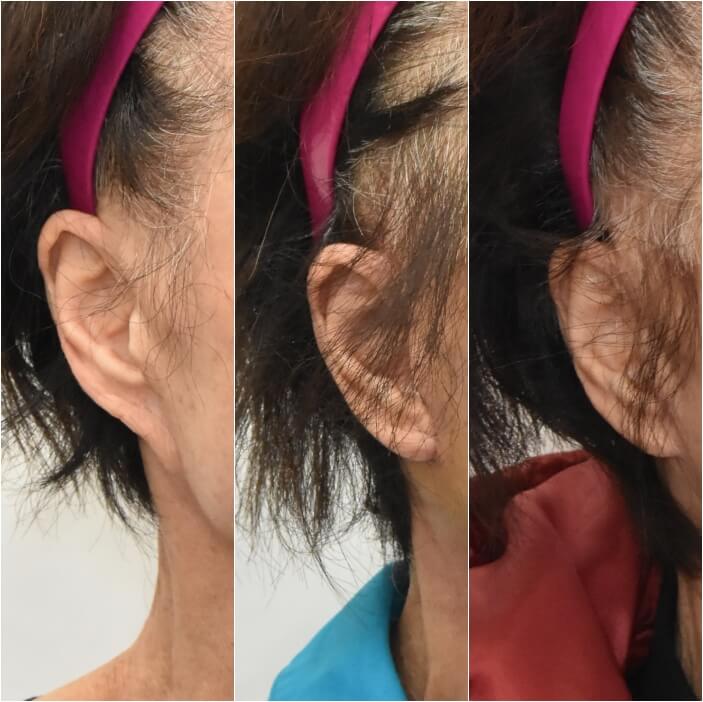
Once an attached earlobe develops, it is hard to reverse. From left: before surgery, 2 weeks after surgery, 7 months after surgery
- Is earlobe surgery also possible at the same time as a facelift?
There are, surprisingly, many articles about facelifts and ear shape. However, because the focus is so often only on the lifting result, there are many patient reviews that overlook the shape of the earlobe.
Even in a first-time surgery case, if the ear shape has changed, I believe it should be corrected during the facelift. And if such careful attention is given, it is possible.
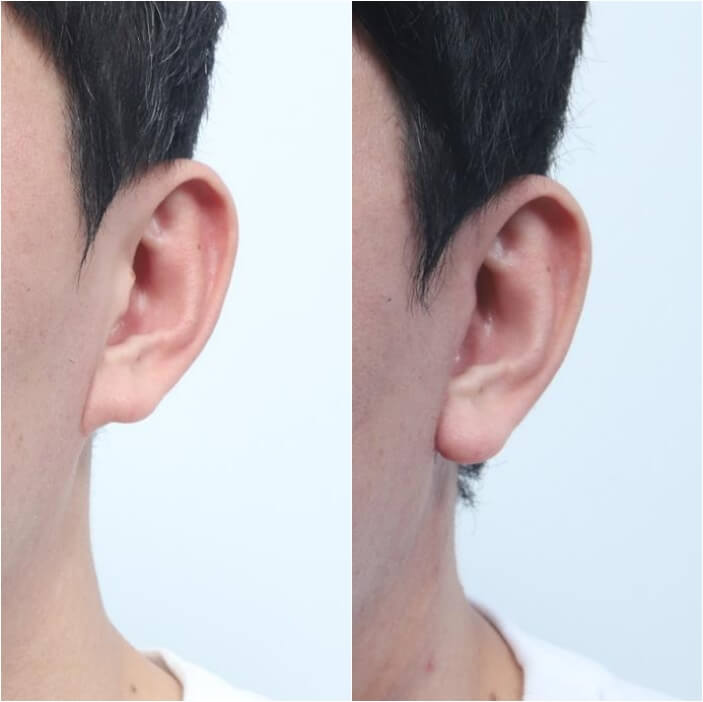
A 43-year-old male patient with no previous surgery: the earlobe before and after a facelift
If you leave the attached ear (according to Stuzin, an attached earlobe or non-pendulous earlobe) as it is and focus only on the lifting, then no matter how much the surgeon may excuse it by saying, “That is how the ear looked originally,” there will still be something unsatisfactory about the result.
If you want a facelift without attached earlobe deformity, as shown below

Please click the KakaoTalk consultation right now!