Hello. I am Dr. Park Seong-hyeok, and I am preparing to open Nunehight Plastic Surgery Clinic.
Unlike the days when I only had to focus on doing surgery well as an employed physician, opening a hospital has turned out to require more attention than I expected.
Loans, business registration, buying supplies needed for the clinic, choosing the computer program, hiring staff, and so on....
While I have been spending busy days contacting one person after another and receiving estimates, I received some personally happy news and wanted to share it on my blog.
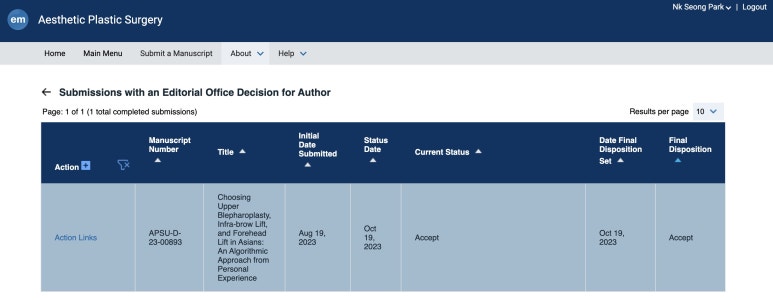
My paper, Choosing Upper Blepharoplasty, Infra-brow Lift, and Forehead Lift in Asians: An Algorithmic Approach from Personal Experience, has been accepted for publication in the SCI journal Aesthetic Plastic Surgery ^^
This paper reflects the trial and error I experienced over a year and a half from 2020, while performing surgery on more than 500 patients, as well as my thoughts on achieving better outcomes. At the time, I kept asking endless questions about things like, “Which surgery is appropriate for eyes with these conditions?”
Among the various eye surgery options that middle-aged patients can choose,
who should undergo upper blepharoplasty...
which eyes are better suited for an infra-brow lift...
under what conditions a forehead lift is more appropriate...
Sometimes I stood on my commute subway reading the paper, and sometimes I wrote the script while taking notes on my phone. I also introduced the answers to those questions on my personal blog in a version that ordinary readers could understand (I did try to write it simply, but... perhaps because my writing skills are lacking, more people said the article was difficult to read ^^;;).
Still, although this content was somewhat heavy for a blog post,
because it is a topic that many doctors would be interested in, and because I wanted to have my ideas academically validated,
I submitted the paper to several journals this summer, and one of them contacted me to say it would be published.
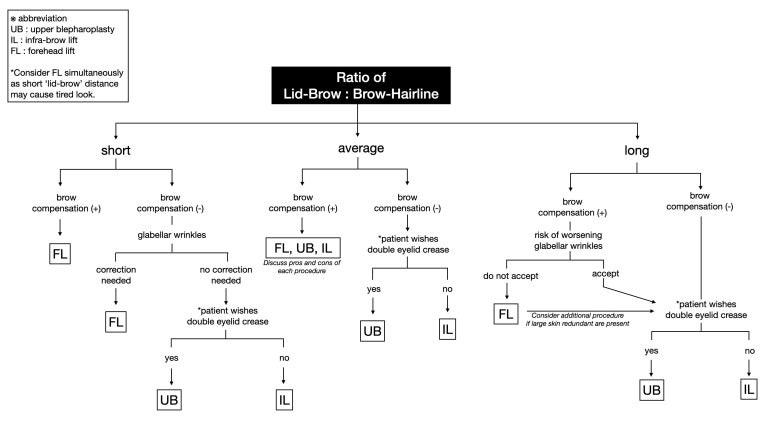
The paper’s content is about dividing patients with drooping eyelids in middle age into three groups, and then recommending the appropriate surgical method according to the degree of use of the frontalis muscle and each patient’s individual surgical goals.
To be frank, this paper lacks numerical data. Its conclusion is also somewhat anticlimactic. And unfortunately, Aesthetic Plastic Surgery is not the No. 1 journal in the field of plastic surgery, and its impact factor is around third place (I had aimed for PRS or ASJ... personally, that is somewhat disappointingㅠ).
However, because beauty cannot be quantified, I thought data such as “how many mm is the average distance” is meaningless, since it varies by race, culture, and individual aesthetic preference. Instead, I argued that the aesthetics of the doctor and the patient are more important, and APS accepted it after just one revision ^^
Above all, this paper is an achievement in that I handled everything myself, 100% with my own hands, without relying on anyone else—not only the patient records, photography, and surgery, but also the English script and the charts. A sole-author paper, which had long been one of my ambitions!!! haha
Going forward, I will continue to research and strive for plastic surgery that is medically grounded and desirable.
Below, I am posting a translated version of the abstract of the accepted paper.
Research Background
Eye surgery is a cosmetic procedure widely performed around the world in the field of plastic surgery. However, achieving ideal results for the upper eyelid is difficult, so careful patient selection and appropriate choice of surgical technique are important.
Research Purpose
This study aims to provide recommendations for choosing the most suitable surgical method among the three commonly performed treatments for the aging upper eyelid: upper blepharoplasty, infra-brow lift, and forehead lift.
Methods
A retrospective cohort study was conducted on 518 patients from October 2020 to May 2022. Pre- and postoperative photographs were analyzed to assess changes in the distance between the eyelid and the eyebrow. In particular, in patients who habitually use the frontalis muscle to compensate for eyelid laxity, a significant change in the postoperative “eyelid-brow distance” was observed.
Study Results
The results confirmed that when ptosis was addressed through upper blepharoplasty or an infra-brow lift, stimulation of frontalis muscle activity decreased, leading to brow drooping. However, the degree of compensatory frontalis muscle use varies from person to person, and the changes in eyelid-brow distance observed before and after photography were influenced by various factors. Therefore, obtaining clear numerical data on changes in the eyelid-brow distance after eyelid surgery was complex. Still, after analyzing 518 cases, the author classified patients into three groups, and this method could contribute to more predictable and satisfying outcomes.
Conclusion
Based on an analysis of pre- and postoperative outcomes in 518 patients, this study proposed a specific strategy to improve patient satisfaction. The proposed treatment algorithm may help less experienced plastic surgeons avoid a stronger impression or unsatisfactory results after midlife eye surgery.