Introduction
A little while ago, I mentioned that my sole-authored paper had been accepted for publication...
About three weeks ago, it was officially published in an international plastic surgery journal. ^^
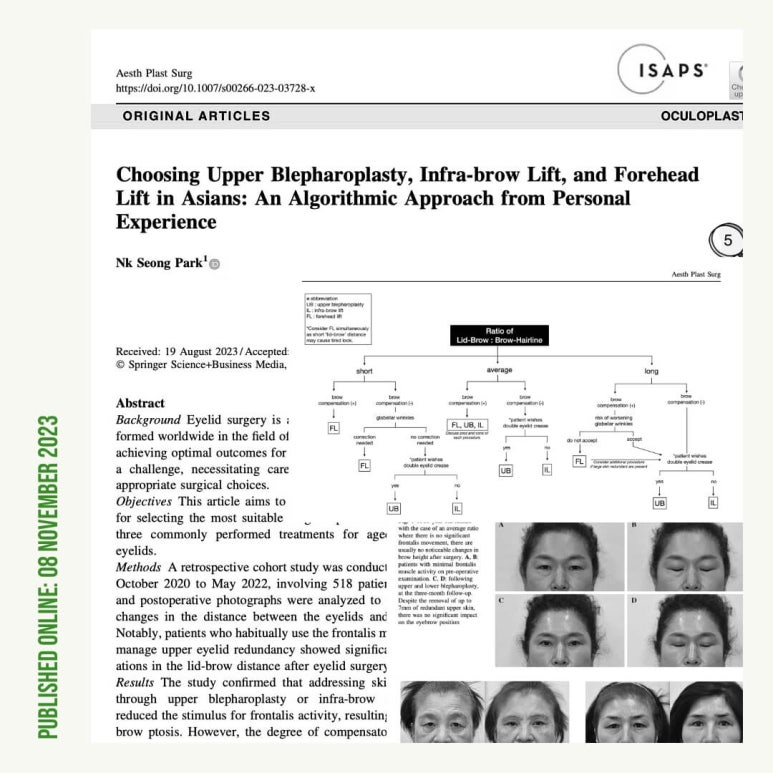
A portion of the paper
"How can we explain to patients with limited background knowledge that 'based on how your eyes are, a different surgery is recommended instead of the one you mentioned'?"
In fact, this paper began with that very question. I looked through many textbooks and references in my own way, but I could not find any material anywhere that guided a patient treatment algorithm among the various eye surgery options. That even led me to the rather presumptuous thought, 'Well then, why don’t I make one myself?'
This post introduces the background behind writing my middle-aged eye surgery paper.
If you only want the conclusion about what kind of eye surgery should be done for your eyes and how, please just read the last paragraph. ^^
Why don’t we talk about beauty?
At conferences where plastic surgeons gather, in textbooks for study, or in discussions about surgery with senior doctors, the focus is mostly on technique.
Should double-eyelid fixation be done on the tarsus or on the SAJT?
In eyelid correction surgery, should the levator and Mueller’s muscle be pulled together, or should the two be separated...?
Even younger doctors who have just become specialists always ask only about the procedure when discussing medical matters. Of course, I was the same when I first started operating. Technique... is very important.
But we do not talk much about what is beautiful, or what should be changed and how in order to become beautiful. Perhaps that is because whether something is "pretty" or "not pretty" is such a subjective and emotional field...?
Aesthetic judgment is just as important as surgical technique! No, maybe even more...
If you are a doctor who has gone through the notoriously tough training of a plastic surgery residency (unless you are truly hopeless with your hands -_-), I think surgical technique becomes standardized fairly quickly. The problem is aesthetic judgment. If a plastic surgeon simply performs the surgery already decided by the clinic—or by the manager—without thinking about beauty... then they are nothing more than a performing bear.

Different by Chae Jeong-wan
The larger and more systematized a hospital is, the more highly divided the work becomes. A person who only does consultations, a person who only answers phones, a person who only disinfects wounds... even doctors may have their work divided under a team collaboration system.
In this highly efficient system (or, to put it another way, a factory -_-;;), a manager negotiating prices ("We’ll give you a special discount just for you... but please never tell anyone else"), and a structure where members themselves must compete for sales... in such an environment, perhaps worrying about beauty is a luxury?

Gangnam Beauty by Mind C
A plastic surgeon who performs cosmetic surgery needs to develop an eye for aesthetics. In fact, when I was a resident, a patient who had had nose surgery by Dr. A (both doctors had more than 15 years of experience) underwent revision surgery by Dr. B a few years later... Seeing how clearly different the results were, I thought, 'Beyond a certain stage, cosmetic plastic surgery is a field of medicine where aesthetic sense matters more than technique.' And this was even though Dr. B, who produced a result that anyone could see had made the patient look better, did not perform nose surgery as often as Dr. A.
A doctor who operates exactly as the patient wants?
Many patients who come to a plastic surgery clinic have already decided for themselves what surgery they want. They can see it, so they self-diagnose, and because people around them say they did well after this surgery, they self-prescribe. From there, all that remains is finding a doctor who will carry out the prescription they have already imagined.
I once had the opportunity to observe the consultation process of a certain senior doctor with many years of experience, and in many cases, the treatment was simply to do exactly the surgery the patient wanted. In fact, this kind of practice inevitably raises the consultation conversion rate. Everyone is naturally drawn to the story they want to hear.
However, regardless of surgical skill, simply doing exactly what the patient requests does not make dissatisfaction cases go to zero. Patients who came for eye surgery often focused only on the eyelids, and because they failed to consider the harmony of the face as a whole, they often ended up making the wrong decision for themselves.
Perhaps this paper is the result of my 고민 and trial and error, and of the synthesis emerging from the gap between the surgery patients want and the surgery I recommend.
Strictly speaking, the content of the paper is not entirely new. The meaning of "indication" can be simply explained as being synonymous with cases in which such-and-such surgery or treatment is "recommended."

Stand on the shoulders of giants and look at a wider world
But there was no intuitive algorithm like 'do A in this case, B in that case' that comprehensively considered the pros and cons of each surgery. So, based on my experience, I decided to make the criteria for which surgery is recommended "instantly understandable at a glance."
So, what surgery should be done for my eyes?
The eye surgeries commonly performed for drooping eyelids in Korea broadly fall into three types.
When I first submitted the paper, the reviewers asked things like, 'If the distance between the eye and the eyebrow is X cm, is that short or long? Provide numerical values.' But since everyone has a different face size, and since aesthetic standards also differ by individual, culture, and race, I do not think there is a single correct answer to where the ideal eyebrow position should be or how wide the distance between the eyes and eyebrows should be to look beautiful.
Rather than absolute length, I think the ratio of eye-to-eyebrow length : eyebrow-to-hairline length is more important. And that ratio is influenced by culture and race. Fortunately, the plastic surgery department at Asan Medical Center had data comparing Miss Korea contestants and the general public.
So when I see someone seeking eye surgery, I treat them according to the following criteria:
-
Groups are divided according to the ratio,
-
Depending on the patient’s personal habits,
-
Depending on whether they want double eyelids
The broad direction of the surgical plan is decided along these lines.
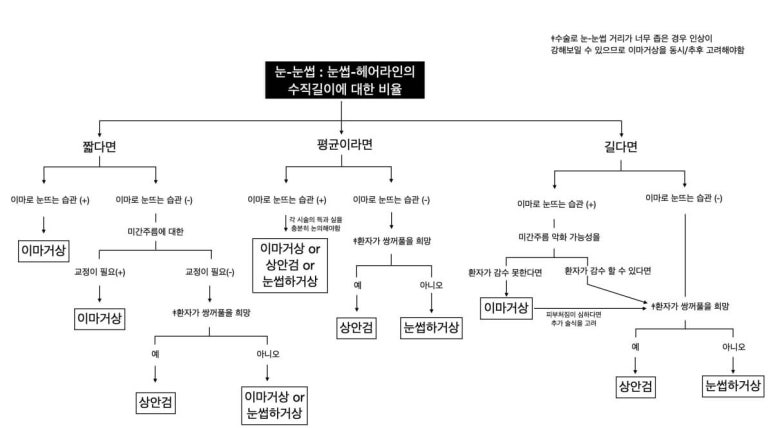
Table included in the paper (translated version)
This table was created based on my experience with a total of 518 patients on whom I performed surgery. It is only a personal recommendation algorithm, and the most important thing is to understand the patient’s needs and expressions well. It is absolutely not a chart meant to apply the above recommendations as a simple formula. But for someone with relatively little experience in eye surgery, I think it can be helpful in establishing surgical criteria.
My iPad mini, which made it possible to do research using spare time during my commute ^^