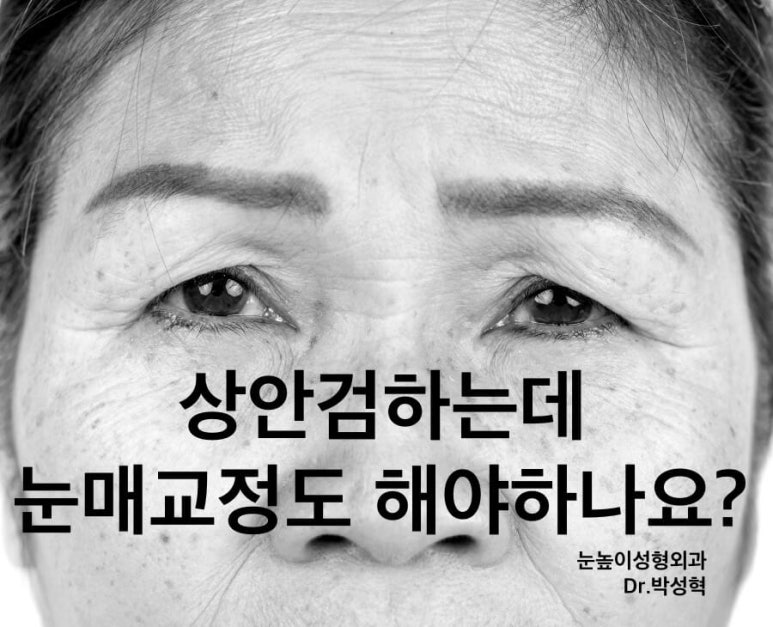
Middle-aged people who want to correct drooping eyelids caused by aging while also creating a more attractive double eyelid line usually consider upper blepharoplasty. In many cases, ptosis correction needs to be done at the same time to achieve satisfying results. However, when upper blepharoplasty and ptosis correction are suggested together, some people worry that it may be overtreatment.
Why recommend ptosis correction?
I will explain the cases in which upper blepharoplasty and ptosis correction need to be performed together, and why.
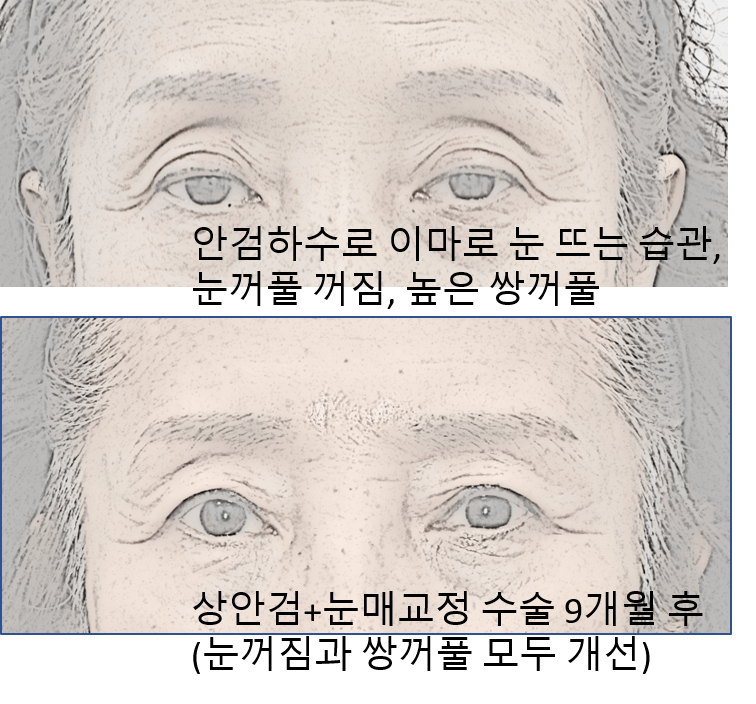
Eye with noticeable ptosis: a case in which ptosis was treated with upper blepharoplasty and ptosis correction
Upper blepharoplasty is limited to removing skin and creating a double eyelid. However, many middle-aged people do not only have sagging skin, but also weakened eyelid-opening strength due to congenital factors or aging. If reduced eyelid-opening strength causes more than one-third of the black of the eye to be covered, it is often difficult to give a youthful and healthy impression overall, no matter how nice the double eyelid line looks.
What patients ultimately need for what is commonly called a clear eye appearance is “appropriate exposure of the black of the eye.” Ptosis correction can be thought of as surgery that enlarges the visible eye.
Is there hidden ptosis too?!
However, there are not only cases where ptosis is obvious, as in the example above. Because the degree of aging differs from person to person, there are also cases in which mild ptosis is hidden by the habit of opening the eyes using the forehead.
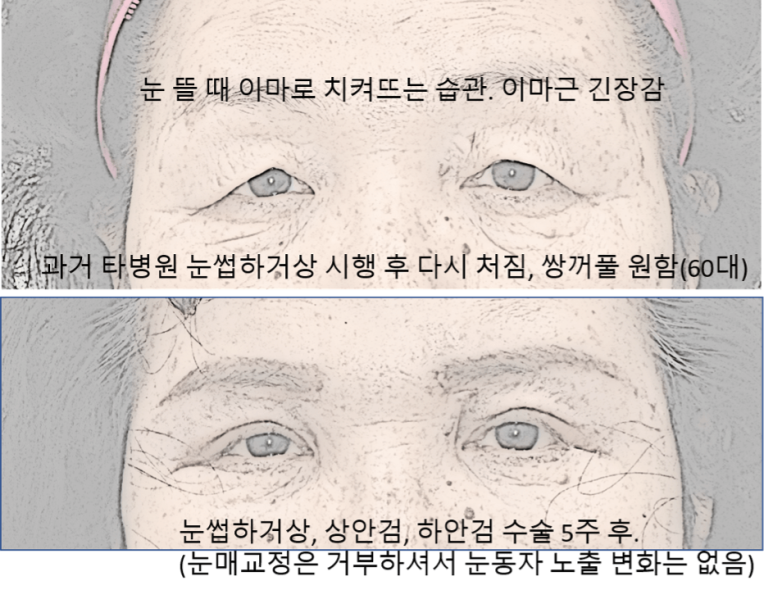
A case in which ptosis is hidden due to the action of the forehead
When sagging eyelid skin blocks the field of vision, people unconsciously lift the forehead and eyebrows. In such cases, the forehead muscles, as well as the eye-opening muscles, are used, so the actual ptosis does not appear prominent.
In these cases, if upper blepharoplasty is used to treat the sagging eyelids, the blocked field of vision improves, so the forehead muscles no longer need to work. If the role of one of the two muscles that were lifting the eyelids disappears, then the eye-opening muscle alone must lift the eyelid.
In such cases, patients may mistakenly think that ptosis has appeared after upper blepharoplasty, but in fact, it is a case in which previously unnoticed ptosis is revealed once they stop unconsciously lifting their eyebrows.
That is why upper blepharoplasty alone may not sufficiently improve eyes that look sleepy and small, or may make them seem newly ptotic; ptosis correction is needed so that the eyes can be opened without using the forehead and eyebrows.
Double eyelids cause ptosis?!
A close acquaintance of mine looked better with only upper blepharoplasty.
That is correct. There are many cases in which upper blepharoplasty alone is enough.
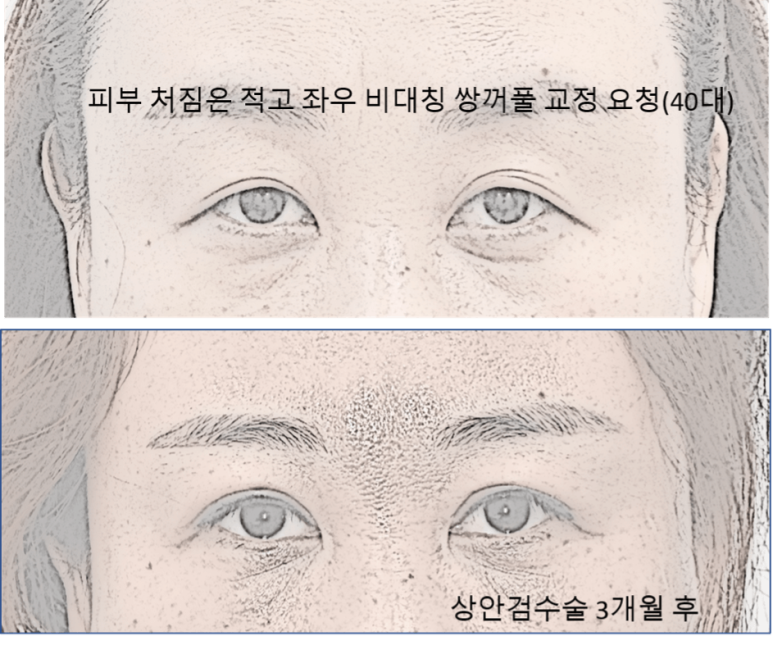
A case in which upper blepharoplasty alone was performed because the eye-opening muscle strength was sufficient
The case above is exactly such a case. During the preoperative examination, when a double eyelid was simulated, the amount of iris exposure was appropriate.
Have you ever compared
carrying an empty bag with...
carrying a bag that has been filled and become heavy?
When you carry the one with things in it, have you ever felt that going up and down stairs becomes difficult?
Some people may feel it is heavy, while others may not. This can vary depending on how much is in the bag, whether your arm strength is strong or weak, and so on.
What I mainly notice while doing eye surgery is...
Creating a double eyelid where there was none is similar, from the perspective of the eye-opening muscle, to having more weight to lift.
-
If the muscle is strong, lifting the extra load of a double eyelid may not be a burden at all.
-
But if the eye-opening strength is weak, ptosis may be visible even with a low double eyelid line.
-
On the other hand, even if the muscle strength is strong, making the double eyelid too high makes the load much heavier, and the eyes may end up looking sleepy.
It is not easy to explain situations like this to patients. Because plastic surgery is visible on the surface, patients sometimes come to the clinic after diagnosing themselves, and they may regard a recommendation for ptosis correction as overtreatment.
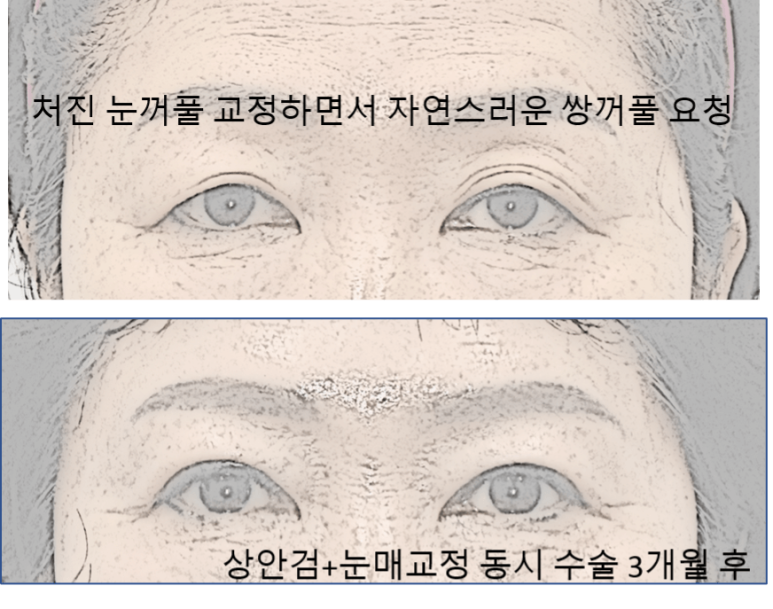
A case in which the need for ptosis correction was well understood
In the case above, ptosis correction was recommended because there was concern that the iris would be covered significantly if ptosis correction was not performed, and fortunately the patient accepted the need for it, allowing a satisfying result to be achieved.
What if the surgery had been performed only as the patient wanted, for double eyelids alone?
When consulting at a plastic surgery clinic, someone who comes in knowing what ptosis correction is has usually done a lot of research. In fact, most patients think that everything will be solved as long as they get double eyelids^^
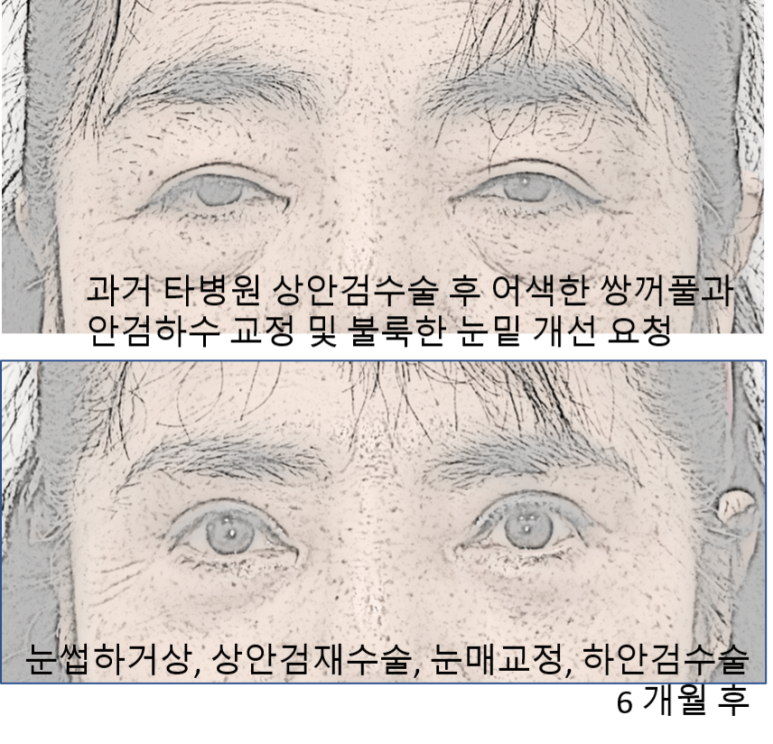
A case in which ptosis correction was performed together for a patient who came asking only for double eyelids
The case above involved a patient who came in wanting only new double eyelids while also improving lower eyelid sagging. Fortunately, the patient understood the need for ptosis correction and also accepted that it would be difficult to improve the sagging skin with upper blepharoplasty alone. Brow lift, revision upper blepharoplasty, ptosis correction, and lower blepharoplasty were performed, and the patient was very satisfied and kindly referred many people afterward^^
What would the result have been if only upper and lower blepharoplasty had been done based solely on the patient’s request...?
Whether to recommend ptosis correction can vary by doctor!
To be honest, ptosis correction is not a cure-all, and I am not a promoter of ptosis correction either. Because of the difficulty of the surgery, results are greatly influenced by the surgeon’s skill, and unfortunately there are also people who suffer from side effects from time to time. However, I believe that avoiding a procedure that is necessary for the best result is also a problem.
There is a rumor among patients that “you should avoid doctors who always recommend ptosis correction”...
Personally, I think whether ptosis correction is recommended depends on the doctor’s skill and the accuracy of the diagnosis.
If it is truly not needed, it should not be recommended.... On the other hand, it is also not uncommon for doctors to refrain from recommending it because they are not confident in the surgical outcome or miss a hidden ptosis diagnosis.
Surgical methods also differ by doctor. In fact, surgical techniques can evolve over time, with new methods being developed and old ones fading away. But you should know that the classical techniques in textbooks are methods that have survived long-term verification by many doctors.
Diagnosis is also an area that requires a great deal of experience. During examination, patients may unconsciously exert more force than usual when opening their eyes. Depending on the desired height of the double eyelid line, ptosis may appear or disappear. Sometimes, surgery using a different approach than eyelid surgery (such as forehead lift or brow lift) is recommended. Therefore, while eye surgery is in high demand, achieving good results requires diverse clinical experience.
Conclusion: When is ptosis correction necessary?
-
When eye-opening strength is weak
-
When ptosis is hidden because the eyes are opened using the forehead
-
When the load on eye-opening strength increases as a double eyelid is created
For middle-aged patients with only mild eyelid skin sagging, and who do not have the habit of raising their forehead when opening their eyes, upper blepharoplasty alone may be sufficient. However, if ptosis is diagnosed, ptosis correction should be performed together. Please consult a board-certified plastic surgeon with extensive experience in surgery for sagging eyes in middle age about “eye surgery that suits my eyes.”
Wait!
Please also keep in mind that upper blepharoplasty and ptosis correction are not the only ways to correct sagging eyes.
Click if you want to know more about surgery for sagging eyes in middle age!
When the space between the eyebrows and eyes is close, upper blepharoplasty can easily make the face look angry. Depending on the condition of each person’s eyes, brow lift or endoscopic forehead lift may be better options.
