
What Is Toning Laser?
Even if you are not someone who has been to a dermatology clinic often, you have probably heard the term laser toning at least once.
Clinics often explain it vaguely as a procedure that brightens skin tone and gives the complexion a clearer look...
But even after several treatments, there are often cases where people still do not really understand how it differs from other lasers used for removing spots or from IPL.
Clinics say that you need at least 5 to 10 sessions for the treatment to be effective...
Didn’t that make you feel a little like you were being taken for a ride?

As a side note...
Back when I was in my third year as a military doctor,
I had plenty of time and not much to do,
so I spent a lot of time visiting dermatology clinics^^;;
At the time, a dermatologist told me,
If you try to treat it all at once,
the pigment will rebound and become darker,
so you have to soothe it and treat it gently.
I was also a doctor,
but perhaps because I knew almost nothing about lasers at the time,
I did not trust that doctor’s words,
and I remember not booking treatment because it felt like I was being taken advantage of.
Even after becoming a plastic surgeon,
it was only after studying lasers in depth
that I later realized
that what that doctor said back then was not a lie....
(My apologies to Dr. xx in Cheonan for that back then)
In this post, using a case of Genesis toning treatment for refractory melasma at Nuneopi Plastic Surgery as an example,
I will explain what toning laser is.
Case of Genesis Toning Treatment for Refractory Melasma
Let’s look at the case first.
This was a patient in their 70s who came to a skin clinic near Gangnam-gu Office Station after saying that the pigment had gotten worse after laser toning.
As we talked, I found out that they had once lived in the same apartment complex as me^^
Because of that, they seemed somewhat open to Nuneopi Plastic Surgery’s treatment suggestion, but since they were still going to another skin clinic, they were hesitant to switch right away.
So I made this suggestion.
Why not try one treatment,
and if the result is good,
continue treatment after that?
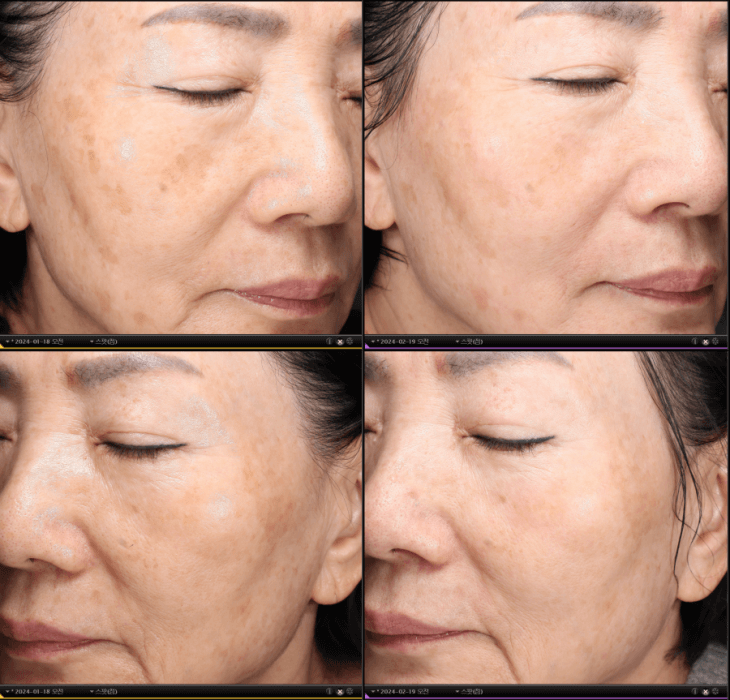
(Left) Before the procedure, (Right) After 1 toning session
This is the result after one treatment using Clear Silk, the Cyton laser owned by Nuneopi Plastic Surgery,
a so-called Genesis toning laser.
The patient was so, so satisfied that they have kindly continued treatment to this day.
So, why did Genesis toning work for this patient,
who had already undergone many different types of lasers?
Pigment Laser vs. Toning: What’s the Difference?
When people usually refer to pigment lasers (lasers with a Q-switch pulse width), they often think of Nd:YAG (1064 nm) or ruby (694 nm) lasers...
Typical pigment laser treatment works by destroying melanocytes to treat pigmented lesions. As light is absorbed by melanin, heat is generated, and that heat causes the melanocytes to die as well (SPTL).
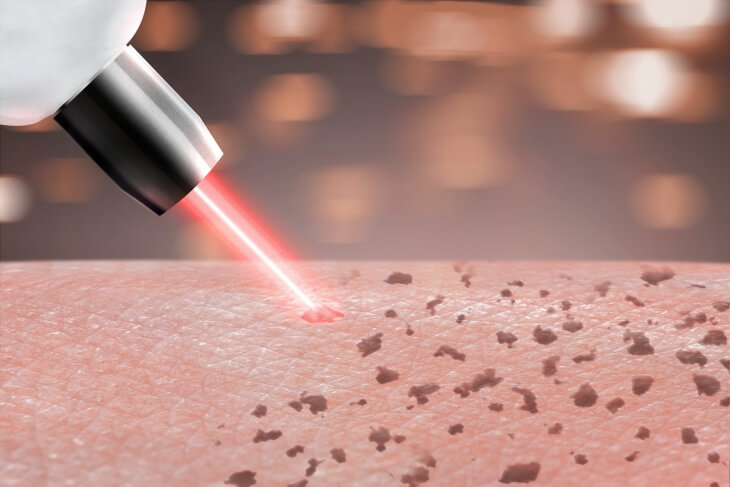
The principle is that melanin, which causes pigmentation, absorbs heat and causes melanocytes to die
Just like common pigmented lesions such as freckles and blemishes,
early doctors expected melasma to respond well to treatment based on this concept as well.
But in reality, that was not the case.
In melasma, the classic method of destroying melanocytes
caused new melanocytes
to create melasma again,
leading to even worse symptoms.
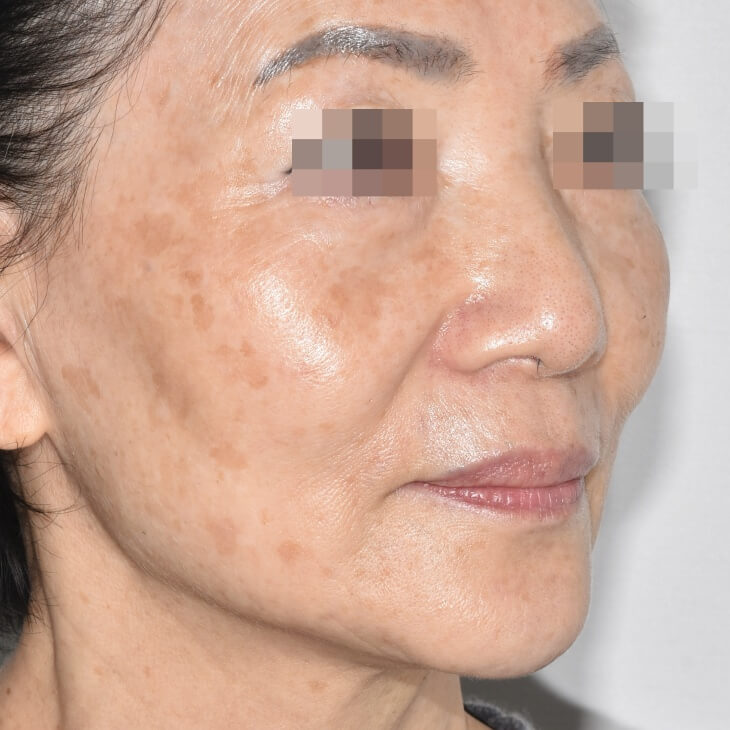
The appearance at the patient’s first visit in the refractory melasma case above. The condition had worsened due to incorrect laser treatment.
Meanwhile, laser toning
does not destroy melanocytes,
but instead aims to destroy only the melanin inside them.
The photo below is excerpted from a paper by a Korea University professor who first introduced the concept of toning to the academic community...
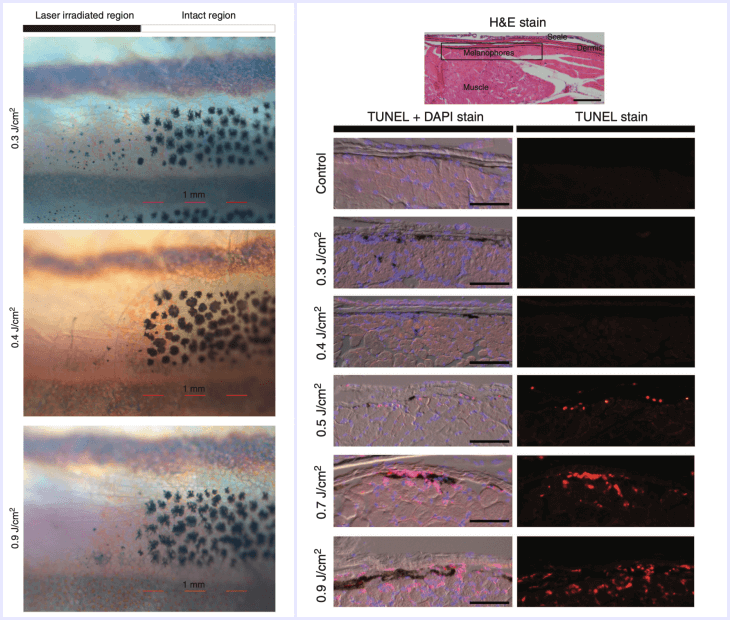
(Left photo) With energy above 0.4 J/cm2, no melanin remains, but at 0.3 J/cm2, melanin is still observed. In other words, there is a threshold energy at which melanin begins to be destroyed.
(Right photo) When special staining (red) was used to identify the distribution of dead cells, 0.5 J/cm2 was limited to the superficial layer of the skin, but at 0.7 J/cm2 or higher, dead cells were widely distributed in deeper layers as well. In other words, this is why incorrect laser treatment worsens melasma.
In the end, when the laser irradiation energy (fluence) is lowered, it is called “toning” because not the entire cell (melanocyte) but only the intracellular organelle (melanin) is lysed. In academic terms, this would be subcellular SPTL or low-fluence Q-switch Nd:YAG.
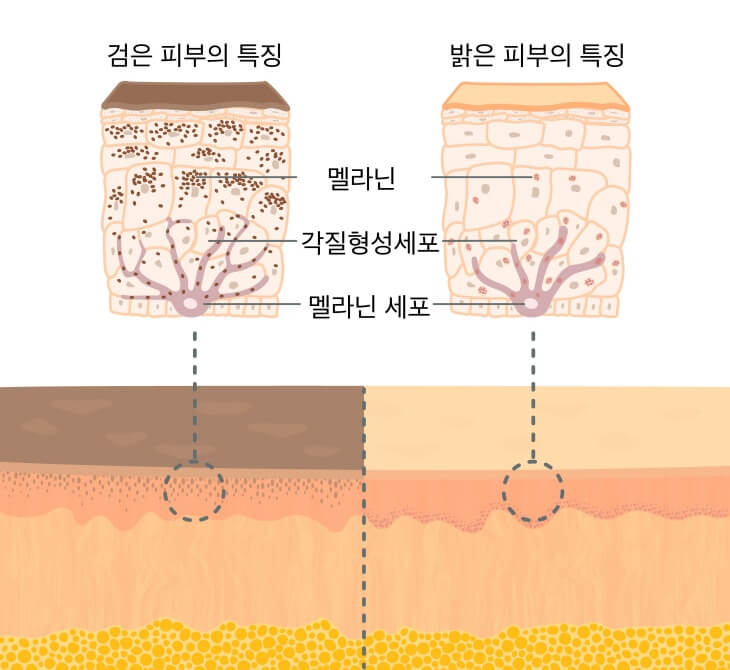
Melanin is produced in melanocytes and is continuously generated and moved upward to the surface, where it is shed in accordance with the skin’s keratinization cycle.
Dual Toning: Genesis Toning + Laser Toning
Then what is the difference between Genesis toning performed at Nuneopi Plastic Surgery and regular toning?
Before explaining that, it is necessary to explain Genesis toning.
Genesis toning is a treatment that uses a 1064 nm laser to apply heat to the dermis. It is a concept of improving skin texture, restoring elasticity, and treating pigmentation by improving the dermal environment...
When the skin is in poor condition, the cause may lie not only in the epidermis but also in the deeper dermis. If you only treat the epidermis that is visible to the eye and do not address problems in the dermis, there will be no fundamental improvement no matter how much treatment is done. It is like farming: no matter how good the seeds or fertilizer are, plants will not grow healthy and well if the soil is poor...
Because Genesis toning is centered on heating the dermis, it uses a laser with a longer pulse width than conventional pigment lasers. GentleMax Pro and Quanta’s Excel V are representative long-pulse lasers.
The Genesis toning used at Nuneopi is Cyton’s Clear Silk. According to the importer, no one had bought it yet, so Nuneopi Plastic Surgery is the only clinic with this device...
The reason I specifically purchased Clear Silk is
because it tells the practitioner the temperature
in real time during the procedure.
Since raising the temperature is the core of the Genesis technique, whether the target temperature has been reached is a factor that affects the result...
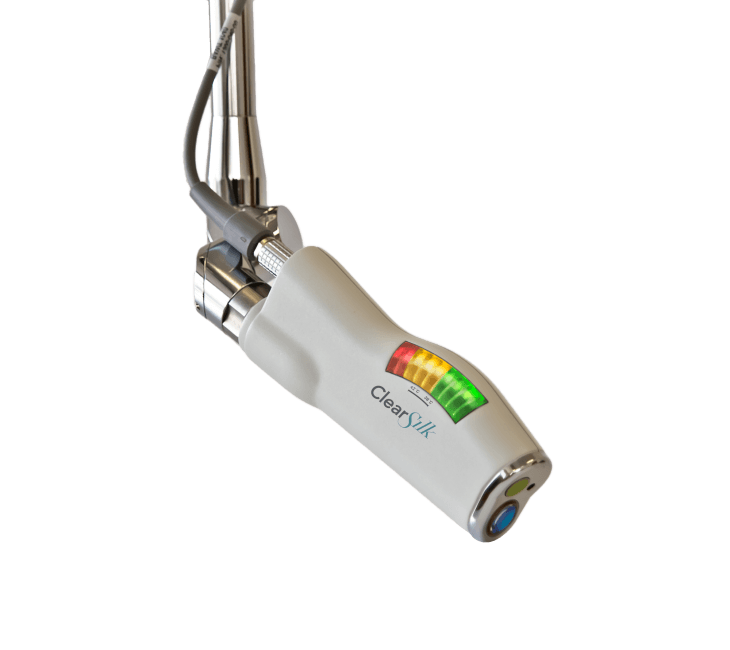
Clear Silk Genesis toning has a function that shows the skin temperature in real time.
Palpation by the practitioner’s hand can serve as a supplementary method, but it can also be affected by surrounding conditions such as room temperature, so it has limitations in accuracy. By measuring the actual temperature and maximizing the effect within a safe range, I think that may be why the skin improved so much even after just one toning session, as in the case above.
I ended up talking quite a bit about Genesis toning... ^^;;
Dual toning refers to regular toning (short wavelength) + Genesis toning (long wavelength).
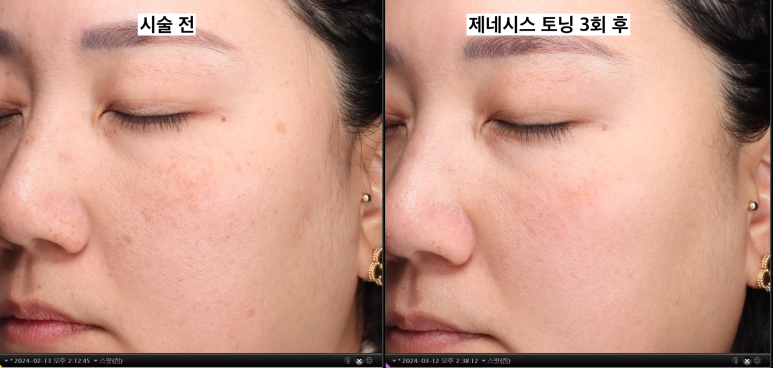
A case of treating refractory pigmentation in the cheekbone area with Genesis toning alone
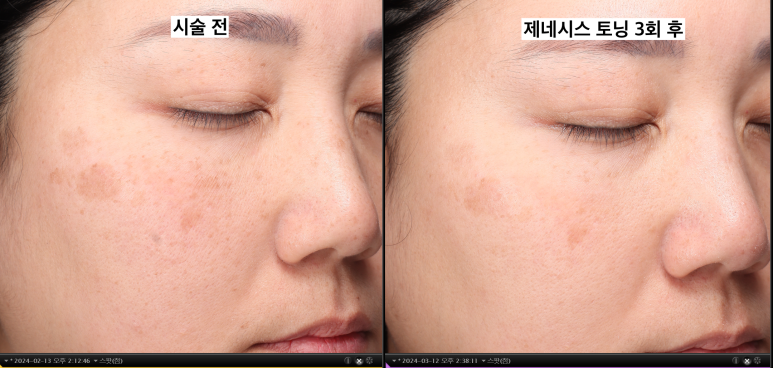
A case of treating refractory pigmentation in the cheekbone area with Genesis toning alone
Can Melasma Be Treated with Laser Toning Alone?
Melasma cannot be treated with laser alone.
Because melasma is a mixed pigmented lesion involving both the epidermis and dermis, treatment should be combined with not only lasers but also whitening agents (hydroquinone, tretinoin acid), peeling agents (AHA, GA), vitamin C iontophoresis, and oral tranexamic acid.
However, in cases like this one, where pigmented lesions have worsened due to incorrect laser treatment, I think that if dermal treatment using Genesis toning is done first, there is a much better chance of improvement.