From time to time, patients ask:
“Can I use only mouthwash when I’m busy?”
To give you the conclusion first,
mouthwash cannot replace brushing your teeth.
Plaque attached to the tooth surface is a sticky film formed when bacteria clump together.
This film does not come off easily just by rinsing with water.
It must be physically scrubbed away with the bristles of a toothbrush touching the boundary between the teeth and gums.
Therefore, the proper way to use mouthwash is not to skip brushing,
but to understand it as a step that supplements brushing and flossing.
Today, Yeonsei Geurida Dental Clinic will explain how to use mouthwash.
When is it best to use mouthwash?
In general, mouthwash is best used as a supplementary step in oral care when brushing is difficult, rather than immediately after a meal, or before bedtime.
However, if you rinse vigorously immediately after brushing with fluoride toothpaste, the fluoride that should remain on the tooth surface may be washed away.
If you are using fluoride mouthwash to help prevent cavities, it may be better to use it at a different time rather than immediately after brushing.
On the other hand, if the purpose is to manage gum inflammation, care around implants, or bacteria after surgery, you should follow the time and frequency recommended by your dentist first.
How to use mouthwash varies depending on its ingredients and purpose.
Even for the same product, the recommended timing may differ depending on whether it is intended for bad breath management, cavity prevention, or as an aid in gum treatment.
Proper amount and rinsing time
Mouthwash is generally used at approximately 10–15 mL per use.
Hold it in your mouth, rinse thoroughly for about 30 seconds to 1 minute, including between the teeth and around the tongue, and then spit it out.
Holding it in your mouth for too long does not make it more effective.
Rather, people with sensitive mouths may experience stinging or dryness.
Precautions vary depending on the ingredients
✔️For relieving bad breath,
✔️For cavity prevention,
✔️For gum care, and so on,
the ingredients differ depending on the purpose.
Products containing alcohol provide a strong feeling of freshness, but may cause irritation or dryness in people whose mouths are already dry.
In such cases, it may be better to consider an alcohol-free product.
Chlorhexidine may be helpful after gum treatment, but using it arbitrarily for a long period may cause tooth staining or changes in taste.
Therefore, we recommend using products intended for treatment according to your dentist’s instructions.
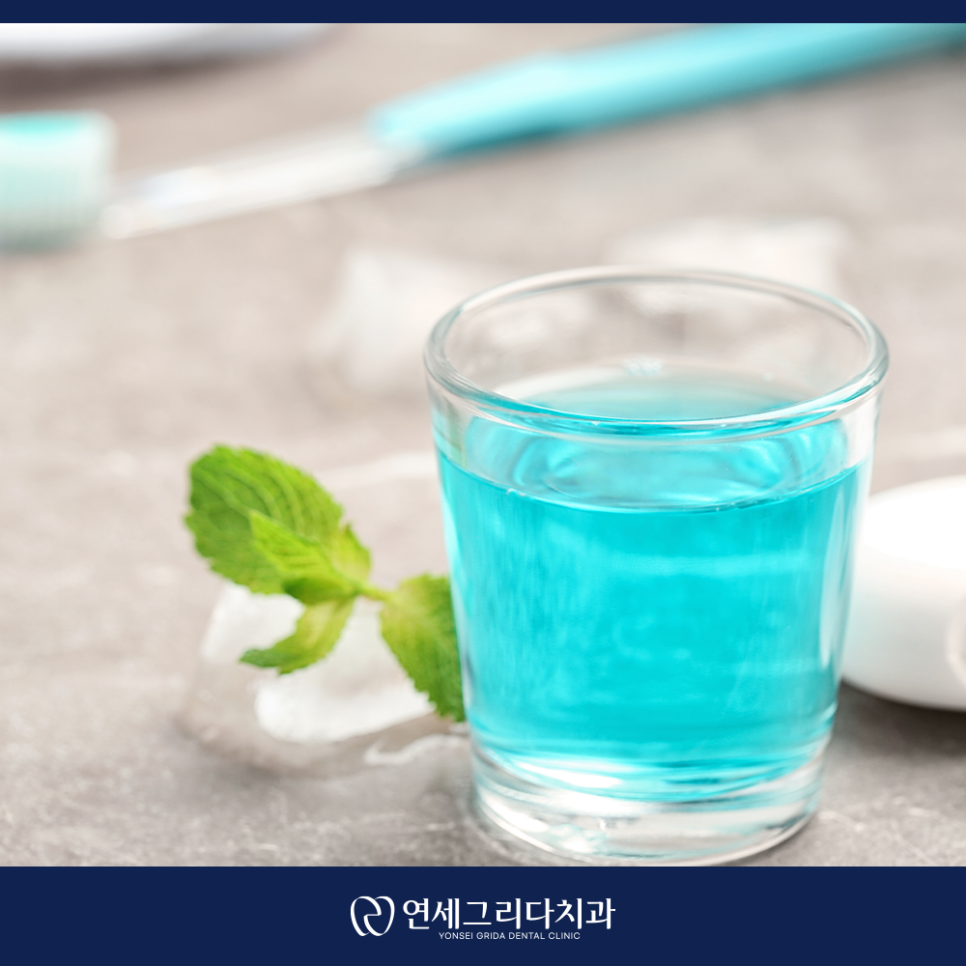
The proper way to use mouthwash
One point that is easy to overlook when using mouthwash is that using it frequently is not necessarily better oral care.
If you have severe mouth sores, experience repeated stinging, or have significant dry mouth, discomfort may increase after use.
Also, if you use mouthwash repeatedly several times a day to mask bad breath, you may discover the underlying cause later.
If bad breath persists for a long time, it may be related not simply to an odor issue, but to tartar, gum inflammation, cavities, or a coating on the tongue.
In such cases, rather than increasing your use of mouthwash, it is better to identify the cause through a dental examination.
The proper way to use mouthwash is to use it appropriately when needed, and if discomfort occurs, discontinue use and have it checked.