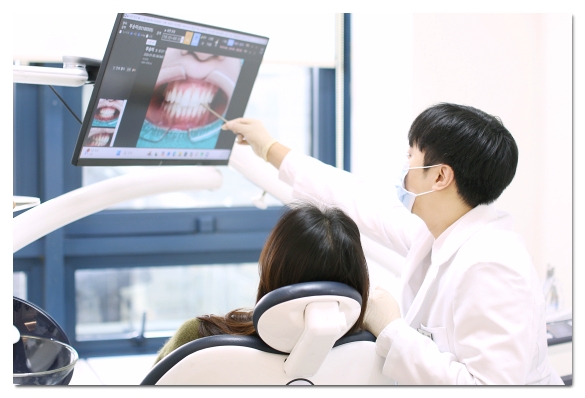
Hello. I’m Park Jae-hyung, the director of Wonjin Dental Clinic.
Can you get just one veneer?
I got four veneers, but now my yellowish teeth stand out even more.

One of the questions we hear most often in the dental office is, “How many do people usually get?”
You may be unsure whether one veneer is enough or whether you need to treat all of your front teeth.
Today, we’ll look at the criteria used to determine the number of veneers, along with some actual cases.
After reading this post, you should be able to decide how many you may need.
Table of Contents
-
The real reason people struggle with the number of veneers
-
Is it okay to get just one veneer?
-
Start by checking which teeth show when you smile
-
What differences are there depending on the number of veneers?
-
Assess your current condition first
-
Ultimately, an individual diagnosis comes first
The real reason people struggle with the number of veneers
The concern about how many veneers to get actually comes down to two things.
One is cost, and the other is “natural-looking results.”
As the number increases, so does the financial burden. However, if too few teeth are treated,
subtle differences in color or shape from the surrounding natural teeth may make the veneers more noticeable instead.
So, how many should you get?
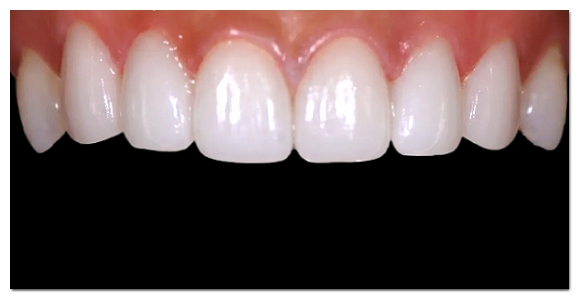
Is it okay to get just one veneer?
Yes, you can get just one.
If you are not getting veneers simply to make your teeth look whiter and more aligned,
but because one tooth was chipped or discolored due to an accident, treatment of an odd number of teeth may be necessary.
Let’s look at the case below.
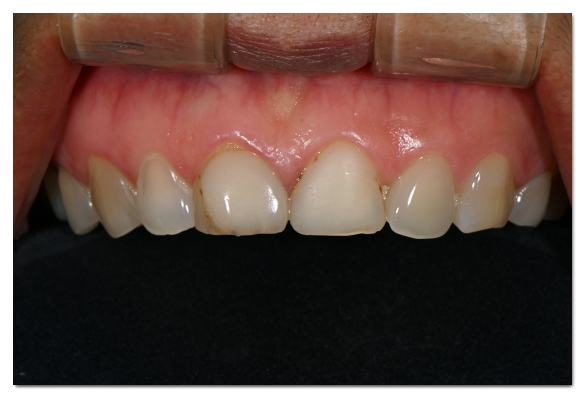
The photo above shows a case in which one veneer was placed. Treatment was needed for the left central incisor.
This patient had previously received veneers on the front teeth.
This time, they wanted to replace only the one left front tooth that had become significantly discolored.
There was also dark staining along the margin of the right front tooth, so we recommended replacing both veneers. However, the patient wanted to replace only one, so we proceeded accordingly.
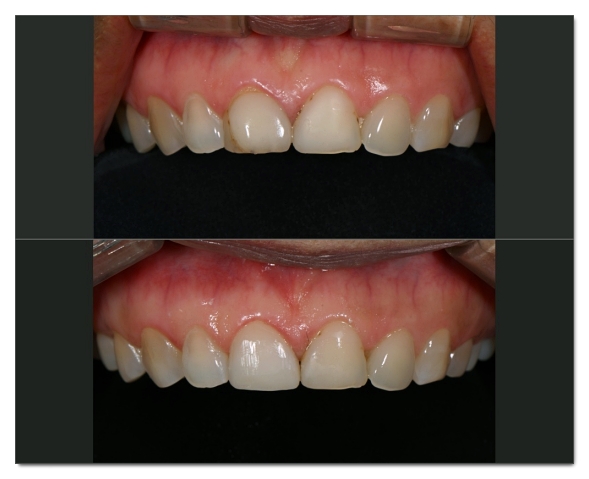
26.05.23–26.05.30
However, there is a fabrication method we recommend in cases like this.
It is called the build-up technique, in which the veneer is created by layering material one layer at a time with a brush.

The reason we recommend it is clear.
When placing an odd number of veneers, the key is to ensure that their color blends well with the surrounding teeth.
With the milling method, in which the veneer is carved by machine, it can be difficult to match the color in detail. This may lead to an unsatisfactory result, such as one tooth standing out too much.
(The milling method is also commonly used for one-day veneers.
The section below explains in simple terms how it differs from veneers made using the build-up technique.)
The color of natural teeth varies by area. Toward the edges, they have a natural translucency and their own characteristic texture,
so the build-up technique is well suited to reproducing these features.
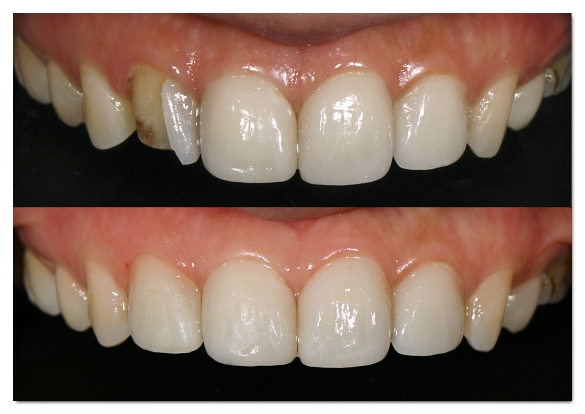
The patient in the case below also came to us after one veneer on the left lateral incisor had fractured.
It blended well with the veneers placed elsewhere and turned out very naturally.
26.06.01–26.06.08
In fact, veneers made using the build-up technique have one more advantage.
They can be made as ultra-thin veneers measuring 0.1 mm.
It is difficult to mill them this thin using a machine.
What is the advantage of thin veneers?
It means that less of the tooth needs to be removed.
Minimizing the amount of tooth reduction may also reduce the risk of veneer debonding.
Other possible complications include veneer fractures, cavities beneath the veneers, and bad breath.
You can learn more clearly how to prevent these complications in the post below.
Please be sure to read it.
Returning to the topic, even so, a dental clinic may recommend an even number of veneers.
That is because the result tends to look most balanced when the same number and shape of teeth are matched on both sides of the central incisors.
However, if your goal is not cosmetic improvement, I don’t think it is necessary to treat several teeth at once.^^

Start by checking which teeth show when you smile
If you are getting veneers to achieve neat, clean-looking front teeth,
the most important criterion for deciding the number is “how far your teeth are visible when you smile.”
This is called the smile line.
When you smile broadly, usually six upper front teeth—and sometimes as many as eight to ten—are visible.
Try smiling broadly as you normally would in front of a mirror.
The teeth that are clearly visible at that time indicate the range that may need treatment.
If the teeth farther back toward the molars, inside the corners of your mouth, are widely visible, the number may increase.
On the other hand, if mainly your front teeth are visible when you smile, a smaller number may be enough to create a neat appearance.
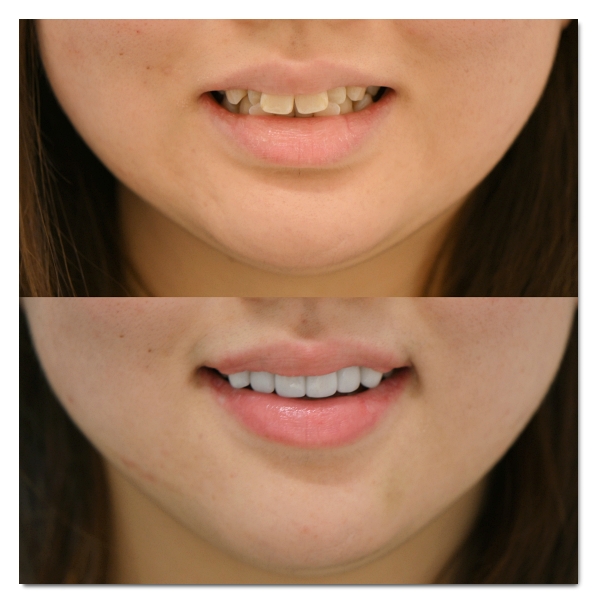
In the case below, you can also see that six teeth are naturally visible when the patient smiles.
26.05.14–26.05.22
What differences are there depending on the number of veneers?
Two veneers may be considered when only the two central incisors are problematic.
They are suitable for a small gap between the teeth or discoloration affecting one or two teeth.
The important numbers are four and six. Although other factors also have an effect, one major criterion is the color of the canines.
The canines are sometimes yellower than the other teeth.
Therefore, when only four veneers are placed, the color contrast may become more pronounced and the result may look less aesthetically pleasing.
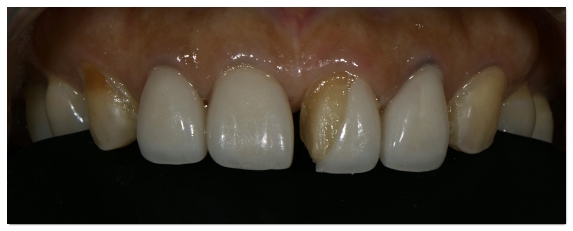
In the photo below, you can see that the existing veneer on the canine has come off.
Even taking that into account, you can see that there is a significant color difference from the adjacent veneer.
If the canines are relatively light in color and the veneer color does not stand out significantly, four veneers are often chosen. Otherwise, six veneers are generally selected.
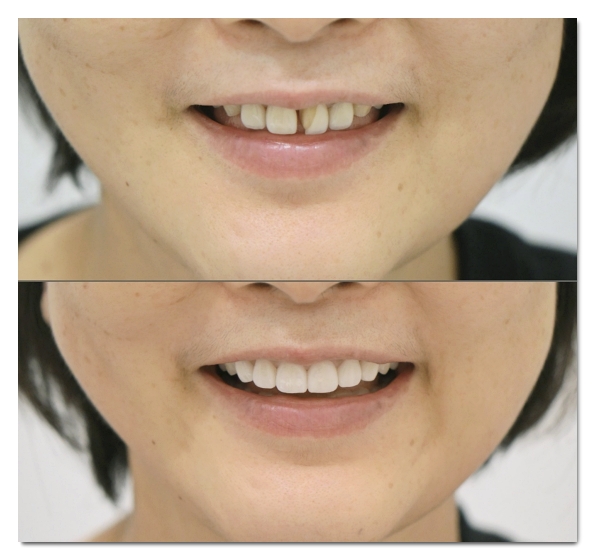
Eight or more veneers may be considered when someone wants to broadly improve the overall color and alignment, as well as left-right and upper-lower symmetry.
(26.05.06–26.06.10)
Assess your current condition first
Before estimating the number, there are several things you can check yourself.
Look at whether the discoloration affects one or two teeth or is more widespread, where the gaps between your teeth are located,
and which teeth concern you most because of their shape or length.
If the problem is concentrated in the center, it may be resolved with a smaller number of veneers. If it extends to both sides, the treatment range will inevitably be broader.
It is also helpful to organize whether color or shape is your main concern,
as this allows you to clearly communicate your priorities during the consultation.
Ultimately, an individual diagnosis comes first
In summary, the number of veneers is not determined simply by asking “how many.”
It is decided by considering the range visible when you smile, the current color and shape of your teeth, left-right symmetry, and your budget.
That is why the appropriate number differs from person to person, even when their concerns are similar.
When you have your initial consultation, I recommend honestly asking, “How would the cost and results differ with this number of veneers?”

You are less likely to regret your decision if you compare the changes and corresponding advantages and disadvantages associated with each number before proceeding.
Therefore, rather than deciding on the number in advance based only on information found online,
I recommend having your teeth examined in person and making your decision after a thorough consultation.
Because veneers involve reshaping the surface of the teeth,
it can be difficult to reverse the process once it has been performed. Careful consideration is therefore especially important.
Thank you. This was Park Jae-hyung.