
Yonsei Garden Dental Clinic’s Mottled Tooth ICON Treatment
Hello, this is Yonsei Garden Dental Clinic in Daechi-dong.
�a0
Many of you may be concerned because there are irregular, blotchy white areas on the tooth surface.
White dots that mainly appear on the front teeth are called white spots (white spot, mottled teeth), and they can occur for a variety of reasons. These white spots tend to stand out even more after whitening treatment. So why do these white spots appear, and how should they be treated?
�a0
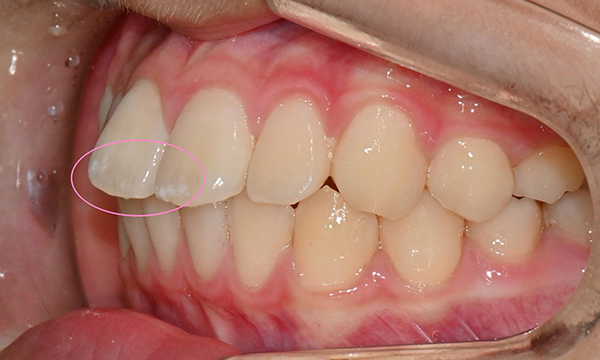
White Spot
Why do white spots occur?
White spots are the result of a congenital structural defect in the enamel, the outermost layer of the tooth, that occurs during tooth development, leading to insufficient calcification. In other words, when the tooth is being formed, the less-calcified enamel reflects light and appears white.
�a0
They can also occur later in life. If a child under the age of 6, when permanent teeth are developing inside the gums, consumes an excessive amount of fluoride, fluorosis can appear in the permanent teeth. The front permanent teeth, which are the most important aesthetically, are formed around age 4, and if fluoride toothpaste is swallowed during this period, fluoride can accumulate in the body and white spots can form due to the excess fluoride. They can also occur if a baby tooth is injured by trauma or develops cavities, or if the tooth germ (tooth bud) of a permanent tooth inside the gum is damaged.
�a0
In addition, after orthodontic treatment, if you do not brush properly around the brackets, plaque builds up on the teeth. If the plaque is not removed consistently, cavities can develop. In the pre-cavity stage, white spots can form due to demineralization, in which the tooth surface is eroded. Calcium and phosphate ions leave the tooth, causing demineralization and creating a porous structure with tiny holes. Because that area has a different refractive index from the surrounding tooth, it looks opaque and white.
How do you distinguish white spots from cavities?
As cavities progress over time, they often become deeper, so the affected area may grow larger or become darker in color. White spots, on the other hand, generally do not change in size, so they can be distinguished from cavities. It is also possible to check by scraping the tooth surface with a dental instrument. In the case of cavities, they are easily scraped and dug into by a sharp dental instrument, whereas white spots have a smoothness similar to the surrounding tooth and do not feel like they are being scraped in the same way as cavities.
�a0
At Yonsei Garden Dental Clinic, we use CUREY to shine visible light on the teeth and check the degree of demineralization of the white spots, then compare and analyze it with the values of healthy teeth.
How are white spots treated?
In fact, white spots are not a major problem even if they are left untreated. However, if there are white blotchy spots on the front teeth, the issue is that they are not aesthetically pleasing.
�a0
The treatment methods for white spots are as follows.
�a0
-
Resin: One method is to remove the area with the white spot and fill it with resin. However, in this case, the treatment is invasive because the affected area must be shaved down, and the treated area may become discolored or detach.
-
Laminate veneer: White spots can also be improved with laminate veneers. The aesthetic improvement is better than resin, but the drawback is that the tooth must still be shaved, and the cost may also be more burdensome than resin.
-
ICON resin infiltration: The third method is resin infiltration, a treatment in which a special resin penetrates the porous structure of the demineralized tooth without shaving the tooth and without anesthesia. Resin infiltration can be performed with ICON (Infiltration CONcept) resin. There is also a brown spot in addition to a white spot; this occurs when organic protein that causes discoloration enters the porous structure of the white spot. If the brown spot is severe, the result is better if whitening is used first to address the darker part of the brown spot, and then ICON treatment is performed two weeks later.
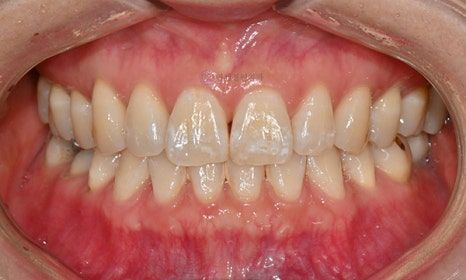
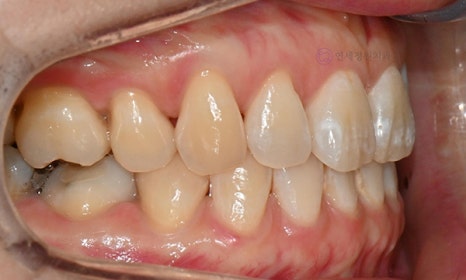
- 8
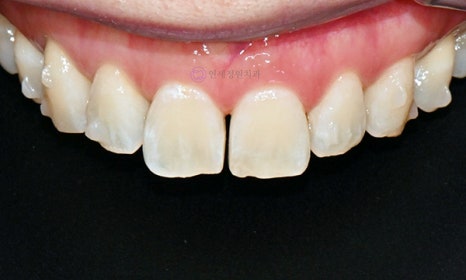
This patient visited us for Invisalign orthodontic treatment, and said they were concerned because the white spots on the front teeth were severe. The left front tooth (right side in the photo) showed a porous structure with a hole along with the white spot. If Invisalign treatment is started, small resin structures called attachments are bonded to the tooth surface, so it is better to perform ICON treatment after orthodontic treatment is completed. However, since attachments were not placed on the two front teeth with severe white spots, we decided to proceed with ICON treatment.
ICON resin infiltration treatment process
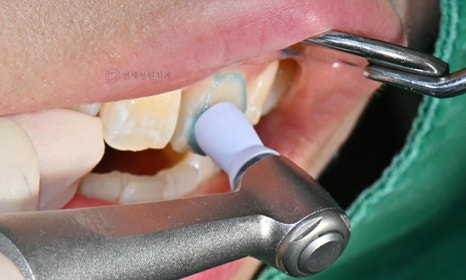
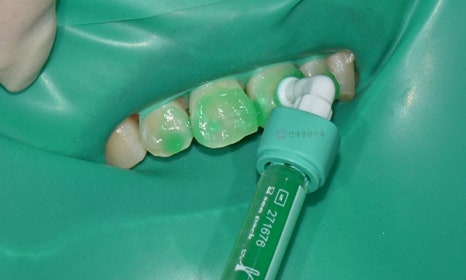
- Tooth surface polishing and etching
�a0
First, the tooth surface is cleaned with a fluoride-free polishing agent. Because the tooth surface is etched with 15% hydrochloric acid, the teeth are first isolated with a rubber dam to protect the gums, and then the tooth surface is etched sufficiently several times with hydrochloric acid to create a porous structure.
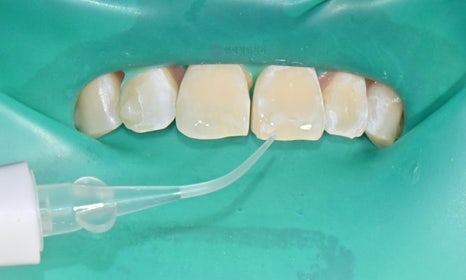
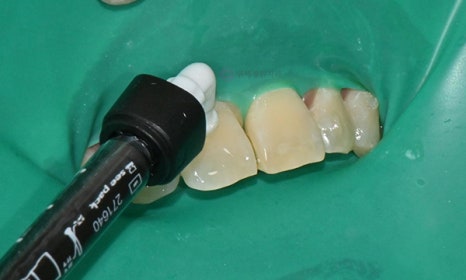
- ICON dry
�a0
The photo on the left shows ICON dry being absorbed after the tooth has been sufficiently dried following etching, and you can see that the white spots have diminished a lot compared to before. If any white spots remain during the drying process, the etching process is repeated.
�a0
- ICON resin infiltration
�a0
ICON resin is applied and polymerized, then the tooth surface is polished smooth. The treatment time is relatively simple and can be completed in about 20 to 30 minutes.
ICON resin infiltration treatment effect
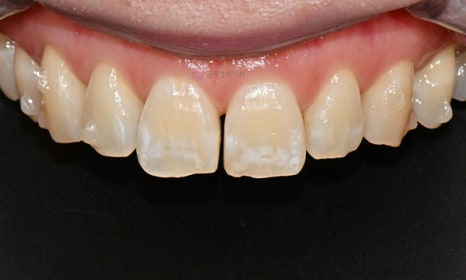
- 9 Before-and-after photos of ICON treatment
These are before-and-after photos of ICON treatment (attachments are bonded to the surrounding teeth for Invisalign treatment, and interproximal reduction has been performed between the front teeth to create space). After ICON treatment, the white spots on the front teeth improved, and the porous structure of the left front tooth (right side in the photo) also improved significantly. The patient, who had been worried that the white spots on the front teeth showed when speaking or smiling, was very satisfied with the results after treatment. Since the photos were taken with the teeth dried, the side area of the tooth where the white spot had been slightly more severe may still look as though some white spot remains, but in the actual natural oral condition with saliva present, it looks much more aesthetically natural than in the photos.
�a0
ICON treatment is especially effective for blotchy white spots on the tooth surface that appear after orthodontic treatment is completed, so we would like to recommend it to our orthodontic patients after treatment is finished (of course, it is even better if white spots do not occur!! :) )
If you would like to treat blotchy white spots on the tooth surface without removing tooth structure, please visit Yonsei Garden Dental Clinic for a consultation :) Yonsei Garden Dental Clinic is close to Samseong Station, Hakyeoul Station, Daechi Station, and Hanti Station, making it very convenient for visits from Samseong-dong, Daechi-dong, Gaepo-dong, Dogok-dong, Ilwon-dong, Yeoksam-dong, Jamsil, and nearby areas.
Building next to BMW at the Wuosung Apartment intersection in Daechi-dong
(Across from Starbucks / Samsung Store)
Yonsei Garden Dental Clinic, an orthodontic clinic in Daechi-dong,
offers convenient and free parking.
Consultation and inquiries: 02-501-2879