
Non-extraction Orthodontics Through Arch Expansion
Hello. I am Yoon Jeong-won, CEO and lead doctor of Yonsei Jeongwon Dental Clinic, an orthodontic clinic in Daechi-dong, Gangnam.
In the previous post, I explained how to turn the arch expansion device. Today, I will show the effects of arch expansion through a patient case.
When starting orthodontic treatment, the biggest concern is whether teeth need to be extracted or not. In particular, many people feel burdened by the idea of extracting healthy premolars rather than wisdom teeth. Tooth extraction is not always necessary during orthodontic treatment, and if enough space can be secured for the teeth to align properly, orthodontic treatment without extraction is often possible through various methods.
There are several ways to secure space for teeth to align. In general, if there is not enough space to properly align the teeth, extraction may be considered. However, there are also other methods such as 'interproximal stripping/reduction,' which creates space by slightly shaving between teeth; moving the teeth overall toward the posterior space where the wisdom teeth are located to secure room for alignment; and arch expansion, which widens the arch.
An arch expander is, simply put, a device that widens the arch (the space where the teeth are arranged) to secure space for tooth alignment and stabilize the bite. Arch expanders can be broadly divided into two types.
- RPE (Rapid Palatal Expander)
This device is mainly used in growing children. It uses relatively mild force to separate the midpalatal suture of the upper jaw bone and create space for the teeth to align evenly. If the premolars have not yet erupted in the area where bands need to be attached to fix the device, a slightly modified expander (Bonded RPE) may be used.
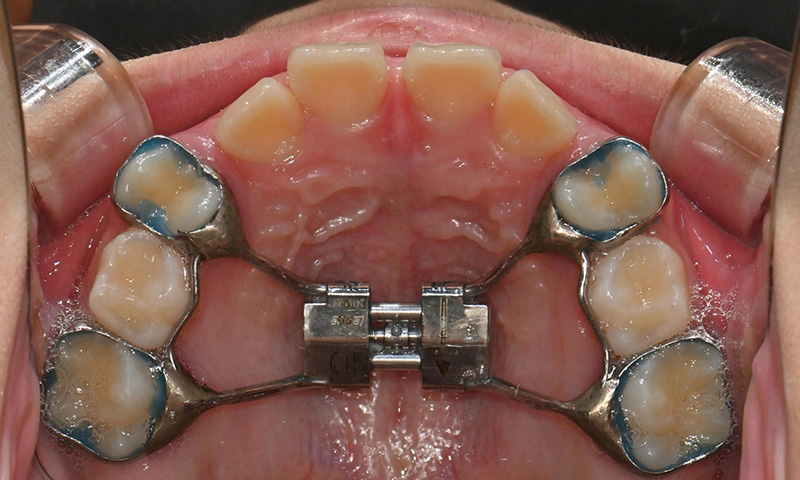 RPE
RPE
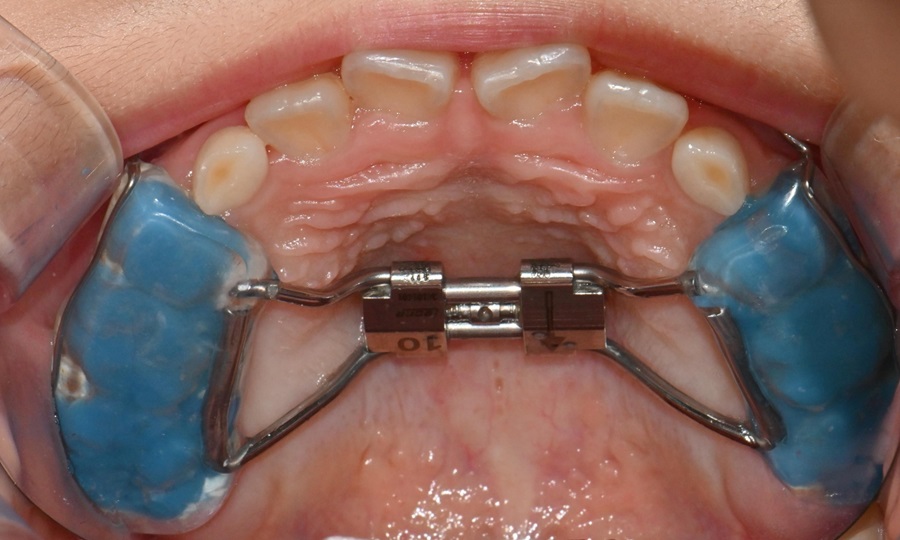 Bonded RPE
- MARPE (Miniscrew-Assisted RPE), MSE (Maxillary Skeletal Expander)
In adults, bone growth is already complete, so the force from the above expanders alone is not sufficient. Therefore, by reinforcing the anchorage with miniscrews, a stronger force is directly delivered to separate the area where fusion of the palatal suture has already progressed. This method is generally used in patients 15 years of age and older.
This type of arch expansion not only secures space for tooth alignment, but also widens the narrow arch and, at the same time, the inside of the nose, which can make nasal breathing somewhat easier for people who breathe through the mouth.
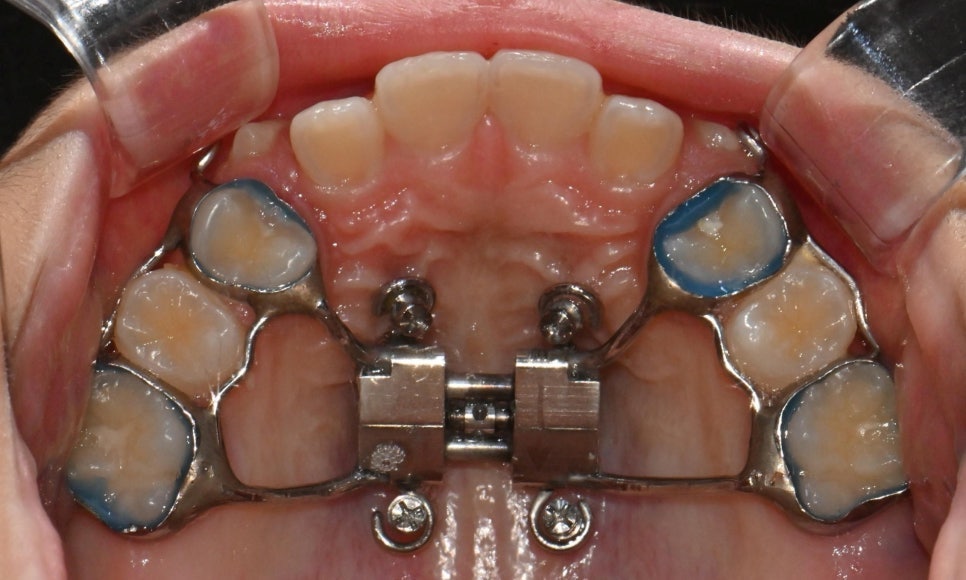 MARPE
MARPE
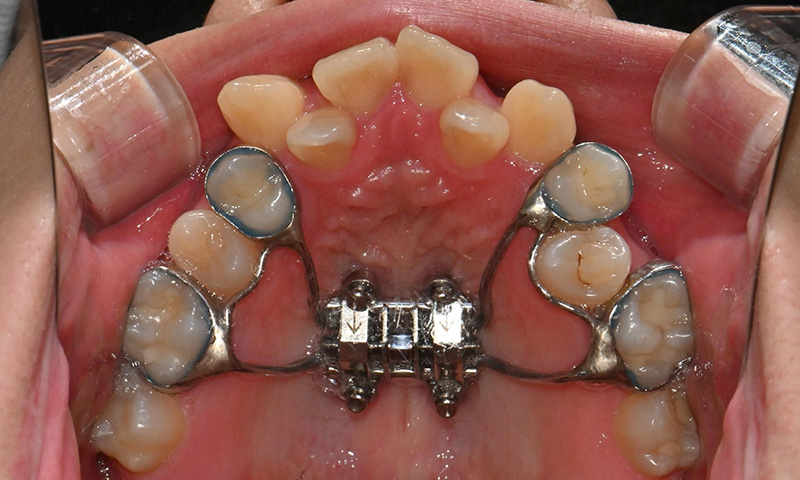 MSE
MSE
 Daechi-dong Orthodontic Clinic, Yonsei Jeongwon Dental Clinic
So, when expanding the arch with an arch expander like this, let’s look at the questions patients often have.
Will my speech sound awkward if I use an arch expander?
When you first wear an arch expander, speech may feel a little uncomfortable. Because the device covers the upper palate or takes up space there, the position where the tongue touches can change, especially for sounds like 'ㅅ', 'ㅈ', and 'ㅊ', so speech may temporarily feel awkward. However, most people adapt naturally within about 1 to 2 weeks. In other words, there may be some discomfort at first, but over time most people adapt, and there is no major interference with speech.
If I forgot to turn the device for one day, do I need to turn it twice the next day?
An arch expander is designed to gradually expand at regular intervals, taking into account the physiological adaptation speed of the gum bone and the midpalatal suture of the upper jaw bone. Therefore, it is not recommended to turn it twice the next day just because you missed a day. Missing one day is not usually a major clinical problem. If you make up for it by turning it a lot the next day, you may instead place sudden excessive force on the suture area, which can increase pain and cause local damage to the suture area, which is not good for either expansion efficiency or stability. Rather, it can interfere with tissue remodeling and may increase only the simple tipping movement of the teeth rather than the bone expansion that is actually needed.
If you forgot to turn it for one day, just turn it once the next day as usual (or the number of turns instructed by your dentist). If you often forget to turn it, it is recommended to set a regular time for it (for example, before bed).
The gap between my front teeth is getting wider! Will it close again later if it opens like this?
As shown in the case above, when you turn the arch expander, the midpalatal suture of the upper jaw bone opens and skeletal expansion occurs, so the appearance of a gap between the front teeth is a very typical and physiological response. When the midpalatal suture separates, the area near the front teeth opens first, which is why a space appears between the teeth. The fact that the front teeth are separating is a good sign that expansion is progressing normally. This opened space may naturally narrow slightly as expansion continues, and afterward, the teeth will be aligned through orthodontic treatment and the space will close, so there is no need to worry at all.
Does breathing become easier when using an arch expander?
Does an arch expander really make breathing better? One of the most common questions from patients and guardians who use arch expanders is, “Does expansion make breathing easier?” In fact, some patients say that it becomes easier to breathe through the nose after expansion, but the same effect does not occur in every patient.
During the process of expanding the upper jaw bone, not only does the space for tooth alignment widen, but the adjacent nasal cavity may also expand. If a narrow upper jaw bone has been limiting the nasal cavity, expanding the upper jaw bone may lead to improved breathing. In particular, in growing children, the sutures are highly responsive and skeletal changes can be significant, so they are more likely to feel the breathing improvement effect.
However, breathing does not improve in every patient. If there are structural issues such as allergic rhinitis, enlarged tonsils or adenoids, or a deviated septum, expanding the upper jaw bone does not eliminate those factors, so when such issues exist, it is difficult to guarantee improved breathing with upper jaw expansion alone.
Does the nose become wider when using an arch expander?
Whether the nose becomes wider with an arch expander is also one of the topics patients are curious about. To put it simply, the nose rarely becomes noticeably wider on the outside, but the internal nasal cavity can become sufficiently wider.
An arch expander separates the maxillary midpalatal suture and expands the maxillary skeleton itself from side to side. In this process, the floor of the nasal cavity connected to the maxillary skeleton can also expand, increasing the width of the nasal cavity and reducing nasal resistance. These changes are especially more clearly observed in growing patients with a narrow and constricted maxilla. In actual studies, cases have been reported in which maxillary expansion widened the cross-sectional area of the nasal cavity and improved breathing function.
However, the expression 'the nose becomes wider' should be considered in two ways. First, anatomically, widening of the internal nasal cavity is a change that can be sufficiently expected after expansion. Second, visible changes in the shape of the nose, such as a clearly wider bridge or nasal wings, usually do not occur. Even when external changes do appear, they are very subtle and only noticeable when photos are compared. In adult patients, since the sutures are often already fused, there is almost no external change, and only limited internal space changes occur.
Daechi-dong, next to the BMW building at Woosung Apartment Intersection
(Across from Starbucks/Samsung Store)
Yonsei Jeongwon Dental Clinic, Daechi-dong Orthodontic Clinic
Parking is convenient and free.
Consultation and inquiries: 02-501-2879