Anterior Crossbite During Growth – Invisalign
Hello. I am Yoon Jeong-won of Yonsei Jeongwon Dental Clinic, an orthodontic clinic in Daechi-dong. The case I am introducing today involves orthodontic treatment during growth for an 11-year-old female patient.
When the patient first visited our clinic, she had already undergone approximately one year and six months of Invisalign First treatment overseas. The initial treatment goal was to improve an “anterior crossbite,” in which the lower front teeth were positioned in front of the upper front teeth. Through Invisalign First treatment, the front teeth had improved to the point where they were almost normally contacting each other, but the treatment had not yet been fully completed.
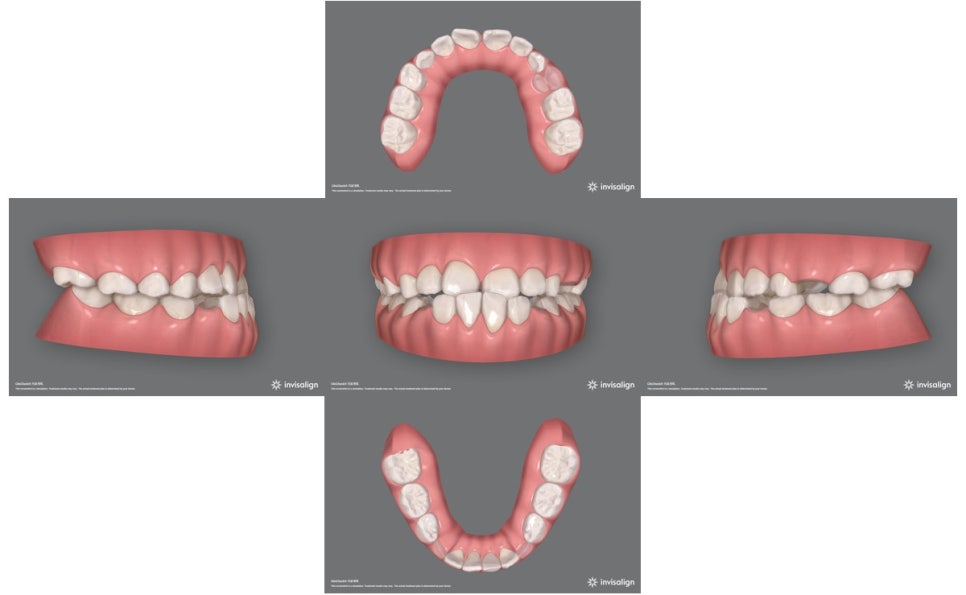
Intraoral photographs taken when treatment began three years ago
In this patient’s case, it was important to begin orthodontic treatment as early as possible because she had an anterior crossbite. In many cases, the general principle for treating an anterior crossbite is to begin treatment as soon as it is detected, unlike a receding chin, which may present somewhat differently. A review of the records taken before treatment also showed somewhat insufficient growth in the midface.
Of course, each orthodontist has different diagnostic and treatment philosophies, so it is not possible to judge the previous treatment as right or wrong. However, if this patient had first visited our clinic during early childhood, I would have chosen growth modification using a facemask before Invisalign First.
This is because a facemask can improve the anterior crossbite while also promoting forward growth of the upper jaw, thereby helping address the insufficient midface growth as well.
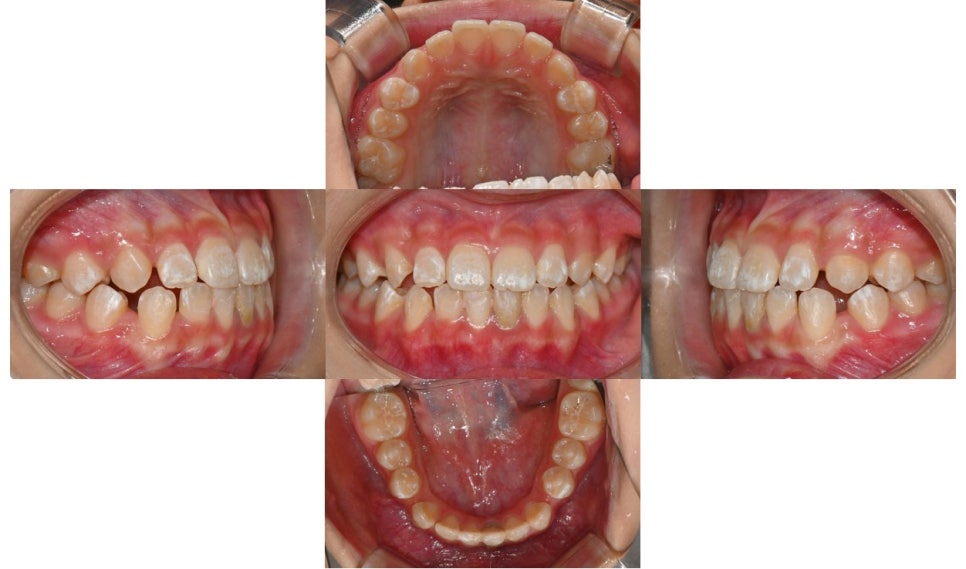
Initial photographs taken when the patient first visited our clinic one year ago
Many parents may have one question at this point.
If the crossbite has improved, why is additional orthodontic treatment needed?
Why is a second phase of orthodontic treatment needed after the first phase? Does this mean the first phase failed?
In fact, this is one of the questions I receive most often about orthodontic treatment during growth.
To give the conclusion first, the second phase is not treatment that is repeated because the first phase failed. The first and second phases have different goals, and they are named separately because they are carried out sequentially according to the child’s stage of growth. In other words, the treatments needed during the growth process are performed in order; the second phase does not mean that the first treatment was incorrect.
The first phase is commonly called “growth modification,” and its concept differs from the orthodontic treatment that we generally think of. Its goal is not to align the teeth, but to use the time during a child’s growth to control the direction and amount of jawbone growth. During growth, the upper and lower jaws continue to develop. At this stage, growth-modification appliances such as facemasks, Frankel appliances, activators, and bionators can be used to promote insufficient growth or restrict excessive growth, guiding development toward a more normal pattern.
An important point is that growth modification has a specific “golden time.” Treatment that promotes upper-jaw growth tends to be more effective when performed at a relatively young age, while treatment that controls lower-jaw growth should be carried out around the pubertal growth spurt to achieve the greatest expected effect. In contrast, conventional orthodontic treatment to align the teeth is possible even in adulthood, but treatment that utilizes the growth of the jawbones themselves is difficult to expect to be effective after the growth period has ended.
Therefore, growth modification should not simply be started as early as possible. It is most important to accurately diagnose the child’s growth stage and the cause of the problem, and to perform treatment at the most appropriate time. Even when the same appliance is used, the results that can be achieved may differ greatly if the timing of treatment is missed.
Then, does every child who receives first-phase orthodontic treatment necessarily need a second phase?
Not necessarily.
If the teeth are already well aligned and the only problem concerns jaw growth, treatment may end with growth modification alone. However, most children have problems with tooth alignment as well as jaw growth. Therefore, after first addressing the skeletal problem through growth modification and waiting until all the permanent teeth have erupted, a second phase is performed to organize the dentition.
There is another question that parents often ask.
Does first-phase treatment make second-phase treatment easier?
In most cases, yes.
If a receding chin or a prominent lower jaw is improved during growth, the difficulty of the second phase is often much lower and the treatment period may also be shorter. Conversely, if the appropriate timing for growth modification is missed, treatment may become more complicated because the bite must be corrected by moving only the teeth. If the skeletal discrepancy is severe, orthognathic surgery may be necessary in adulthood.
The photographs below show a case in which growth modification was performed using an activator and headgear to improve a receding chin. If conventional orthodontic treatment alone had been performed after all the permanent teeth erupted, without this treatment during growth, it would likely have required much more complex and lengthy treatment to achieve proper contact between the upper and lower front teeth. In this way, growth modification performed at the appropriate time uses effects that can only be obtained during growth and is an important process that makes subsequent orthodontic treatment easier and more efficient.
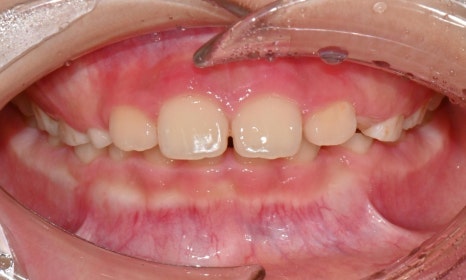
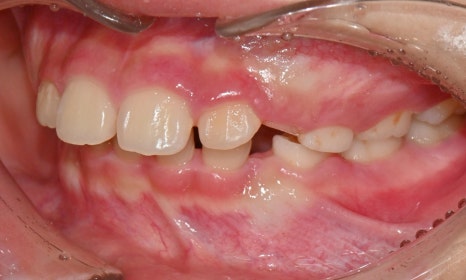
Before activator + headgear treatment
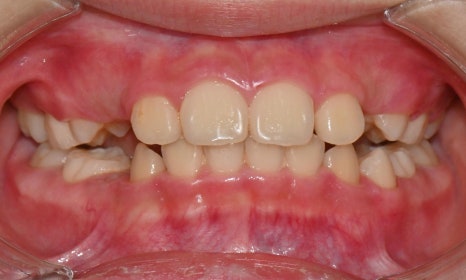
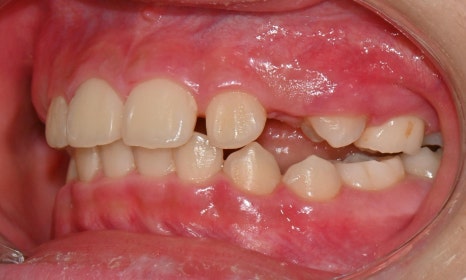
After activator + headgear treatment
Returning to the original case, this patient can be considered an example in which Invisalign First served the role of first-phase treatment instead of the traditional growth-modification appliance, a facemask. Of course, not every growing patient with an anterior crossbite can be treated with Invisalign First. Depending on the growth pattern, there are certainly cases in which a growth-modification appliance such as a facemask is necessary. However, when the growth discrepancy between the upper and lower jaws is not severe, Invisalign First can also be a good option. This is because it can improve the bite during growth while also organizing tooth alignment and space.
Through Invisalign First treatment, this patient’s crossbite improved well, but considerable spaces remained between the teeth, and the contact between the upper and lower teeth was still unstable. In addition, one lower front tooth, which had received root canal treatment in the past, showed discoloration. Because it is important for growing patients to achieve a functionally stable bite rather than simply aligning the front teeth, our clinic planned additional treatment using Invisalign Comprehensive Phase 2.
The additional treatment focused on closing all the remaining spaces and allowing the upper and lower teeth to meet naturally and stably. During treatment, Class III elastics were also used to control the tendency of the lower jaw to move forward. Orthodontic elastics are an important element that helps move the teeth in the desired direction, and the patient’s cooperation has a significant effect on the treatment outcome. Fortunately, the patient cooperated very well, allowing us to effectively organize the spaces and stabilize the bite using 17 aligners.
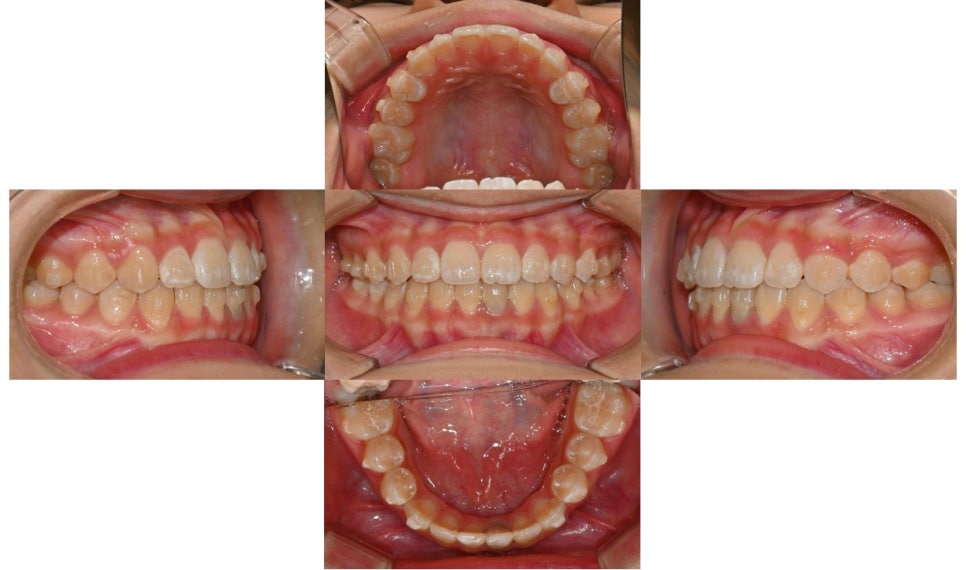
Completion of the first set of aligners 17 weeks after treatment began
After the first set of aligners was completed, the overall bite was considerably more stable, but the midlines of the upper and lower teeth were slightly misaligned. In addition, the second molars that had newly erupted during treatment required more precise adjustment. Therefore, an additional set of 17 aligners was produced to align the midlines and complete treatment so that the newly erupted molars would also fit together stably.
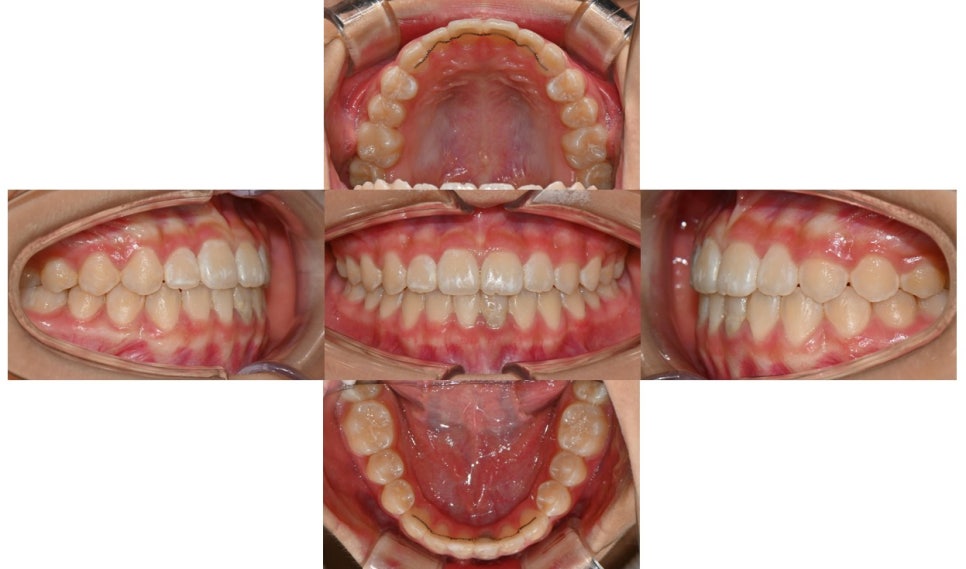
Completion of orthodontic treatment
With Invisalign treatment, treatment does not automatically end simply because the first set of aligners has been completed. After reassessing how much the teeth have actually moved according to the plan, additional aligners are often produced to refine even small details when a more complete result can be achieved. This refinement process plays a very important role in creating a more precise and stable treatment result.
This case demonstrates that even patients who have already received Invisalign First treatment may need additional orthodontic treatment depending on their growth process and the eruption status of their permanent teeth. It also shows that the most important factor in orthodontic treatment during growth is not which appliance was used, but whether appropriate treatment was performed according to the child’s stage of growth.
However, this patient has not yet completed growth, so the end of orthodontic treatment does not mean that follow-up care is over. We will continue to monitor the growth pattern of the jaws, including the lower jaw, through regular checkups and confirm that the bite remains stable. Because the bite may change as a growing patient develops, consistent follow-up after treatment is also an important part of successful orthodontic treatment during growth.
Yonsei Jeongwon Dental Clinic in Daechi-dong
If you are choosing a dental clinic for orthodontic treatment, we recommend having it performed by a doctor with extensive experience.
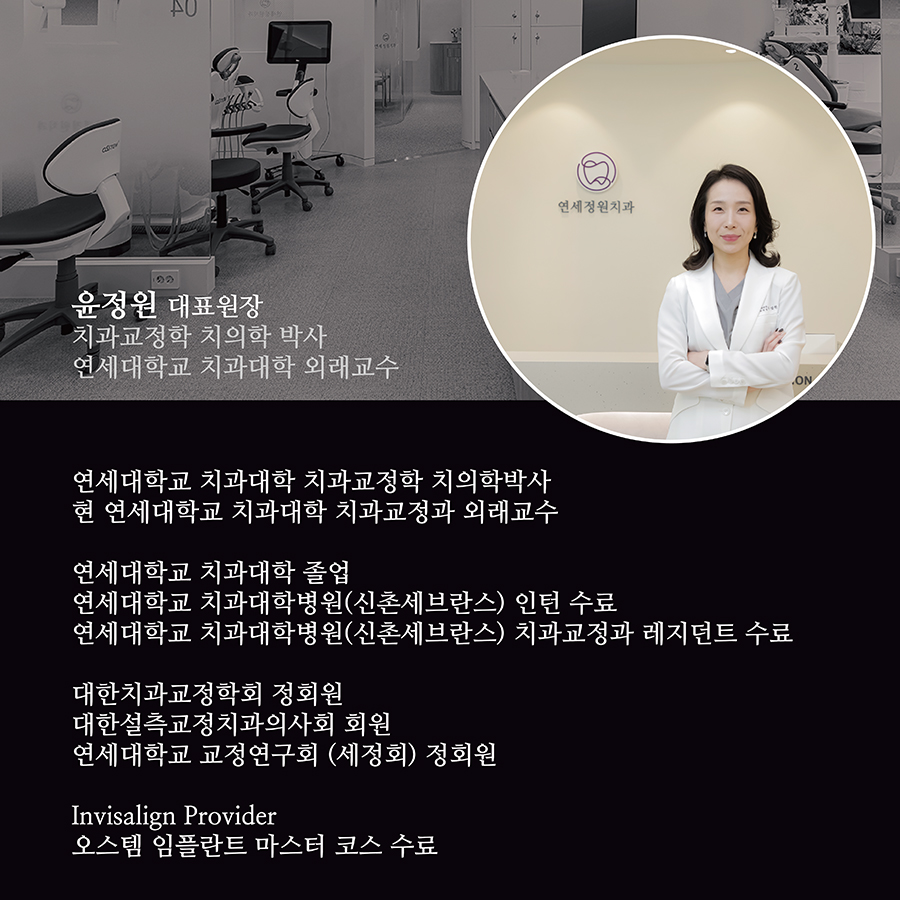
Dr. Yoon Jeong-won, the director of Yonsei Jeongwon Dental Clinic, has devoted more than 16 years to orthodontic care and has treated more than 6,000 diverse orthodontic cases to date. Dr. Yoon is an orthodontist and Doctor of Dental Science from Yonsei University Dental Hospital and also serves as an adjunct professor. As the clinic director, Dr. Yoon is always present at the clinic, and there is no need to worry about a change in the treating doctor during the course of treatment. The clinic also offers the advantages of flexible appointments and better response to emergencies.
With extensive orthodontic experience, Dr. Yoon has treated many challenging cases in which patients were diagnosed at other dental clinics as needing surgery for a prominent lower jaw but were able to receive nonsurgical orthodontic treatment. Those seeking orthodontic treatment can therefore receive care suited to their individual situation.
Nonsurgical orthodontic treatment for a receding chin without extractions – Yonsei Jeongwon Dental Clinic
In addition, Dr. An Ji-ho, a prosthodontist responsible for general dental care, works at the clinic. This means that patients can receive all necessary treatment at Yonsei Jeongwon Dental Clinic without the inconvenience of visiting another dental clinic for dental procedures that may arise during orthodontic treatment, such as extractions or cavity treatment. All the care needed for orthodontic treatment can therefore be handled in one place, where a high level of treatment is provided.
In terms of facilities, the clinic has a systematic seven-step diagnostic system using the latest equipment, including panoramic X-rays, low-radiation 3D CBCT, iTero Lumina 3D intraoral scanning, before-and-after simulations through Morpheus 3D imaging, and VUNO Med®-BoneAge™ for determining the timing of orthodontic treatment according to each child’s amount of growth through growth-plate assessment.
Furthermore, Yonsei Jeongwon Dental Clinic sterilizes the instruments used during treatment and uses sterile treatment water through the Novacare system, so there is no need to worry about the water used during treatment. The clinic also maintains comfortable indoor air through an efficient air-circulation system using a total heat exchanger and a safe air-purification system with dual filters, including HEPA and pre-filters.
If you are considering orthodontic treatment, please do not put it off any longer. Contact Yonsei Jeongwon Dental Clinic at your convenience, and we will provide a detailed consultation. Yonsei Jeongwon Dental Clinic’s orthodontic treatment fees include the costs of precision diagnosis and monthly fees, among others, so you do not need to worry about additional charges (excluding the cost of retainers). In addition, because general dental care is available at the same clinic, all treatment needed during orthodontic care, including extractions and cavity treatment, can be provided in one place. The clinic also offers an installment payment system to reduce the burden of paying a large amount all at once, making the treatment more convenient.
When you visit Yonsei Jeongwon Dental Clinic, an orthodontic specialty clinic in Daechi-dong, you can accurately assess your current condition through a simple oral examination at no additional cost. You can also receive an explanation of various orthodontic appliances during your consultation, so please feel free to contact us or visit the clinic for a consultation.
During your consultation, you can compare various appliances, including Clarity, Clippy-C, and Invisalign, directly and receive a detailed explanation of their advantages and disadvantages. We encourage you to call or visit us for a consultation without hesitation.
Yonsei Jeongwon Dental Clinic is conveniently located near Samseong Station, Hakyeoul Station, Daechi Station, and Hanti Station, making it easy to visit from Samseong-dong, Daechi-dong, Gaepo-dong, Dogok-dong, Irwon-dong, Yeoksam-dong, and Jamsil.
The building next to BMW at the Daechi-dong Woosung Apartments intersection
(Across from Starbucks/Samsung Store)
Yonsei Jeongwon Dental Clinic in Daechi-dong
offers convenient and free parking.
Consultations and inquiries: 02-501-2879
#OrthodonticTreatmentDuringGrowth #Invisalign #Facemask #AnteriorCrossbite #YonseiJeongwonDentalClinic #DaechiDongOrthodonticClinic #GangnamOrthodonticClinic #OrthodonticTreatment #RecedingChinTreatment #NonsurgicalOrthodontics #NonExtractionOrthodontics #ProtrudingMouthTreatment #FacialAsymmetryTreatment #NonsurgicalProtrudingMouthTreatment #NonsurgicalFacialAsymmetryTreatment #ProtrudingMouthBeforeAndAfter #RecedingChinAndProtrudingMouthTreatment #ChangesInFacialShapeAfterOrthodonticTreatment