Hello.
This is Seoul Ove Dental Hospital :)
"I had a front tooth implant,
but my gums have receded and the metal post is showing."
"The gum around my implant has sunk, so the tooth looks unusually long...
Can it be done again?"
These are concerns we hear very often in the consultation room.
Today, I would like to talk about the gums—something that is just as important as, or perhaps even more important than, the teeth themselves when it comes to front tooth implants.
The gums complete the front teeth
For molar implants, success means being able to chew well.
But front teeth are different.
When you smile, your gums are visible along with your teeth.
Even if an excellent prosthesis is placed, the front teeth will not look complete if the gums have collapsed.
✅ If the gum line is asymmetrical
✅ If the implant boundary is visible
✅ If the tooth looks too long
Patients end up seeing only that area every time they look in the mirror.
That is why front tooth implants need to be able to recreate the gums in order to achieve a truly natural result.
Bone and gums are the foundation of implant treatment
What is an implant?
It is commonly called an “artificial tooth,” but more precisely, it is a treatment in which a titanium root is placed in the jawbone and a tooth is placed on top of it.
It can be compared to constructing a building:
✅ Jawbone = the land and foundation
✅ Implant = the pillar
✅ Prosthesis (tooth) = the building
✅ Gums = the exterior and landscaping
No matter how strong the pillars are, a building cannot last if the foundation is weak, and it will not look good if the exterior has collapsed.
That is why bone grafting is needed when bone is insufficient, and gum grafting is needed when the gums are insufficient.
What is bone grafting?
After a tooth is extracted, the jawbone at that site is gradually resorbed over time.
This is especially common in the front tooth area, where the bone on the outer side is often as thin as a sheet of paper.
If there has been inflammation or a fracture, it is common for more bone to have been lost.
What is bone grafting?
It is the process of placing graft material in areas where bone has become insufficient, thereby rebuilding the foundation needed to support the implant.
It usually takes several months of healing for the bone to fill in.
What is gum grafting?
What is gum grafting?
It is a treatment that reinforces gum tissue where the gums have become sunken or thin.
There are two main methods:
✅ Free gingival graft
; Gum tissue is taken from the palate and transferred to the area where it is needed.
This method is useful for increasing the “amount” of insufficient gum tissue.
✅ Flap graft (flap surgery)
The surrounding gums are pulled over and used to cover the area while maintaining their blood supply.
This method provides stable integration and is useful for shaping the gum line.
The two methods have different advantages and disadvantages, so depending on the case, only one may be used, or both may be used together.
This decision is a key factor that determines the success or failure of front tooth esthetics.
Multiple surgeries are usually required
To restore a front tooth whose gums have also collapsed with an implant, the following process is generally required:
[Front Tooth Implant Surgery Process]
1️⃣ Extraction
2️⃣ Bone grafting (bone reconstruction)
3️⃣ Implant placement
4️⃣ Gum grafting 1–2 times
Because healing periods are needed between each step, it often takes four to five surgeries and nearly a year of treatment.
As surgeries are repeated, the burden on the patient inevitably increases:
✅ A longer recovery period
✅ Greater financial burden
✅ Increased fear of surgery
All of these are repeated to the same extent.
Is it possible with one surgery?
If supported by precise diagnosis and planning,
there is also a method of performing an implant, bone graft, and gum graft simultaneously on the day of extraction.
However, this method is highly challenging.
The implant must be placed in the exact position at the same time as the extraction, and the insufficient bone and the gums above it must be reconstructed all at once.
The key is to plan the previously mentioned free gingival graft and flap surgery together within a single procedure.
Tissue taken from the palate is used to restore the gum volume, and a flap with an intact blood supply is used to cover it, helping it integrate.
This makes it possible to restore both the volume and the line of the collapsed gums at the same time.
An actual treatment case
This is the case of a patient whose jawbone was damaged by a front tooth fracture and inflammation.
At the patient’s first visit, the bone on the outer side had been lost due to inflammation around the tooth root. The gums had also collapsed, making the tooth look long.
[Before Surgery & 2 Weeks After Surgery]
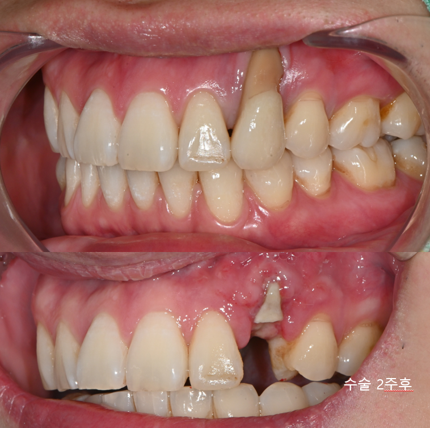
Before surgery (top) / 2 weeks after surgery (bottom)
The case was expected to require four to five surgeries if treatment were divided into stages.
After a detailed diagnosis, simultaneous surgery was considered possible, so implant placement, bone grafting, and gum grafting were performed in a single procedure on the day of extraction.
[Immediately After Surgery — Gum Graft Sutures & Palatal Donor Site]
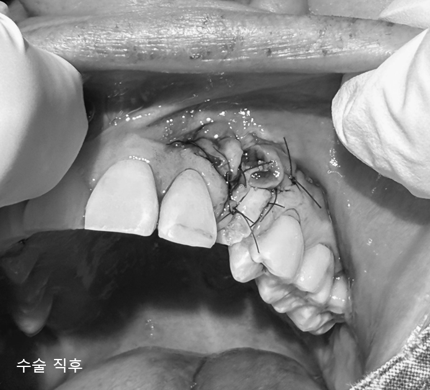
Immediately after surgery — Gum graft sutures
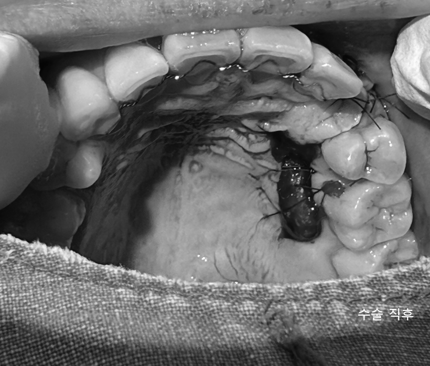
Immediately after surgery — Palatal donor site
Tissue taken from the palate and flap surgery were used together to restore the gum volume around the implant and refine the gum line.
[X-rays — Before Surgery, Immediately After Surgery & 4 Months Later]
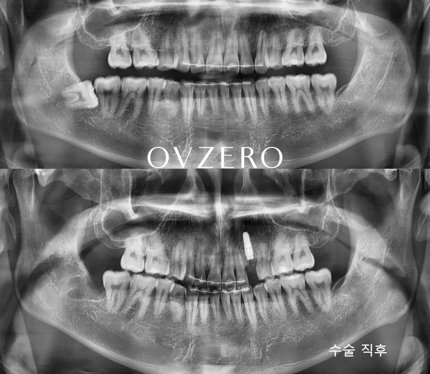
X-ray — Before surgery (top) / Immediately after surgery (bottom)
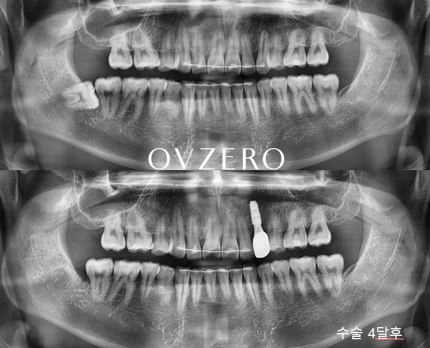
X-ray — Before surgery (top) / 4 months after surgery (bottom)
Four months after surgery, the previously sunken gum line can be seen joining naturally with the neighboring teeth.
[Before Surgery & 4 Months After Surgery]
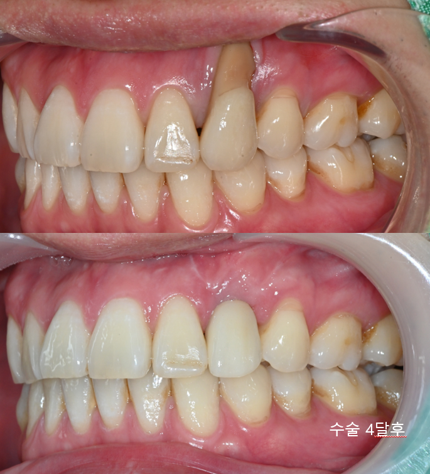
Before surgery (top) / 4 months after surgery (bottom)
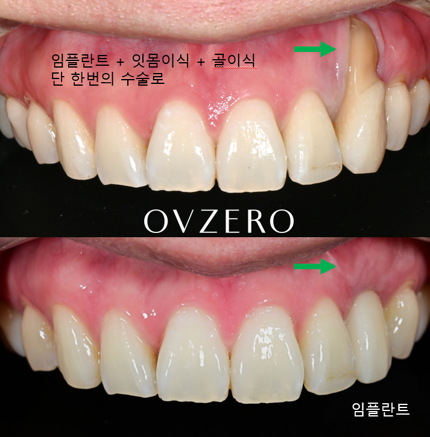
The gum line restored with an implant + bone graft + gum graft in a single surgery
This result was possible because not only the tooth, but also the bone and gums, were restored together.
Where should you receive this type of treatment?
To be honest, there are not many places that routinely perform this type of simultaneous surgery.
Combining extraction, bone grafting, and gum grafting into one surgery requires clinicians who have received specialized training in oral and maxillofacial surgery. In addition, the procedure does not end simply because the surgery itself went well.
When choosing a hospital, we recommend checking these three things:
✅ An oral and maxillofacial surgery specialist
Extraction, bone grafting, and gum grafting are all surgical procedures.
The precision of the gum incision design and suturing affects the result of the gum line.
✅ Collaboration with a prosthodontics specialist
The shape and angle of the tooth that will be placed on the implant must also be planned together before surgery to create natural-looking front teeth.
✅ An in-house dental laboratory
Communication with the dental technician is important for making a prosthesis that fits the gum line precisely.
With an in-house dental laboratory, the color and shape can be coordinated immediately.
Seoul Ove Dental Hospital is different.
Seoul Ove Dental Hospital has a system in which oral and maxillofacial surgery, prosthetic planning, and in-house dental laboratory work are all carried out in one location.
Not every case is eligible.
However, one point we would like to state honestly is that simultaneous surgery is not possible for everyone.
✅ Extent of inflammation
✅ Amount of remaining bone
✅ Thickness and condition of the gums
Depending on these conditions, it may clearly be safer to divide treatment into stages.
What matters is not unconditionally reducing the number of surgeries, but creating a plan suited to your case through an accurate diagnosis.
If you have been told that a front tooth needs to be extracted, or if you are concerned about your gums after an implant,
please have the condition of your bone and gums accurately diagnosed before beginning treatment.
The period before extraction is the best time to preserve the gums. 😊
[Hospital Location]
📍 Seoul Ove Dental Hospital
196 Baekjegobun-ro, Songpa-gu, Seoul, B1, 4th & 5th floors
🚇 1-minute walk from Exit 3 of Samjeon Station
[Quick Appointments & Other Inquiries]
📞 02-418-2275
💬 Kakao Channel inquiries
-
All treatment photographs are of patients treated at this hospital. (The same person photographed under the same conditions.)
-
Depending on individual differences, side effects may occur after procedures or surgery. Please consult thoroughly with your medical team.