Sayuri’s mother started treatment in November 2023 after being diagnosed with breast cancer,
underwent surgery in January 2024, and continued cancer treatment until September of the same year.
During this process, she shared on YouTube that cancer treatment caused significant hair loss.
The Relationship Between Cancer Treatment and Hair Loss
Cancer treatment is generally accompanied by hair loss.
About two weeks after treatment begins, hair starts to fall out, and the extent is often quite severe.
In university hospitals in Japan, devices are used to keep the scalp cool during cancer treatment to reduce hair loss,
but such machines have not yet been introduced in Korea.
However, Samsung Hospital is experimentally conducting cancer treatment using these cooling helmets, and the Department of Plastic Surgery at Yonsei University is also interested and conducting research.
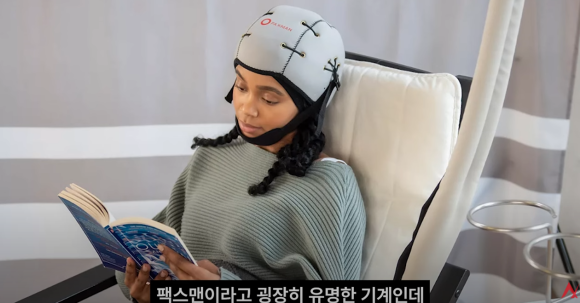
In the United States, a cooling helmet device called “Paxman” has become widespread and is even covered by insurance, but it has not yet been introduced in Korea, which is unfortunate.
Causes of Hair Loss During Cancer Treatment
Cancer drugs circulate throughout the body and affect not only cancer cells but also hair cells.
The dividing cells targeted by anticancer drugs also affect structures such as hair cells, causing hair to fall out.
For this reason, hair loss occurs during cancer treatment.
The principle of the cooling helmet is to minimize hair loss by reducing blood flow and lowering the amount of anticancer drug delivered to hair cells.
Sayuri’s mother applied this cooling principle by using a cold diaper on the scalp to try to reduce hair loss.
There are reports of cases suggesting that this method may actually be effective in reducing hair loss.
The use of cooling helmets is attracting attention as a promising way to reduce hair loss during cancer treatment.
However, its introduction in Korea is still delayed,
and patients are waiting for the speedy introduction and support of such devices.
Therefore, alternative methods such as ice packs can be used.
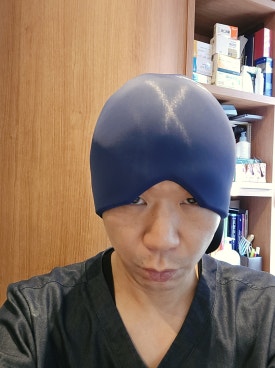
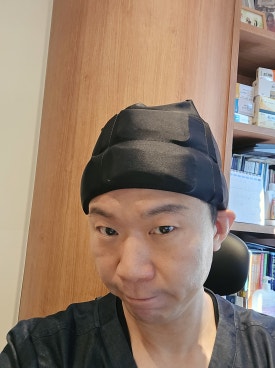
The photos below show scalp cooling packs that can be easily purchased online.
They contain gel inside the cap, and you can keep them in the refrigerator to cool them before use.
Inspired by Sayuri’s mother’s case, an idea came to mind about freezing diapers and using them, and I am planning this campaign in cooperation with medical staff and companies that share similar views to mine.
If there are any additional news or updates, I will share them through the blog.
To everyone undergoing cancer treatment, stay strong!
Small efforts can bring big changes.
Your efforts will surely lead to better results.
[In accordance with Article 56, Paragraph 1 of the Medical Service Act, this post is written directly by the director for informational purposes. Hair loss surgery and treatment may have side effects, so please make a careful decision after consulting with a specialist.]