More and more people are practicing intermittent fasting for their health.
I have also been doing intermittent fasting for the past five years.
That is because it is a dietary approach whose many positive effects—such as weight loss, improved gut health, and anti-aging—have been proven.
However, recent research has found that intermittent fasting may also trigger hair loss.

According to a paper published by researchers at UCLA in the United States (Chen et al.), intermittent fasting damages Hair Follicle Stem Cells (HFSCs), increasing the likelihood of hair loss.
This research result is an important finding that sheds new light on the relationship between dieting and hair loss, and it seems likely to raise new concerns for those considering fasting.
So how does intermittent fasting affect hair?
Chen et al. investigated the effects of fasting on hair growth using mouse models that underwent 16:8 fasting (16 hours of fasting followed by 8 hours of eating) and alternate-day fasting (one day of fasting followed by one day of eating).
The results showed that mice that fasted experienced slower hair regrowth than mice that were fed normally, and an increase in hair follicle cell death (apoptosis).
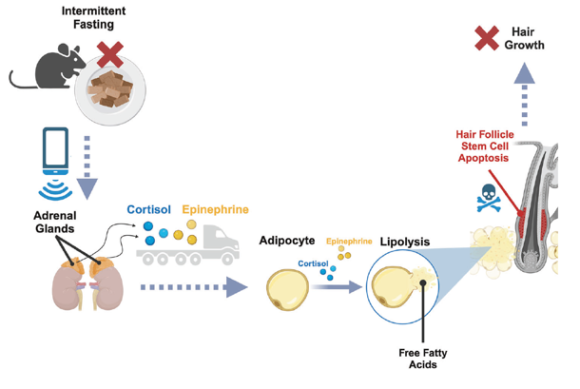
• Increased death of hair follicle cells (HFSCs)
o The longer fasting continues, the more likely hair follicle cells are to be damaged and eventually lead to hair loss
• Changes in adipocytes
o During fasting, fat is broken down and free fatty acids are released from adipocytes
o When free fatty acids accumulate near hair follicle cells, they can damage the cells and induce apoptosis
• Increased hormones (cortisol & epinephrine)
o Fasting causes the body to feel stress and release cortisol and epinephrine
o These hormones promote fat breakdown, increasing free fatty acids and negatively affecting hair growth
• Increased oxidative stress
o After fasting, oxidative stress increases in hair follicle cells and mitochondrial function declines
o The researchers confirmed that when vitamin E (a powerful antioxidant) was applied to fasting mice, HFSC damage decreased and hair regrowth was restored
The fact that intermittent fasting may cause hair loss is an interesting finding, but
it cannot be concluded that fasting = hair loss.
There may be several other factors involved.
Factors that increase the risk of hair loss
- Constitution and genetic factors
o Not everyone is affected in the same way. Some people may not experience hair loss even after fasting
- Nutritional deficiencies
o If essential nutrients during fasting (protein, iron, zinc, vitamin D, omega-3, etc.) are insufficient, the likelihood of hair loss may increase
- Lack of oxidative stress management
o As shown in the study, consuming antioxidants (vitamin E, vitamin C, etc.) may help reduce cell damage
- Lack of stress management
o Because cortisol can increase during fasting and damage hair follicle cells, stress management such as meditation, yoga, and regular sleep is necessary
How to prevent hair loss while doing intermittent fasting
- Maintain nutritional balance
o You should manage your diet so that you do not lack essential nutrients for hair growth, such as protein, iron, zinc, biotin, and omega-3
- Use antioxidants
o The study confirmed that applying or consuming vitamin E reduced hair follicle cell damage
o Eating nuts rich in vitamin E (almonds, sunflower seeds) or oils (olive oil, avocado oil) may help
- Adjust your fasting method
o Rather than the 16:8 method, considering 12:12 (12 hours of fasting followed by 12 hours of eating) or fasting once or twice a week may help reduce the risk of hair loss while still providing health benefits
- Consult a specialist if hair loss begins
o If your hair becomes thinner or shedding increases while doing intermittent fasting, you should promptly consult a specialist
o If the cause is analyzed and addressed early, hair loss can be effectively prevented
Intermittent Fasting Diet: Take Care of Both Your Body and Your Hair
Intermittent fasting can have positive effects on health, but according to research, it is important to remember that excessive fasting may also harm hair health.
In particular, if adequate nutrient supplementation and stress management are not provided during fasting,
the important point of this study is that the risk of hair loss is likely to increase.
If you want both a healthy body and abundant hair at the same time, adjusting your fasting method and paying attention to nutrition is the best approach.
It's time to grow hairhair, this was Kim Jino.
Begetting new hair (必生新毛).
Reference paper
• Chen et al., Hangry Hairs: Intermittent Fasting Linked to Hair Loss, Cell Research, 2025.
(https://doi.org/10.1038/s41422-025-01082-y)
[This post is written directly by a board-certified plastic surgeon for informational purposes in accordance with Article 56, Paragraph 1 of the Medical Service Act. Hair loss surgery and treatment may have side effects, and please make a careful decision after consulting with a specialist.]