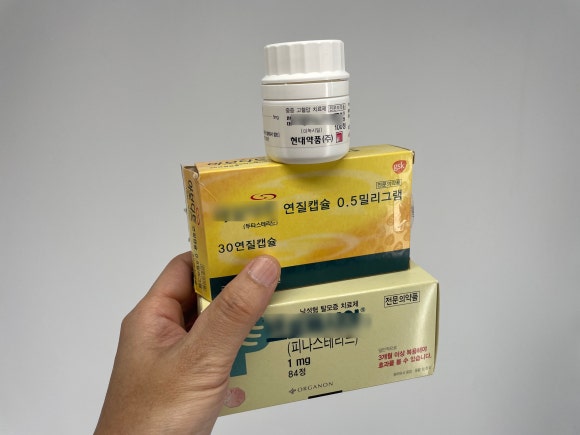
When hair starts falling out, most people first try switching shampoos or looking for supplements. But if the symptoms continue, they eventually start considering medication.
When you search for hair loss medication, there is one term that often appears in related searches.
That term is “liver toxicity.”
There are quite a few people who hesitate between wanting to protect their hair and worrying about liver health.
In fact, hair loss treatments are an important topic for many people who take them or are considering taking them.
Common hair loss medications such as finasteride, dutasteride, and minoxidil are widely used ingredients around the world.
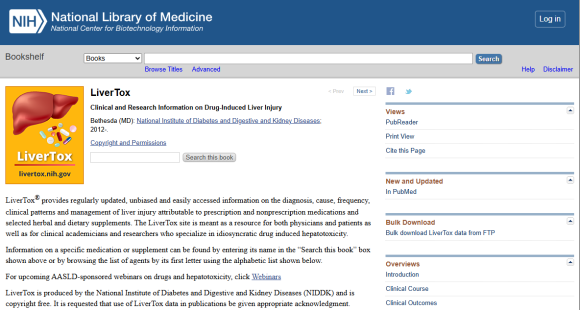
In LiverTox, each drug’s liver toxicity grade (Likelihood Score) is classified from A to E. This is a scientific assessment of the likelihood that a drug may affect the liver.
This site provides information analyzing the effects of various medications on the liver, and it is used as a trusted resource by doctors and researchers.
Simply put, Grade A means that clear cases of liver injury have been reported, while Grade E means there is almost no association with liver injury.
LiverTox liver toxicity grading criteria
Grade A - Clear cases of liver injury have been reported
Grade B - Liver injury has been reported rarely, but the causal relationship is unclear
Grade C - Rare cases of liver injury have been reported
Grade D - Liver injury has been reported relatively frequently
Grade E - There are no clear cases of liver injury, and safety has been established
So where do the hair loss treatments we commonly take fall under these criteria? Here are the results from LiverTox data.
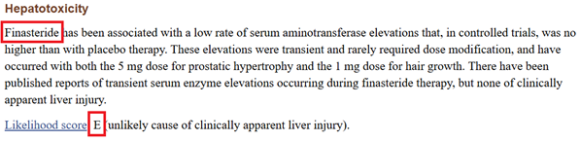
Finasteride grade explanation
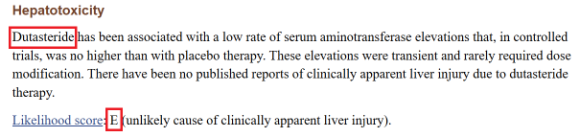
Dutasteride grade explanation
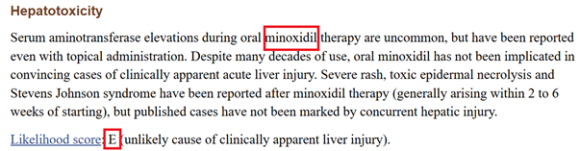
Minoxidil grade explanation
Drug name / Liver toxicity grade / Explanation
Finasteride (Finasteride) Grade E
Unlikely to be a clinically clear cause of liver injury
Dutasteride (Dutasteride) Grade E
Unlikely to be a clinically clear cause of liver injury
Minoxidil (Minoxidil) Grade E
Unlikely to be a clinically clear cause of liver injury
In other words, finasteride, dutasteride, and minoxidil all received Grade E,
which means there are no clear cases of liver injury and safety has been established.
In other words, these are medications that are very unlikely to place a burden on the liver within the usual dosage range.
Of course, even if a medicine is safe, caution is still necessary.
If you keep the following points in mind, you can take it with greater peace of mind.
- If you have a history of liver disease, consult a doctor before taking it.
o For people with reduced liver function, long-term medication use may be a burden, so be sure to consult a specialist.
- Get regular liver function tests.
o In general, hair loss treatments do not cause liver injury,
but individual differences may exist.
Checking liver enzyme levels such as AST and ALT periodically is even
safer.
- Be careful about interactions with other medications.
o If you are taking them together with medications that may affect the liver, such as steroids or antibiotics, be sure to consult a doctor.
Are hair loss medications causing elevated liver enzyme levels?
Let’s take a closer look at liver toxicity Conclusion
Hair loss treatments have a low risk of liver toxicity.
Looking at the U.S. National Institutes of Health LiverTox analysis of the liver toxicity of finasteride, dutasteride, and minoxidil, no clinically significant cases of liver injury have been reported to date, and all three drugs were evaluated as Grade E.
This means that hair loss treatments are medications with a very low risk of liver side effects.
However, because drug metabolism can differ from person to person, if you take them for a long period of time, the wisest approach is to combine regular health checkups with consultations with a doctor.
Based on trustworthy research data, I hope you proceed with hair loss treatment that is safer and more effective!

Now it’s time for hair to grow. This was Kim Jin-o.
Filsaengsinmo (必生新毛).
[This post is written directly by a board-certified plastic surgeon for informational purposes in accordance with Article 56, Paragraph 1 of the Medical Service Act. Hair loss surgery and treatment may have side effects, and you should make a careful decision through consultation with a specialist.]