
Source - Insight
Mr. Kim Kwang-gyu
When you see actor Kim Kwang-gyu on TV, his forehead and crown have shown hair loss progression, but the hair on the back and sides of his head still maintains a full appearance.
Many men with hair loss show a similar pattern.
So it is often explained that “the hair on the back and sides of the head is highly resistant to male hormones (androgens).”
But why is that? Is it simply due to differences in response to male hormones? To understand this more deeply, we first need to look at how skin and hair are formed.
How is our body formed?
(Understanding endoderm, mesoderm, and ectoderm easily)
As a person develops from a fertilized egg into an individual, three basic layers that make up the body are formed.
These are called germ layers, and simply put, you can think of them as the
basic building materials that make up our body.
• Endoderm: The layer that forms internal organs such as the stomach, lungs, and liver.
• Mesoderm: The layer that forms bones, muscles, blood vessels, and other structural parts of the body.
• Ectoderm: The layer that forms the skin, nerves, and hair.
From this perspective, since both skin and hair come from the ectoderm, it may seem as though the hair on the crown and the hair on the back of the head are the same.
However, according to research, the hair on the forehead and crown and the hair on the back of the head are formed somewhat differently during embryonic development.
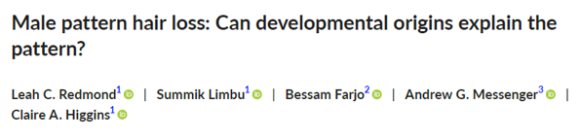
According to a recent study (Redmond et al., 2023), hair on the forehead and crown is derived from the ectoderm, while hair on the back of the head is relatively more influenced by the mesoderm.
In other words, from birth, the genetic characteristics of hair differ by region.
And this difference plays an important role over time in determining the pattern of male pattern hair loss.
When you look at people with advanced genetic hair loss, it is common to see that the front and top have almost no hair while the hair on the back remains intact.
This is likely not simply due to a difference in response to male hormones, but because the hair had different origins from birth.
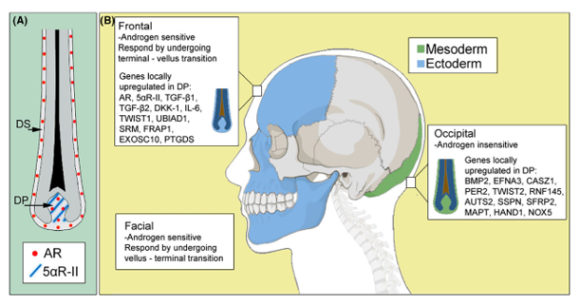
Figure: Distribution of hair follicles associated with mesoderm and ectoderm (green: mesoderm, blue: ectoderm)
Source: Redmond, L. C., et al. (2023). Male pattern hair loss: Can developmental origins explain the pattern? Experimental Dermatology, 32(7), 1174-1181
Implications for hair loss treatment
Understanding these differences can have important implications for hair loss treatment.
For example, if the reason hair from the back of the head is used in hair transplant surgery is not simply because of androgen resistance, but because it originally has a genetically different origin, that also helps explain why transplanted hair is less affected by hair loss.
In addition, future hair loss research may develop new treatments that reflect embryological differences rather than simply regulating male hormones.
Why Does the Hair on the Back of the Head Remain Even with Severe Hair Loss? (Characteristics of Hair Loss on the Back of the Head)
Conclusion
We often simply explain hair loss as being caused by “genetics” and “hormones,” but
by looking at the embryological origins of hair, we can better understand the fundamental reasons behind hair loss.
From birth, some follicles have a structure that makes them more vulnerable to the male hormone androgen, and this plays an important role in determining the hair loss pattern.
For hair loss treatment to become more precise in the future, an approach that considers these embryological differences in follicles will be necessary.
It is now time for hairhair, Kim Jin-oh.
Filsaengsinmo (必生新毛).
References
Redmond, L. C., et al. (2023). Male pattern hair loss: Can developmental origins explain the pattern? Experimental Dermatology, 32(7), 1174-1181. https://doi.org/10.xxxx/yyyy
[This post is being written directly by a board-certified plastic surgeon for informational purposes in accordance with Article 56, Paragraph 1 of the Medical Service Act. Hair loss surgery and treatment may have side effects, and they should be carefully decided upon through consultation with a specialist.]