Research on hair loss continues to advance day by day, but many patients still ask questions like:
"When will my hair grow back?" and "Do hair loss medications really work?"
A study that can help answer these questions was recently published.
Through a real-time study spanning 20 years, the findings revealed long-term tracking of changes in the hair cycle and the effects of minoxidil.

Does hair not grow forever?
The process of hair growing and falling out is commonly called the hair cycle.
In general, hair goes through the Anagen phase → Catagen phase → Telogen phase → Exogen phase.
On a healthy scalp, more than 90% of hair is in the Anagen phase, and the rest is in the Catagen and Telogen phases.
So does this cycle change over time? According to the study, the hair follicle cycle gradually shortens with age and is highly likely to eventually enter a prolonged dormancy state.
In the study, some hair follicles fell completely dormant for more than 3 years, and when topical minoxidil, a hair loss medication, was applied afterward, hair growth was stimulated again.
In other words, even during the progression of hair loss, the follicles may not disappear completely but instead may change into a "dormant state."
This suggests that drug treatments such as minoxidil may play an important role in reactivating dormant hair follicles.
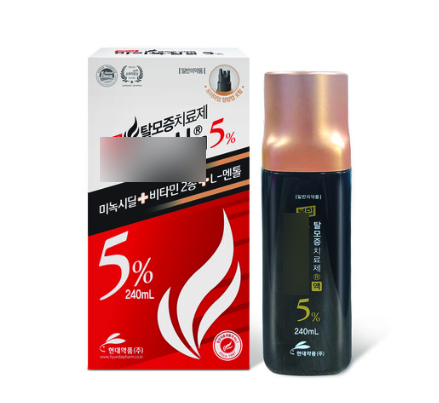
Does the hair loss treatment minoxidil really work?
Source - Medical Newspaper
Minoxidil 5%
In this study, when 5% minoxidil was applied to hair follicles that had been in dormancy for 3 years,
new hair was confirmed to begin growing within 3 months.
However, one interesting point was that the diameter of the newly grown hair was thinner than before, and the growth rate was also slower.
Minoxidil plays a role in reactivating hair follicles, but it is important to note that the hair does not completely return to its original state.
These results also have important clinical implications: when patients using minoxidil ask, "My hair is growing, but why is it so thin?" this can serve as scientific evidence to explain the reason.
The study also reports that if minoxidil treatment is stopped, the growth rate is likely to decrease again.
This means that minoxidil needs to be used continuously as "maintenance therapy" for hair loss treatment to be effective.
Changes in the hair cycle after hair transplantation
This study did not simply analyze the effects of minoxidil; it also observed how transplanted hair follicles change over time.
The transplanted follicles initially grew normally, but over time their growth rate gradually slowed and they eventually entered dormancy.
However, the important point is that transplanted follicles may still have the potential to grow normally again.
The study emphasizes that using minoxidil may reactivate some follicles.
In other words, the phenomenon of hair becoming thinner over time after hair transplantation may be due to changes in the hair cycle,
rather than "transplant failure."
Therefore, patients do not need to worry if their hair becomes thinner or seems to decrease over time after transplantation.
With appropriate treatment, there is a possibility of reactivating the hair.
The future of hair loss treatment: a personalized approach
The most important point suggested by this study is that hair loss treatment cannot be solved with just one method.
-
Hair follicles are likely to gradually transition into a dormant phase over time.
-
Minoxidil can reactivate some follicles, but it does not guarantee complete recovery.
-
Even after hair transplantation, hair may become thinner over time, and additional treatment may be needed.
Therefore, a personalized approach to hair loss treatment is essential.
Rather than simply saying, "Take hair loss medication" or "Apply minoxidil," a long-term treatment plan that considers the patient's hair cycle is needed.
If you are considering hair loss treatment, it is important to find the optimal treatment method suited to your own hair condition.
Rather than looking for a quick fix, you should understand that long-term management and consistent treatment are necessary.
Now it's time for hairhair, this was Kim Jino.
Pilsaengsinmo (必生新毛).
References
• Van Neste, D. (2025). Real-time structure-function study of scalp hair cycles: an experimental approach for monitoring living hair roots with a 20-year follow-up. Plastic and Aesthetic Research, 12, 4. doi:10.20517/2347-9264.2024.114
[This post is written directly by a board-certified plastic surgeon for informational purposes in accordance with Article 56, Paragraph 1 of the Medical Service Act. Hair loss surgery and treatment may have side effects, and you should make a careful decision after consulting with a specialist.]