A female patient in her 40s whom I met in the clinic had finished cancer treatment six months earlier, but she cautiously told me that her hair still had not come back.
“Could it be... that it won’t grow back like this?”
Her expression was full of anxiety.
Hair loss is not simply a matter of appearance.
It can shake a person’s confidence in everyday life.
In particular, hair loss that does not recover even after cancer treatment
— that is, permanent chemotherapy-induced alopecia (a condition in which hair does not grow back after chemotherapy) — places an even greater psychological burden on patients.
So in what cases might hair fail to grow back?
Can that possibly be known in advance?
In March 2025, a paper published in the journal Dermatology and Therapy by a dermatology research team at the University of Bologna in Italy is drawing attention.
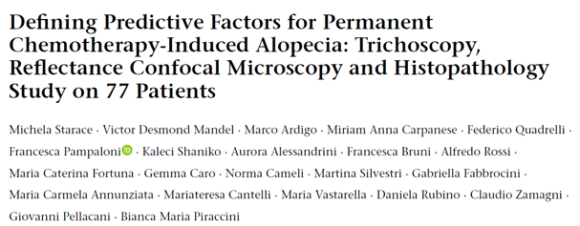
The research team performed a detailed analysis of the scalp and hair follicle condition in 77 patients undergoing cancer treatment using three methods.
-
Scalp magnification examination: observing the scalp and hair follicle condition with a magnifying device similar to a microscope
-
High-resolution skin microscopy: a special device that allows real-time viewing deep within the skin
-
Biopsy: removing actual scalp tissue to examine the hair follicle structure
Previously, there had been almost no image-based research that could predict chemotherapy-induced hair loss,
and this was the first time high-resolution equipment was used.
In other words, this study is meaningful in that it provided scientific evidence for predicting hair loss that had previously been left to “chance.”
The study participants were people whose hair loss began during or after chemotherapy and whose hair had not grown back for more than a year.
By analyzing their scalp and hair follicles, the researchers identified common signals indicating a possibility that the hair loss would not recover.
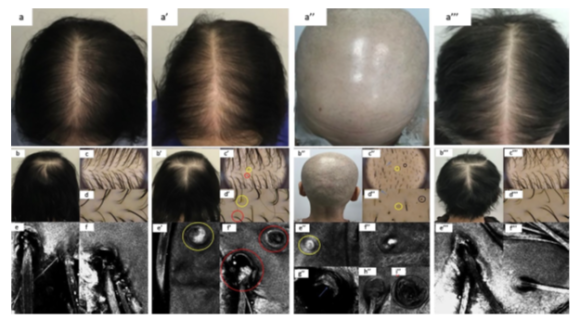
Photo source Starace, M., Mandel, V.D., Ardigo, M., Carpanese, M.A., Quadrelli, F., Pampaloni, F., Shaniko, K., Alessandrini, A., Bruni, F., Rossi, A., Fortuna, M.C., Caro, G., Cameli, N., Silvestri, M., Fabbrocini, G., Annunziata, M.C., Cantelli, M., Vastarella, M., Rubino, D., Zamagni, C., Pellacani, G. and Piraccini, B.M., 2025. Defining Predictive Factors for Permanent Chemotherapy-Induced Alopecia: Trichoscopy, Reflectance Confocal Microscopy and Histopathology Study on 77 Patients. Dermatology and Therapy, [online] Available
Three signs that hair may not grow back
- Reduced hair follicle density and thinner hair
On scalp magnification examination, patients with permanent hair loss had fewer hair follicles, and the remaining hair was also thinner in diameter.
It was not simply a feeling that “the hair has gotten thinner”; the foundation from which hair grows was actually disappearing.
- Closed follicular openings and changes in skin tissue
On high-resolution microscopy, closed hair follicle openings were observed.
In other words, the pathway through which hair grows was completely blocked.
At the same time, signs were also seen that the skin surface had become harder (fibrosis) and that the structure of the skin layers itself had changed.
- Fibrosis revealed by biopsy
Biopsy confirmed that the hair follicles had been replaced by fibrous tissue.
In other words, the structure had changed into one in which hair would be difficult to regrow.
If findings like the above are observed during or immediately after chemotherapy, early response is possible for that patient.
More prompt measures can be taken, such as medication to help prevent hair loss, scalp care, and, if necessary, consultation for hair transplantation.
Of course, this study does not provide all the answers.
Further research considering larger patient groups, various anticancer drugs, and racial differences will be needed.
It is now time for hair to grow again — this was Kim Jino.
Pilsaengsinmo (必生新毛).
References
Starace, M., Mandel, V.D., Ardigo, M., Carpanese, M.A., Quadrelli, F., Pampaloni, F., Shaniko, K., Alessandrini, A., Bruni, F., Rossi, A., Fortuna, M.C., Caro, G., Cameli, N., Silvestri, M., Fabbrocini, G., Annunziata, M.C., Cantelli, M., Vastarella, M., Rubino, D., Zamagni, C., Pellacani, G. and Piraccini, B.M., 2025. Defining Predictive Factors for Permanent Chemotherapy-Induced Alopecia: Trichoscopy, Reflectance Confocal Microscopy and Histopathology Study on 77 Patients. Dermatology and Therapy, [online] Available
[This post is being written directly by a board-certified plastic surgeon for informational purposes in accordance with Article 56, Paragraph 1 of the Medical Service Act. Hair loss surgery and treatment may have side effects, and you should make a careful decision through consultation with a specialist.]