Melatonin is widely known as a sleep aid and is easy to get through overseas direct purchase.
But did you know that melatonin may also affect hair health?
I have taken melatonin myself.
My mother gave it to me as a gift, saying, “It will help you sleep well.”
I usually do not have much trouble sleeping, so I did not feel a clear effect,
but since I had no particular side effects, I took it regularly for a while.
At the time, I thought of it simply as a “medicine that helps with sleep.”
But after reading an interesting paper recently, my view of melatonin changed.

It discussed the relationship between melatonin and hair growth in goats.
Through that content, I could also glimpse the possibility of its use in human hair loss treatment.
The paper explains that melatonin is not just a sleep-inducing hormone, but also plays an important role in antioxidant activity (a function that helps prevent cell damage) and in regulating cell growth and differentiation.
In particular, it is said to act on the part of the hair root called the hair follicle, extending the growth phase of hair and helping it grow more healthily.
According to the study, melatonin activates intracellular signaling pathways such as “Wnt/β-catenin,” “BMP,” and “MAPK,”
stimulating the growth and differentiation of hair follicle cells, and suppresses cellular aging through the “Keap1-Nrf2” pathway.
In simple terms, melatonin helps hair grow well by turning on various switches inside cells and protects cells from external stress.
Another interesting point is that melatonin is produced not only in the brain’s pineal gland, but also in the skin and the gut.
In particular, short-chain fatty acids (SCFAs) produced by gut microbes affect the synthesis of serotonin, the precursor of melatonin, so the link from “gut health → skin → hair” is drawing new attention.
This is sometimes called the “gut-skin-hair axis.”
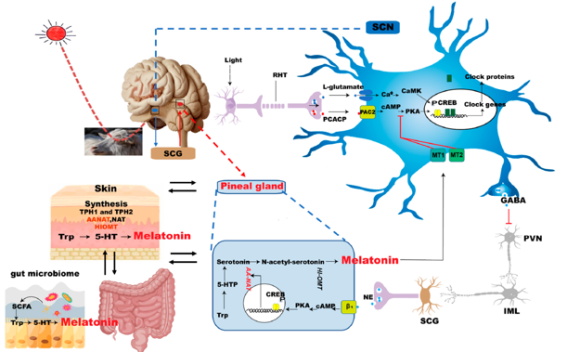
Figure source
Zheng, Z., Su, Z., & Zhang, W. (2025). Melatonin’s Role in Hair Follicle Growth and Development: A Cashmere Goat Perspective. International Journal of Molecular Sciences, 26(7), 2844
Of course, this study was an animal experiment on goats.
It is difficult to apply it directly to humans, but considering that melatonin is already being used in skin beauty products for whitening and anti-aging purposes, it is reasonable to hope that it may also help with hair health.
Above all, it is noteworthy that melatonin may not only improve sleep and thereby reduce stress and indirectly help prevent hair loss, but may also act directly on hair follicle cells to slow hair loss.
It suggests that hair loss treatment is not simply a matter of applying or taking medication, but a complex issue that also requires consideration of sleep, gut health, and skin condition.
Through this paper, I also came to look at melatonin in a new way.
If you are currently taking melatonin as a sleep aid, it may be interesting to observe whether any changes appear in your scalp or hair over the long term.
Of course, it is important to avoid indiscriminate use and to consult a specialist before using it at an appropriate dose.
Now it is time for hair to grow, this was Kim Jino.
필생신모(必生新毛).
References
Zheng, Z., Su, Z., & Zhang, W. (2025). Melatonin’s Role in Hair Follicle Growth and Development: A Cashmere Goat Perspective. International Journal of Molecular Sciences, 26(7), 2844. https://doi.org/10.3390/ijms26072844
[In accordance with Article 56, Paragraph 1 of the Medical Service Act, this post is being written directly by a board-certified plastic surgeon to provide information. Hair transplant surgery and treatment may involve side effects, and you should make a careful decision after consulting with a specialist.]