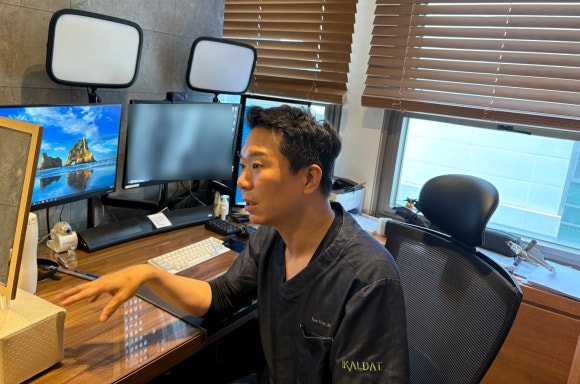
These days, there is a question I often hear from patients in the exam room.
It is,
“Doctor, do I have to take this hair loss medication for the rest of my life?”
Whenever I hear that question, I briefly switch on my acting skills.
Like a movie protagonist facing a major life decision, I put on a slightly serious expression.
“If you think about it that dramatically... it only gets harder.”

Then I smile and add,
“Just think of it as taking it until the day you stop caring about your hair.
Actually, I’ve been taking mine day by day, and it’s already been 20 years.”
Most patients who hear this are surprised.
“Twenty years? Every day? Without missing once?”
Of course, there were days I missed. I’m human.
The day after drinking, when I couldn’t adjust to the time difference during an overseas business trip, when I forgot the pill case while traveling, and so on.
But because there were days like that, I was able to take it again the next day without making a fuss.
Since I never treated missing one day as a big deal, I’ve been able to keep taking it consistently until now.
I once had a friend who exercised very consistently.
His shoulders were almost as broad as Kim Jong-kook’s, and I found it amazing that he went to the gym without missing a single day.
One day, I asked him,
“How do you do that every day?”
His answer was this:
“Just do it one day at a time.
If I don’t feel like it today, I’ll rest tomorrow. I think like that. But strangely enough, when tomorrow actually comes, I end up doing it again.”
That really stayed with me.
Thinking, “I have to keep going” creates pressure, while the freedom of “I can stop anytime” can actually become the force that helps you continue.
A psychology experiment comes to mind.
Participants were shown the same video, and half were told, “Remember this well,”
while the other half were told, “Don’t remember this.”
Surprisingly, the “Don’t remember this” group actually remembered the content better.
This kind of response is called psychological reactance.
It is the psychological reaction that makes you want to do more when you are told not to, and want to run away when you are told you must do it.
Taking hair loss medication is the same.
If you think, “I have to take this for the rest of my life,” life suddenly feels heavy and dull.
But if you think, “If it gets annoying, I’ll just stop,” a paradoxical effect appears, and you end up taking it more consistently.
One of my patients has been taking the medication well for over five years now.
Their philosophy is very simple.
“If I stop thinking about my hair, I won’t take it. But I see myself in the mirror every day, so I keep taking it.”
Another patient said they wanted to stop taking it because of one comment from their girlfriend.
When they heard, “Are you going to take that medication for the rest of your life?” they felt like they had done something terribly wrong.
I told them,
“She should have said it like this instead: ‘Then you’ll keep your hair for the rest of your life!’”
They laughed loudly when they heard that, and in the end decided to take the medication again.
The human mind is truly strange.
We often assign ourselves heavy responsibilities and then, crushed by that weight, give up.
A vow like, “I must not miss even one day,” can ultimately ruin the very thing it is meant to protect.
At times like that, try thinking this way:
“Today I’ll just take it. I’ll think about tomorrow tomorrow.”
I may also reach a day when I stop taking the medication.
Or maybe that day will never come.
What matters is the fact that I live each day by making my own choice.
It becomes a habit, not an obligation; ease, not burden.
Whether it’s hair, exercise, writing, or anything else,
you can stop anytime, and that’s okay.
And strangely enough, that very thought is what keeps us going.