These are the questions I hear most often in the clinic these days.
"Doctor, what shampoo should I use to prevent hair loss?"
"What supplements should I take for them to work?"
"Is a scalp-applied medicine better, or is an oral medicine better?"
"Does laser treatment work?"
�
In this way, many people are interested in ways to prevent hair loss.
Strangely enough, and perhaps naturally, I have never been asked a question like this.
"Doctor, does the scalp age too?"
Come to think of it, no one asks about the age of the scalp.
There are plenty of worries about hair loss, but there is rarely any question about the health of the scalp, which is the foundation of it, or about scalp aging. That has always stayed on my mind.
Hair loss is usually thought of as a problem with the hair itself, but the scalp, the "ground" where that hair grows and takes root, is not well known.
So I find myself asking this question.
"Have you ever thought about the age of your scalp?"
Skin Ages Faster Than the Face
We are familiar with skin aging.
Wrinkles, dark spots, and loss of elasticity, for example.
Almost all procedures marketed as "youth-preserving treatments" in dermatology or plastic surgery are aimed at reversing the aging of facial skin.
But from the perspective of treating hair loss, there is skin that ages faster and more deeply than the face. That is the scalp.
The scalp is not simply the ground where hair takes root.
When the scalp is healthy, hair can grow healthily as well.
The problem is that this scalp ages faster than many people expect.
In some beauty industries, it is even said that the scalp ages more than six times faster than facial skin.
There is a lack of clear academic evidence for this figure, but recent research makes it seem clear that the scalp ages in a unique and rapid way among skin types.
Scalp Aging, Seen Through Science

For example, Flament et al. (2013) compared the scalp at the crown and the forehead skin in women in their 30s and 60s. They reported that as age increased, the epidermal thickness of the scalp decreased,
while total skin thickness actually increased, and the tissue density confirmed by ultrasound tended to decrease.
This suggests that the scalp is structurally vulnerable to aging.
It is also a sign that the scalp is not simply becoming thinner, but that aging is progressing from the deeper layers of the skin.
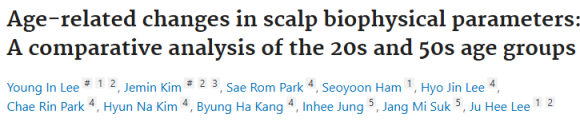
Another study, Lee et al. (2023), compared and analyzed the scalp of people in their 20s and 50s and found that as age increased, scalp elasticity and redness increased, while sebum secretion and pH decreased, and desquamated dead skin cells increased.
In particular, the accumulation of AGE (advanced glycation end-products), a protein associated with aging, also increased, showing a tendency for scalp tone to become more yellow and overall skin health to worsen.
AGE is a substance produced by glycation stress. It alters collagen and elastin and is known as one of the main drivers that accelerate skin aging.
These changes go beyond a simple outward issue and are directly connected to hair loss.
When the scalp loses elasticity, the function of the sebaceous glands declines, and blood flow decreases, the oxygen and nutrients delivered to the hair follicles also decrease.
As a result, hair follicles shrink, hair gradually becomes finer, and hair is lost.
This progression of hair loss may seem slow, but at some point it can reach a point of no return.
The Scalp Also Needs Anti-Aging
Just as we receive botulinum toxin injections to prevent facial wrinkles and undergo lifting procedures to improve elasticity,
the scalp also needs comparable attention and treatment.
Recently, various treatments aimed at scalp anti-aging have been applied.
Representative treatments include low-level laser therapy (LLLT), hyperbaric oxygen therapy, microcurrent stimulation, botulinum toxin injections, polynucleotides (PDRN), regenerative-inducing polymers (for example, RejuranX, JuvelookX), and wound dressing-based treatments.
These treatments aim to restore scalp tissue and delay aging, showing that existing skin regeneration technologies can also be applied to the scalp and hair follicle environment.
A New Attempt, A New Hair Loss Treatment
Conventional hair loss treatment has relied on oral medications and topical agents focused on hormonal mechanisms.
Of course, these approaches still remain an important pillar of treatment today.
But there is also a clear trend toward seeking a different path.
That is anti-aging treatment that focuses on aging of the scalp and hair follicles themselves.
This treatment approach is not simply for cosmetic purposes, but a strategy for restoring scalp physiological function and supporting long-term hair follicle health.
In clinical experience, I have been able to observe many cases in which inflammatory responses around the hair follicles were reduced, scalp elasticity was restored,
and the progression of hair loss was gradually delayed.
These treatments show that they should not end with a single procedure, but instead should become a long-term approach to keeping the scalp youthful.
The realization that hair loss treatment is not enough if it targets only the hair itself
and the new question of how the scalp, as skin, should be treated are beginning.
These experiences do not end with a single procedure, but continue as one treatment direction.
It may still be more honest to call this a "new attempt," but
at least one thing is clear: hair loss treatment is not enough if it targets only the hair follicle.
The scalp is skin, and skin ages.
If so, isn’t there enough reason to share the same care and effort we give the face with the scalp as well?
Changes That Begin on Top of the Head
A patient once said this to me.
"I was always more worried about facial wrinkles than about my hair, so I only focused on facial care.
I wish I had tried hair loss treatment sooner."
We always pay attention to the face, the first thing we see in the mirror.
But what truly supports that face is none other than the scalp.
Now is the time to pay attention to how tired and aged this small patch of ground on top of the head has become.
Water flows from top to bottom, but aging starts from the scalp and moves downward.
The first anti-aging strategy for the skin is to keep the scalp youthful.
All change begins first in the places we cannot see.
Just as there is no tree without roots, if you want healthy hair, shouldn’t you start by looking after the scalp, its root?
Even though no one sees it, the scalp aging day by day inside still needs a warm gaze.
We often look in the mirror and focus only on wrinkles on the face.
But the question that changes the direction of life may begin on top of the head.
Now it is time to haerhair, this was Kim Jino.
Pilsaengsinmo (必生新毛).
References
-
Flament, F., Bazin, R., Laquieze, S., Rubert, V., Simonpietri, E., & Piot, B. (2013). Effect of the sun on visible clinical signs of aging in Caucasian skin. Clinical, Cosmetic and Investigational Dermatology, 6, 221–232. https://pubmed.ncbi.nlm.nih.gov/24094093
-
Lee, H., Kim, M., & Choi, Y. (2023). Age-related changes in biophysical parameters of the scalp: A cross-sectional study. Experimental Dermatology, 32(5), 707–716. https://onlinelibrary.wiley.com/doi/10.1111/exd.14982
[This post is written directly by a board-certified plastic surgeon for informational purposes in accordance with Article 56, Paragraph 1 of the Medical Service Act. Hair loss surgery and treatment may have side effects, and they should be carefully decided upon through consultation with a specialist.]