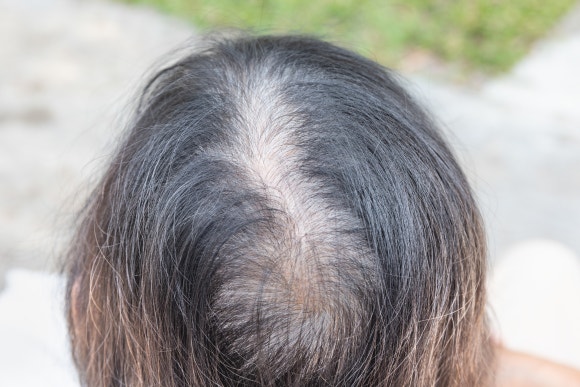
It is something everyone knows from experience that as we get older, hair becomes thinner and falls out more quickly.
However, why this happens and what changes are occurring inside the process remain, in many respects, unanswered questions.
A recently published study took a careful approach in an effort to provide a clue to this long-standing question.
It directly reproduced in the laboratory how aging affects the roots of hair and leads to hair loss.

The researchers created an experimental model that cultured the dermal papilla, the key part of the hair root, in a three-dimensional structure.
One model had no blood vessels, while the other included fine blood vessels like actual skin.
Through these two models, they were able to manipulate and observe the hair-loss process in the laboratory.
First, they added specific proteins (TGF-β1 and FGF-18) to induce a shift from the growth phase of hair into the resting phase, stopping it there.
As a result, genes that help hair grow were turned off, and the cells no longer divided.
This process was very similar to the changes that occur inside hair follicles when actual hair loss progresses.
What stood out in particular was that, over time, blood vessels decreased and the oxygen and nutrients supplied to the hair roots also declined.
In the model with blood vessels, the tissue structure was maintained for longer and the cellular environment remained more stable.
By contrast, in the model without blood vessels, the root structure collapsed as time passed, and signals indicating cellular senescence became clearly visible.
The core of the study is that it recreated aged hair roots in the laboratory to closely resemble reality and then observed what reactions occurred when drugs such as minoxidil, retinol, or an anticancer drug were applied.
When minoxidil was added, the broken blood vessel structure showed some recovery, and cellular damage was also reduced.
In addition, the tissue structure around the cells regained some order.
Retinol showed a similar effect, but it was somewhat weaker, while the anticancer drug made the damage worse.
This study shows that aging of the hair root is not simply a matter of getting older, but a complex process in which blood vessels decline, the environment around the cells deteriorates, and the cells themselves are also damaged.
It also experimentally demonstrates that this chain of changes is one of the causes leading to hair loss.
We usually think of hair loss only as a genetic or hormonal problem.
But this study clearly shows how sensitive the hair root itself is to age and how delicately it is affected.
It also quietly, but clearly, conveys the message that to prevent or treat hair loss in the future, we should not only stimulate the hair itself, but also consider how to maintain the health of the root and slow its aging.
This study opens up the possibility that anti-aging treatment strategies could be expanded to hair-loss treatment, offering a new clue for future therapeutic directions.
Now it is time for hairhair, Kim Jin-o.
May new hair be born (必生新毛).
References
Masi, G., Guiducci, C. & Rescigno, F. (2025) Mimicking senescence factors to characterize the mechanisms responsible for hair regression and hair loss: an in vitro study. Organoids, 4(3), 17. https://doi.org/10.3390/organoids4030017
[This post is written directly by a board-certified plastic surgeon for information-sharing purposes in accordance with Article 56, Paragraph 1 of the Medical Service Act. Hair transplant surgery and treatment may have side effects, and you should make a careful decision through consultation with a specialist.]