On August 7, 2025, at a lecture held by the Korean Medical Association, I listened to Professor Kim Chan-woong’s talk on “Interprofessional Communication and Collaboration.” As an emergency medicine physician and a researcher active in the Medical Communication Society, the professor vividly described the moments of conflict and cooperation that occur every day in the intense environment of the emergency room. This lecture was not a simple delivery of theory, but clearly showed through real cases how communication works and fails, and how the results can make a difference in patient safety and treatment outcomes.
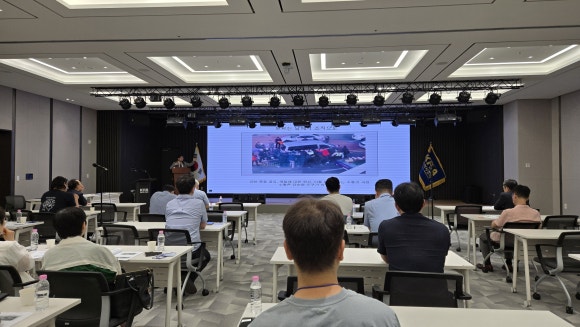
Lecture for the 2025 High-Level Medical Policy Program on August 7, 2025
The professor repeatedly emphasized that the essence of communication is not “skill” but “relationship.” In relationships built on trust, even a rough tone can keep a conversation going, but in relationships without trust, even honorific speech can leave a wound. A relationship is not formed overnight; it is created through the accumulation of repeated conversations and actions. Only on this foundation of trust is true collaboration possible, and he said that what is needed is not mere “cooperation,” in which each person simply carries out their own role, but “collaboration,” in which people cross boundaries and fill gaps according to the situation.
In the middle of the lecture, practical tips that can be used immediately in medical settings were introduced, such as the distinction between “public space and private space,” and the differentiation of “information, emotion, and intent.” For example, when a patient asks a question, the right response is only possible if you first determine whether it is simply a request for information, an expression of emotion, or a conveyance of a particular intent. If these are not distinguished, unnecessary misunderstandings and conflicts accumulate, and teamwork quickly falls apart. The professor emphasized that these careful distinctions and choices determine the quality of communication.
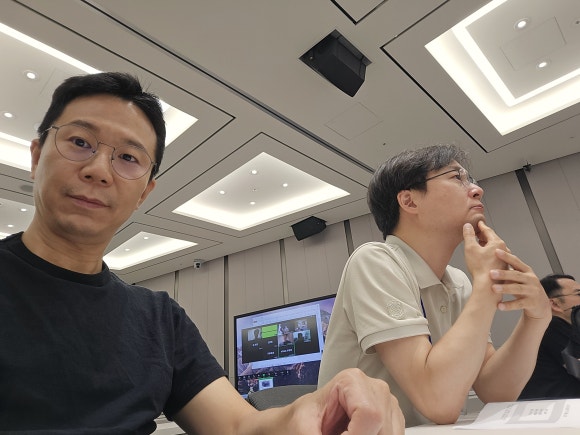
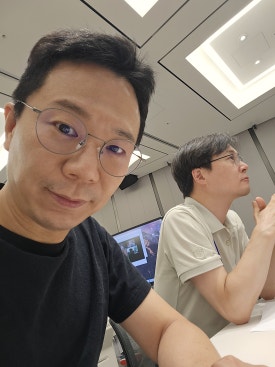
With fellow alumnus Director Lee Geun-wook during the lecture
One particularly impressive topic was “psychological safety.” True learning and growth happen only in an environment where, instead of blaming a colleague who has made a mistake, people work together to solve the problem and support one another so they can try again. The professor compared, using real hospital cases, how differently emergency responses unfold in teams with psychological safety versus those without it. He said that in teams sharing a clear common goal of patient safety and recovery, people voluntarily step forward to fill gaps beyond rank and experience, whereas in organizations where blame comes first, only withdrawal and avoidance remain.
Listening to this, I thought about my own clinical practice. Moments when I neglected relationships because I was busy, and experiences where I hesitated to get involved because it was not “my area,” came to mind. I felt a renewed determination to take one step closer for the patient and for colleagues moving toward the same goal. Communication is ultimately a “choice,” and those choices build relationships and change outcomes.
As I left the lecture hall, I felt that this principle is not limited to medicine. The same applies in relationships with family, friends, and coworkers. Making an effort to know one another, choosing emotional expression carefully, and looking toward the same goal together. If we follow this simple yet powerful principle, collaboration will become far more natural and sustainable. .