Men in midlife and later often start male hormone replacement therapy (testosterone replacement therapy, Testosterone Replacement Therapy, TRT) because of fatigue, reduced sexual function, and muscle loss. However, many people have another concern at the same time: worsening hair loss.
Q1. Why can hair loss get worse when starting male hormone replacement therapy?
A. Testosterone itself does not directly cause hair loss.
The issue occurs when testosterone is converted by 5-Alpha Reductase into dihydrotestosterone (Dihydrotestosterone, DHT).
DHT is the key hormone that shrinks hair follicles and promotes male pattern hair loss¹.
Therefore, when health is restored through male hormone replacement therapy, hair loss may become more noticeable along with the positive effects.
“Testosterone is converted to DHT by 5α-reductase, and DHT acts as the main cause of male pattern hair loss.” ²
Q2. To prevent hair loss, is it good to take a 5-alpha reductase inhibitor such as finasteride or dutasteride together?
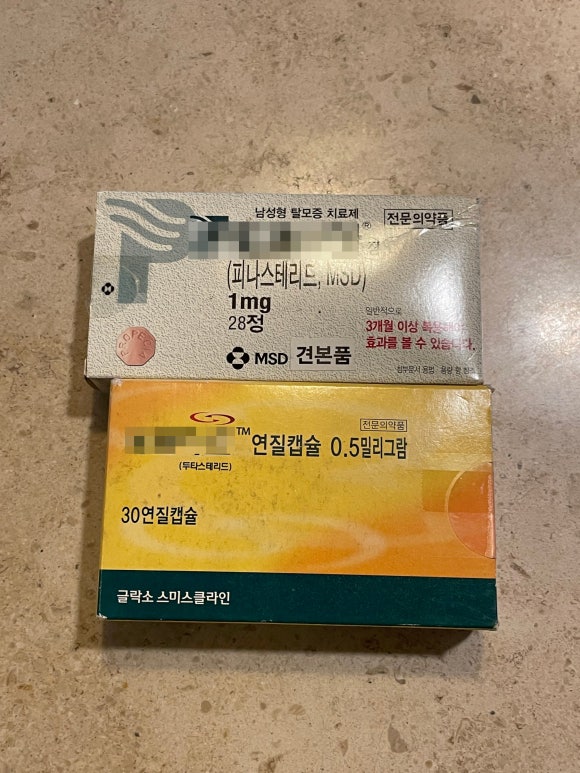
A. Yes, it can be considered. 5-Alpha Reductase Inhibitors (5-Alpha Reductase Inhibitor, 5-ARI) block the conversion of testosterone into DHT.
According to actual studies, a significant decrease in blood DHT levels has been reported within 3 months of taking the medication³.
However, total testosterone and free testosterone show no clear change, or only a very slight increase.
Therefore, this medication is not a drug that raises testosterone; it is more accurate to view it as an adjunct therapy for suppressing hair loss.
“5α-reductase inhibitors significantly reduce blood DHT levels within 3 months of taking them, while total T and free T show no clear change or only a slight increase.” ⁴
Q3. Then is the hair-loss-suppressing effect definite?
A. The hair-loss-suppressing effect is well established.
It is especially effective for male pattern hair loss such as crown thinning, and with consistent use it helps maintain hair density and suppress further hair loss.
However, the degree of response varies from person to person, and in cases of hair loss that has already progressed significantly, the effect is more about preventing further progression than regrowing hair.
Q4. Are there any precautions when taking a 5-alpha reductase inhibitor?
A. With long-term use, there are reports that some patients may experience changes related to sexual function or effects on sperm health⁵.
However, in most cases it can be used safely.
The important point is to prescribe it in a personalized way depending on the patient’s situation, such as future plans for having children and the degree of hair loss progression.
In my clinical experience, if a patient starting male hormone replacement therapy is very worried about hair loss, combining a 5-alpha reductase inhibitor is a method worth considering.
Q5. What treatment combination is actually effective?
A. It depends on the patient’s situation, but generally the following approach can be helpful.
| Treatment | Expected effect | Features |
|---|
| Male hormone replacement therapy | Restores masculinity, increases energy | May worsen hair loss |
| 5-Alpha Reductase Inhibitor | Suppresses DHT, suppresses hair loss | Limited effect on increasing testosterone levels |
| Combination therapy | Restores masculinity + suppresses hair loss | Requires a patient-specific plan |
In my experience, combining the two treatments can lead to a balanced result that restores masculinity while minimizing hair loss.
The hidden concern behind testosterone replacement therapy: could it also affect hair density?
Conclusion
Male hormone replacement therapy is a powerful way to restore men’s health and vitality,
but at the same time it can worsen hair loss.
In this case, using a 5-alpha reductase inhibitor together can help achieve treatment goals while preventing the progression of hair loss.
What matters most is an individualized approach tailored to each patient’s situation, and for that, sufficient consultation with a specialist is necessary.
It is time for hairhair, this was Kim Jino.
Pilsaengsinmo (必生新毛).
Written by: Kim Jino of New Hair Plastic Surgery (Public Relations Director of the Korean Society of Plastic and Reconstructive Surgeons / Academic Director of the Korean Society of Laser Dermatology and Hair)
References
-
Hamilton JB. Male hormone stimulation is prerequisite and an incitant in common baldness. American Journal of Anatomy, 1942; 71(3):451-480.
-
Kaufman KD. Androgens and alopecia. Molecular and Cellular Endocrinology, 2002; 198(1-2):89-95.
-
Clark RV, Hermann DJ, Cunningham GR, et al. Marked suppression of dihydrotestosterone in men with benign prostatic hyperplasia by dutasteride, a dual 5α-reductase inhibitor. Journal of Clinical Endocrinology & Metabolism, 2004; 89(5):2179-2184.
-
Amory JK, Wang C, Swerdloff RS, et al. The effect of 5α-reductase inhibition with dutasteride and finasteride on semen parameters and serum hormones in healthy men. Journal of Clinical Endocrinology & Metabolism, 2007; 92(5):1659-1665.
-
Traish AM, Hassani J, Guay AT, et al. Adverse side effects of 5α-reductase inhibitors therapy: persistent diminished libido and erectile dysfunction and depression in a subset of patients. Journal of Sexual Medicine, 2011; 8(3):872-884.
[This post is written directly by a board-certified plastic surgeon for informational purposes in accordance with Article 56, Paragraph 1 of the Medical Service Act. Hair transplant surgery and treatment may have side effects, so please make a careful decision after consulting with a specialist.]