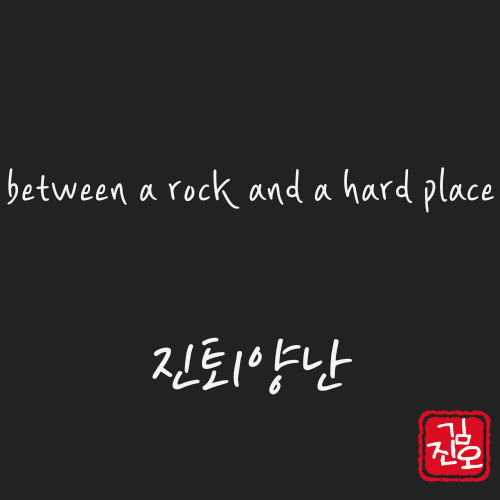
“between a rock and a hard place” is an expression often used to describe a difficult situation in which both options are hard to avoid. In Korean, it can be translated as “진퇴양난” or “a situation where you can’t do either this or that.”
This expression is used very frequently by Americans in everyday life, and it can also be used appropriately in professional contexts such as conferences or formal settings.
3 everyday conversation examples
-
Since either choice would be a loss, I was between a rock and a hard place. → I was between a rock and a hard place, no matter which option I chose.
-
I was completely between a rock and a hard place, caught between my boss and my coworkers. → I was between a rock and a hard place, caught between my boss and my coworkers.
-
I have rent to pay, but my car also needs repairs, so I’m between a rock and a hard place. → I’m between a rock and a hard place with rent due and my car needing repairs.
3 conference/professional English examples
-
In this patient’s case, both treatment options carried a risk of side effects, so we were between a rock and a hard place. → In this case, both treatment options carried significant risks, leaving us between a rock and a hard place.
-
The research team was between a rock and a hard place, balancing ethical standards with clinical necessity. → The researchers found themselves between a rock and a hard place, balancing ethical standards with clinical necessity.
-
The issue of expanding insurance coverage created a between-a-rock-and-a-hard-place situation between financial constraints and patient needs. → The policy decision put us between a rock and a hard place, facing financial constraints and patient demands.