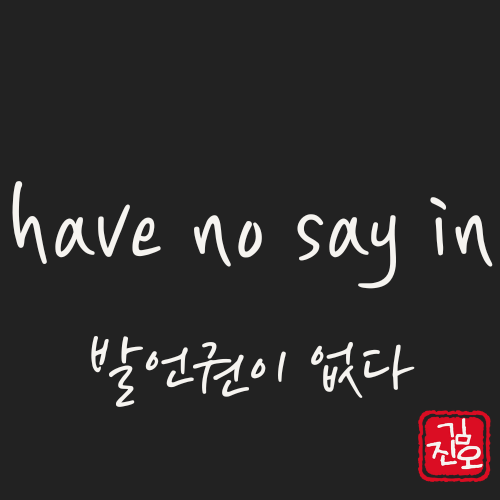
"Have no say" means being in a state where you have absolutely no right or influence to express an opinion on a matter or decision.
In Korean, it can be translated naturally as “to have no right to give an opinion” or “to have no involvement.”
It is commonly used in workplace, school, and social settings, and in academic or formal contexts as well, where it expresses “having no authority to participate.”
3 example sentences in everyday conversation
-
I didn’t get to say anything in the team project. → I had no say in the team project.
-
The kids have no say in what’s for dinner. → The kids have no say in what’s for dinner.
-
He has no say in the company’s major decisions. → He has no say in the major decisions of the company.
3 example sentences in academic/professional English
-
Young researchers often have no say in choosing the research topics. → Young researchers often have no say in choosing the research topics.
-
Some medical staff have no say in how the hospital is managed. → Some medical staff have no say in how the hospital is managed.
-
Patients usually have no say in the design phase of clinical trials. → Patients usually have no say in the design phase of clinical trials.