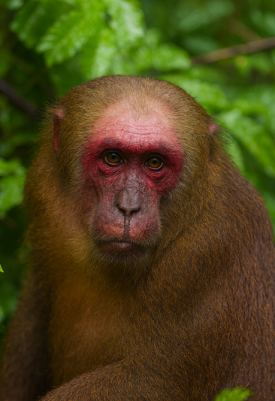
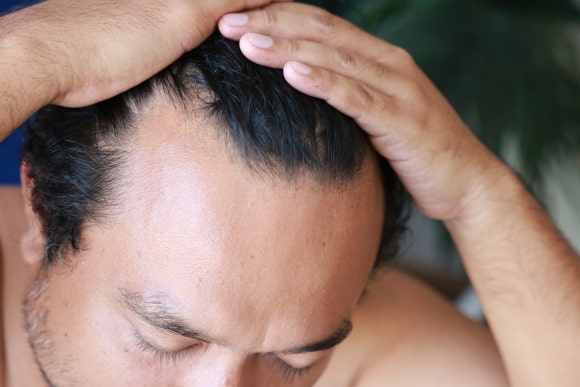
Hair loss is often thought of as a concern unique to humans, but in fact, similar phenomena are also observed among animals.
In particular, the red-faced monkey (Macaca arctoides) has attracted academic attention because, as it ages, it shows a pattern similar to the M-shaped hair loss seen in humans.
What is even more surprising is that it is not simply losing hair; like humans, it also responds to medication.
Q1. Is hair loss a phenomenon unique to humans?
No. Various forms of hair loss occur in the animal world as well.
Most are caused by season, hormones, stress, captive conditions, and other factors, but like in humans,
cases of pattern hair loss that gradually progresses in specific areas are extremely rare.
A representative example is the red-faced monkey².
Q2. What are the characteristics of the red-faced monkey’s hair loss pattern?
As this monkey reaches adulthood, hair loss progresses from the forehead toward the top of the head.
Rather than simple shedding, it is characterized by a progressive pattern similar to human M-shaped or crown-type hair loss.
In the endocrinology textbook Endotext, these animals are described as a rare animal model that can predict male and female pattern hair loss⁶.
Q3. Does it actually respond to hair loss treatments?
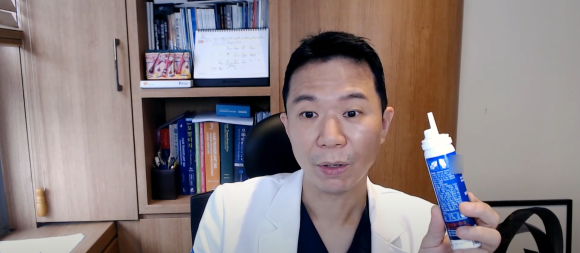
Yes. According to Dr. Uno’s 1986 study, when minoxidil was applied to the scalp of hair-loss areas in red-faced monkeys, thick hair grew back¹.
This shows that it is not merely similar in appearance, but also shares pharmacological responses with humans.
Thanks to this, the species has become highly valuable as a preclinical model for new drug development.
Q4. How are hair loss patterns in other animals different?
Dogs: In some breeds such as Dachshunds and Greyhounds, recurrent flank alopecia has been reported, in which the hair on the flanks falls out and then grows back³.
Laboratory mice: Used as models for alopecia areata and useful for studying autoimmune responses⁴.
Other primates: Hair loss can occur due to stress or environmental factors, but progressive hair loss in specific areas is rare⁵.
In other words, the best model for human-like pattern hair loss is the red-faced monkey.
Q5. Why is the red-faced monkey important in hair loss research?
It shows hair loss patterns similar to humans, responds to medication in a similar way,
and exhibits progressive differences associated with hormones and age.
Therefore, researchers have used red-faced monkeys to better understand the causes of hair loss,
safely test new treatments, and build evidence for application in actual patient care²⁶.
Male Pattern Hair Loss: Not Just a Human Concern?
Secret of the Red-Faced Monkey Summary Table
| Category | Red-Faced Monkey | Other Animals |
|---|
| Hair loss pattern | Forehead to crown progression, similar to M-shaped loss²⁶ | Dogs: seasonal flank alopecia³ Mice: alopecia areata model⁴ Primates: environment- and stress-related⁵ |
| Research use | Androgenetic alopecia model² | Research on specific diseases and autoimmune conditions |
| Drug response | Thick hair regrowth with minoxidil application¹ | Similar responses rarely reported |
| Academic evaluation | “A rare model that can predict male and female pattern hair loss”⁶ | Limited use |
Now it’s time for hairhair, this was Kim Jin-oh.
Be born, new hair (必生新毛).
Written by: Kim Jin-oh of New Hair Plastic Surgery (Public Relations Director of the Korean Society of Plastic and Reconstructive Surgeons / Academic Director of the Korean Society for Laser, Dermatology and Hair Restoration)
References
-
Uno, H. (1986) ‘The stumptailed macaque as a model for baldness: effects of minoxidil’, International Journal of Cosmetic Science, 8(2), pp. 63–71. Available at: https://pubmed.ncbi.nlm.nih.gov/19460042/
-
Sundberg, J.P., King, L.E. and Bascom, C. (2001) ‘Animal models for male pattern (androgenetic) alopecia’, European Journal of Dermatology, 11(4), pp. 321–325. Available at: https://pubmed.ncbi.nlm.nih.gov/11399538/
-
Vandenabeele, S., Declercq, J., De Cock, H. and Daminet, S. (2014) ‘Canine recurrent flank alopecia’, Vlaams Diergeneeskundig Tijdschrift, 83, pp. 275–284.
-
Sun, J., Silva, K.A., McElwee, K.J. and King, L.E. (2008) ‘The C3H/HeJ mouse and DEBR rat models for alopecia areata’, Comparative Medicine, 58(6), pp. 513–526.
-
Novak, M.A. and Meyer, J.S. (2009) ‘Alopecia: possible causes and treatments, particularly in captive nonhuman primates’, Journal of the American Association for Laboratory Animal Science, 48(3), pp. 230–241.
-
Asfour, L. and Sinclair, R. (2023) ‘Male Androgenetic Alopecia’, in Feingold, K.R. et al. (eds) Endotext. South Dartmouth, MA: MDText.com, Inc.
[This post is written directly by a plastic surgery specialist for informational purposes in accordance with Article 56, Paragraph 1 of the Medical Services Act. Hair transplant surgery and treatment may have side effects, and should be carefully considered through consultation with a specialist.]